
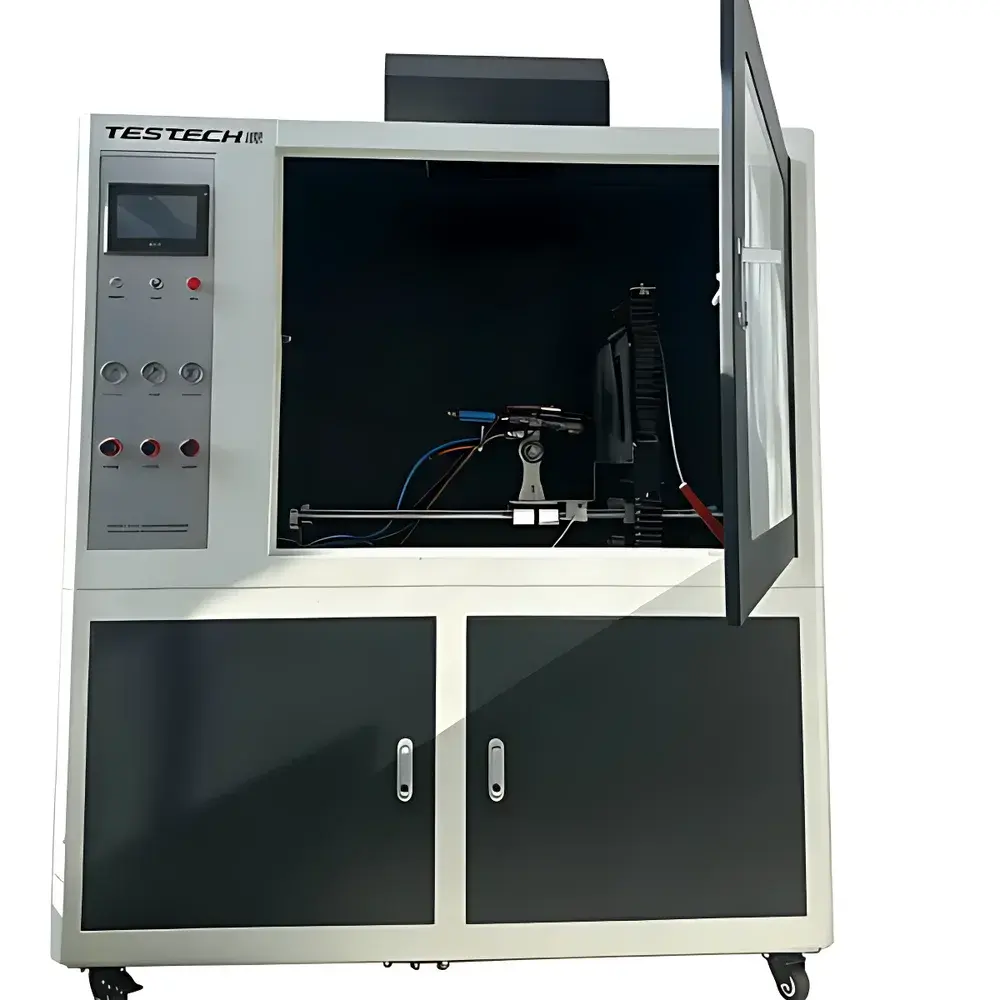
TESTech TTech-UL2596 Torch-and-Grit Combustion Tester for Battery Enclosure Flame Retardancy Evaluation
| Brand | TESTech |
|---|---|
| Origin | Jiangsu, China |
| Manufacturer Type | Direct Manufacturer |
| Model | TTech-UL2596 |
| Compliance Standard | UL 2596–2023 |
| Flame Temperature | Up to 1200 °C |
| Flame Power Output | 3 kW |
| Grit Feed Rate | 1.5 g/s ±10% |
| Test Cycle Modes | 15 s flame only |
| Control Interface | PC-based LabVIEW software + industrial touchscreen HMI |
| Gas Flow Control | Mass flow controllers for fuel gas and oxygen |
| Grit Air Flow Control | Mass flow controller |
| Frame Dimensions | 1200 mm × 500 mm × 1500 mm (W×D×H) |
| Burner Nozzle Diameter | 28.6 mm |
| Integrated Fireproof Baffle | Stainless steel + ceramic fiber, slide-in replaceable design |
Overview
The TESTech TTech-UL2596 Torch-and-Grit Combustion Tester is an engineered physical property testing system designed specifically to evaluate the combined thermal and mechanical resistance of battery enclosure materials under simulated thermal runaway conditions. Unlike conventional flame-only tests (e.g., UL 94 or ISO 5660), this instrument implements a dual-stress methodology—simultaneous high-temperature flame impingement and abrasive grit impact—per the requirements of UL 2596–2023, “Standard for Test Methods for Thermal and Mechanical Performance of Battery Enclosure Materials.” The test principle is grounded in Couette-type thermal-mechanical loading: a precisely regulated propane/oxygen flame (up to 1200 °C, 3 kW output) is directed at the specimen while calibrated silica grit is pneumatically propelled onto the same surface at defined mass flow (1.5 g/s ±10%) and velocity. This replicates the synergistic degradation mechanisms observed during real-world EV battery thermal runaway events—where jetting flames, ejecta particles, and structural deformation co-occur. The system enables quantitative assessment of material integrity metrics including char depth, surface erosion rate, backside temperature rise, ignition delay, and post-test dimensional stability.
Key Features
- UL 2596–2023–compliant architecture with traceable calibration paths for flame temperature, gas flow, and grit feed rate
- Integrated dual-function burner: precision-machined stainless steel nozzle (28.6 mm ID) supporting adjustable angle (0°–45°) and XYZ-positioning on linear rail system
- Modular gas delivery subsystem featuring dual mass flow controllers (MFCs) for fuel gas and oxygen, redundant safety components (flame arrestors, explosion-proof solenoid valves, pressure regulators, and analog pressure gauges)
- Self-contained grit delivery module with inverted gravity-fed powder reservoir and MFC-controlled compressed air carrier stream
- Rigid aluminum extrusion frame (1200 × 500 × 1500 mm) with stainless steel load-bearing surfaces and integrated linear guide rails for repeatable burner and specimen positioning
- Replaceable fire-resistant baffle assembly: stainless steel housing with removable ceramic fiber insulation panels (rated to 1400 °C), enabling rapid maintenance without system recalibration
- LabVIEW-based control platform with industrial-grade touchscreen HMI, supporting programmable test sequences, real-time thermocouple logging (Type K, 0.1 °C resolution), and audit-trail-enabled parameter recording
Sample Compatibility & Compliance
The TTech-UL2596 accommodates flat sheet specimens up to 200 mm × 200 mm × 25 mm (L×W×T), mounted vertically on a motorized stage with fine positional adjustment. Compatible materials include polyamide (PA66-GF30), polyphenylene sulfide (PPS), aluminum alloys (e.g., 6061-T6), magnesium die-castings, and hybrid composites used in EV battery trays and housings. All operational parameters—including flame duration, grit exposure time, cycle count, gas stoichiometry, and thermal ramp profiles—are configurable to align with UL 2596 Annex A test protocols. The system meets mechanical safety requirements per ISO 12100 and electrical safety per IEC 61000-6-2/6-4. Data acquisition complies with GLP principles; raw sensor logs (time-stamped, with operator ID and parameter set hash) are exportable in CSV and TDMS formats for regulatory submission.
Software & Data Management
Control and data handling are executed via a dedicated LabVIEW Real-Time application running on an embedded industrial PC. The interface supports six predefined test modes (including 15 s flame-only, 5 s flame + grit, and multi-cycle sequences), each fully parameterizable. All setpoints—gas flows (SLPM), grit air pressure (bar), flame-on duration (ms resolution), and cycle repetition—are stored with versioned configuration files. Thermocouple inputs (up to 4 channels) are sampled at 10 Hz and displayed in real time with derivative overlays (dT/dt). Audit trails record operator login, parameter changes, emergency stops, and calibration events in accordance with FDA 21 CFR Part 11 requirements (electronic signatures enabled). Raw datasets include metadata headers compliant with ASTM E2500–22 for instrument qualification documentation.
Applications
This tester serves R&D laboratories and Tier-1 automotive suppliers conducting material qualification for UN GTR 20, GB/T 38031–2020, and ISO 6469–3 compliance. Primary use cases include comparative screening of flame-retardant polymer formulations under thermo-mechanical stress, validation of coating adhesion after thermal shock, benchmarking of metal vs. composite enclosure candidates for pouch vs. prismatic cell integration, and root-cause analysis of failure modes observed in full-scale battery abuse testing (e.g., nail penetration + overcharge). It is also employed in academic research on ablation kinetics of intumescent systems and particle–flame interaction physics at elevated enthalpy fluxes (~250 kW/m²).
FAQ
What standards does the TTech-UL2596 directly support?
UL 2596–2023 is the primary referenced standard; test reports generated meet evidence requirements for OEM material approval processes aligned with ISO 26262 ASIL-B hardware qualification.
Can the system be used for non-battery applications?
Yes—its dual-stress capability applies to aerospace composite skin testing, protective clothing evaluation per NFPA 2112, and fire barrier validation for energy storage system enclosures.
Is third-party calibration certification available?
TESTech provides NIST-traceable calibration certificates for all MFCs, thermocouples, and pressure transducers, with optional annual recalibration services including on-site verification.
What safety interlocks are implemented?
Hardware-level interlocks include flame sensor feedback loop, gas leak detection (catalytic bead sensor), overtemperature cutoff (>1300 °C), door-open emergency shutdown, and grit feed timeout monitoring.
How is grit composition and particle size controlled?
The system is validated for use with ANSI 12/20 silica sand (D50 ≈ 850 µm); users must supply certified grit batches meeting ASTM D1214 specifications; particle size distribution is verified offline using laser diffraction.



