
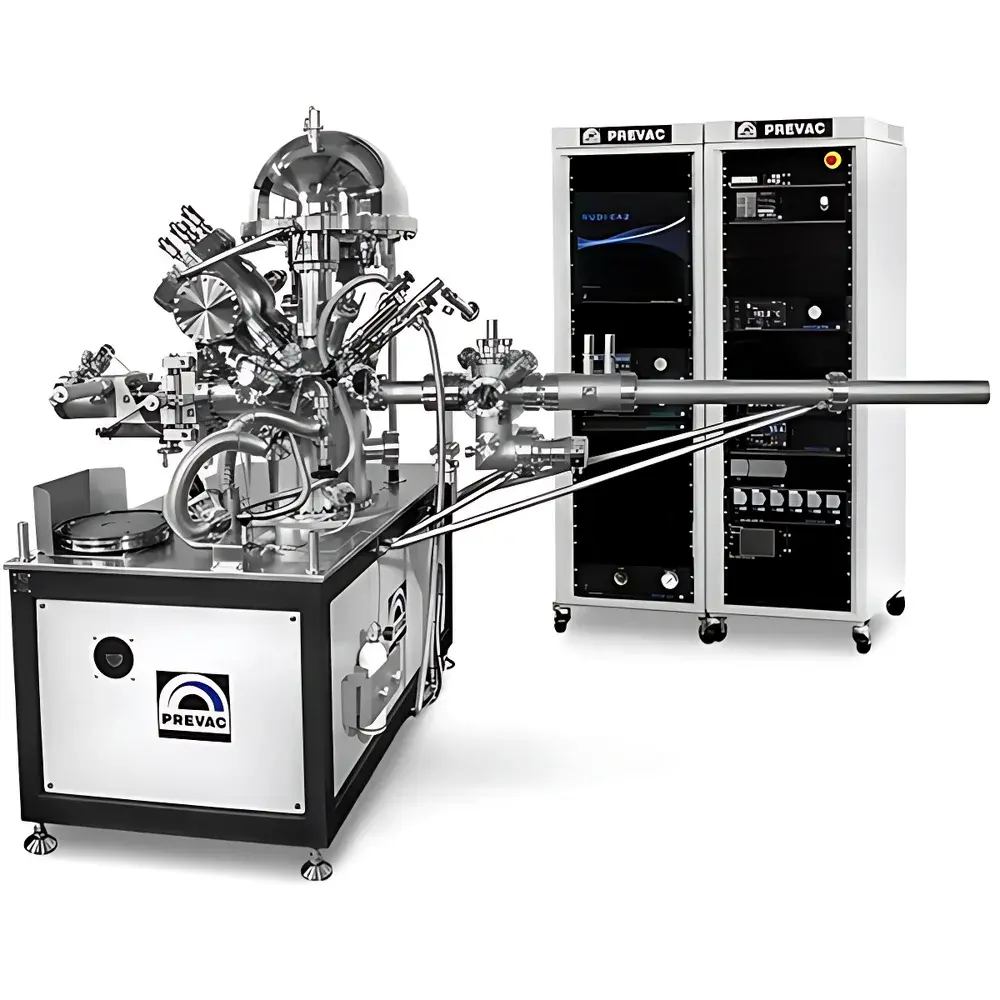
PREVAC PES Ultrahigh Vacuum Photoelectron Spectroscopy System
| Brand | PREVAC |
|---|---|
| Origin | Poland |
| Model | PES |
| Base Pressure | ≤1×10⁻¹¹ mbar |
| Analysis Chamber Diameter | Ø310 mm |
| Sample Temperature Range | 20 K (LHe) to 1400 °C |
| Sample Manipulator | 4–6-axis motorized |
| Energy Analyzer | Hemispherical EA15 UHV |
| X-ray Sources | Monochromated dual-anode (AlKα/AgLα) and non-monochromated dual-anode (AlKα/MgKα) |
| UV Source | Powered He-I (21.2 eV) and He-II (40.8 eV) lamps |
| Flood Gun | Electron flood source for charge neutralization |
| Ion Sources | Ar⁺ sputter gun and gas cluster ion beam (GCIB) for depth profiling/cleaning |
| Optional Add-ons | LEED, RGA, IPES/LEIPS, AES, EELS, ISS modules |
| Control Software | Spectrium (Tango-compliant, PLC-integrated) |
| Vacuum System | Composite pumping stack including roughing pump, turbomolecular pump (TMP), ion pump, and titanium sublimation pump (TSP) with LN₂ shroud |
Overview
The PREVAC PES Ultrahigh Vacuum Photoelectron Spectroscopy System is a modular, research-grade surface analysis platform engineered for quantitative electronic structure characterization under ultrahigh vacuum (UHV) conditions (≤1×10⁻¹¹ mbar). Based on the photoelectric effect, the system measures the kinetic energy distribution of electrons photoemitted from solid surfaces upon irradiation with monochromatic or broadband photons—enabling precise determination of valence band structure, core-level binding energies, chemical state identification, work function, and interfacial electronic coupling. As a unified platform supporting UPS (Ultraviolet Photoelectron Spectroscopy), XPS (X-ray Photoelectron Spectroscopy), HAXPES (Hard X-ray PES), ARPES (Angle-Resolved PES), and complementary techniques such as AES, EELS, ISS, IPES, and LEED, it serves as a foundational instrument for surface science, catalysis, 2D materials, thin-film heterostructures, and quantum material investigations. Its design adheres strictly to ISO 14040-compliant UHV engineering standards, with all internal surfaces electropolished stainless steel (316L), all-metal seals (CF and ISO-KF), and bakeable components rated for ≥150 °C.
Key Features
- Modular UHV architecture with dedicated load-lock chamber enabling rapid sample exchange without breaking main chamber vacuum—typical transfer time <90 seconds
- Hemispherical energy analyzer EA15 UHV with 150 mm radius, 0.1% energy resolution (ΔE/E), and pass energy range 0.01–100 eV
- Dual-mode X-ray excitation: high-brightness monochromated AlKα (1486.6 eV) and AgLα (2984.3 eV) sources; plus non-monochromated AlKα/MgKα (1253.6 eV) for enhanced throughput in survey scans
- UV photon sources delivering He-I (21.2 eV) and He-II (40.8 eV) lines with spectral purity >99.5%, optimized for high-resolution valence band mapping
- Motorized 4–6-axis sample manipulator with cryogenic (LHe/LN₂-cooled) and high-temperature (up to 1400 °C) capability, enabling in situ thermal treatments and phase transition studies
- Integrated ion sources: focused Ar⁺ sputter gun (0.1–5 keV) and gas cluster ion beam (GCIB) for gentle depth profiling of organic and oxide layers
- Comprehensive UHV pumping suite: primary roughing pump, 70–300 L/s turbomolecular pump, 100–300 L/s ion pump, and large-area (≥1000 cm²) titanium sublimation pump with LN₂-cooled shroud
- Full-spectrum residual gas analysis (RGA) and calibrated Bayard–Alpert and cold cathode gauges for real-time pressure monitoring across 10⁻³ to 10⁻¹¹ mbar ranges
Sample Compatibility & Compliance
The system accommodates samples ranging from 10×10 mm² wafers to 1-inch diameter substrates—including single crystals, epitaxial films, MOFs, perovskites, graphene, TMDs, and catalytic nanoparticles. All sample holders are UHV-compatible, non-magnetic, and thermally anchored for stable temperature control. The analysis chamber features standardized CF-63 and CF-100 flanges compliant with ISO 3669 and ASTM E1591-16, allowing seamless integration of third-party accessories (e.g., molecular beam epitaxy sources, in situ reaction cells, or low-energy electron diffraction units). The entire platform meets EU Machinery Directive 2006/42/EC, CE marking requirements for UHV equipment, and supports GLP-compliant operation via audit-trail-enabled Spectrium software (21 CFR Part 11-ready configuration available).
Software & Data Management
Spectrium—a Tango Device Server–based control environment—provides deterministic, real-time orchestration of spectrometer hardware, source sequencing, manipulator motion, and data acquisition. It supports recipe-driven automation for multi-technique workflows (e.g., sequential XPS → UPS → LEED → AES), with full metadata tagging (pressure logs, source parameters, calibration timestamps). Raw spectra are stored in HDF5 format with embedded NIST SRD-compliant metadata schemas. Post-processing includes Shirley/Tougaard background subtraction, peak fitting using Voigt profiles, chemical shift referencing (C 1s = 284.8 eV), and angle-resolved intensity mapping. Export options include ASCII, VAMAS, and JCAMP-DX formats for interoperability with commercial quantification tools (e.g., CasaXPS, Scofield database integration).
Applications
- Quantitative surface stoichiometry and oxidation state analysis of catalysts (e.g., Co₃O₄, NiFe LDH) before/after electrochemical cycling
- Valence band offset determination at semiconductor heterojunctions (e.g., Si/SiO₂, MoS₂/h-BN) via UPS/XPS alignment
- In situ thermal desorption spectroscopy (TDS) combined with XPS to track surface reaction intermediates
- Depth profiling of polymer multilayers using GCIB sputtering with sub-nm depth resolution
- Electronic band dispersion mapping of topological insulators (e.g., Bi₂Se₃) via ARPES mode with 0.05° angular resolution
- Work function mapping across patterned 2D material arrays using Kelvin probe–compatible UPS protocols
FAQ
What vacuum level is achievable, and how is it verified?
The base pressure of ≤1×10⁻¹¹ mbar is achieved using a composite pump stack and confirmed via calibrated ion gauge readings after 24-hour bakeout at 150 °C.
Can the system be upgraded to support ARPES with momentum resolution?
Yes—ARPES functionality requires optional high-resolution hemispherical analyzer upgrade, 2D delay-line detector, and motorized goniometer stage, all mechanically and software-integrated via Spectrium’s Tango interface.
Is remote operation supported for multi-user facility environments?
Spectrium supports secure SSH-based remote access with role-based permissions, session logging, and concurrent user management—fully compatible with institutional HPC clusters and centralized authentication (LDAP/RADIUS).
What maintenance intervals are recommended for UHV components?
Ion pump cartridges require replacement every 3–5 years depending on gas load; TMP oil changes every 12 months; all metal seals inspected during annual UHV integrity validation per ISO 20484.
Does the system comply with FDA or ISO standards for regulated material analysis?
While not a medical device, the platform meets ISO 17025 requirements for analytical instrument qualification when deployed in GMP/GLP labs, with documented IQ/OQ/PQ protocols available upon request.
Related Products






