
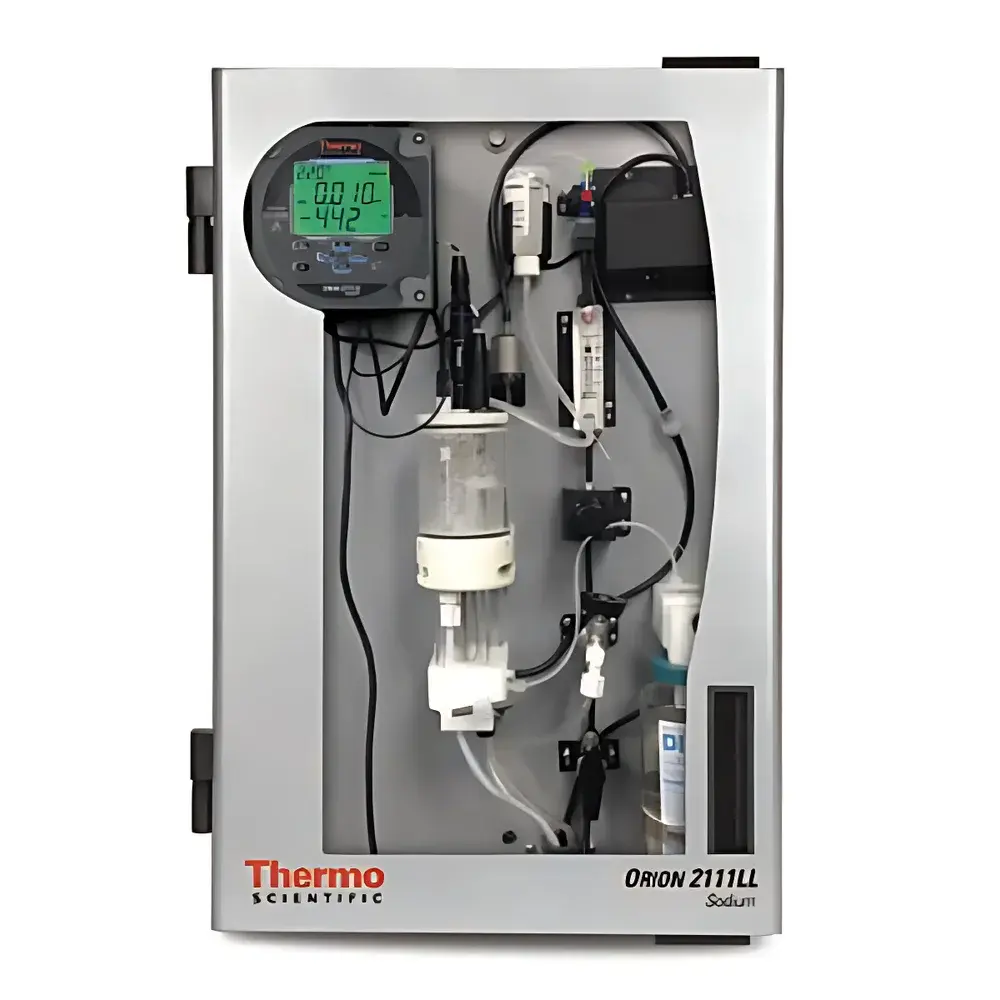
Thermo Fisher Scientific 2111LL Online Ultra-Low Range Sodium Analyzer
| Brand | Thermo Fisher |
|---|---|
| Origin | USA |
| Manufacturer | Thermo Fisher Scientific |
| Product Type | Online Sodium Ion Analyzer |
| Model | 2111LL |
| Measurement Range | 0.001 ppb – 10 ppm |
| Detection Limit | 0.001 ppb |
| Response Time | 2 min (to 95% of final value) |
| Accuracy | ±0.1 ppb or ±0.5% (whichever is greater) |
| Temperature Operating Range | 5–45 °C |
| Electrode Type | Sodium-Selective Glass Electrode (ROSS Ultra®) |
| Calibration Method | Dual-Standard Known Addition (DKA) |
| Output | Isolated 4–20 mA (linear/logarithmic selectable) |
| Display | Backlit LCD, 54 × 76 mm, graphical marquee + concentration + mV/status |
| Power | 85–132 VAC / 170–264 VAC, 50–60 Hz |
| Enclosure Dimensions | 65 × 45 × 27 cm (L×W×D) |
| Weight | 22.7 kg |
Overview
The Thermo Fisher Scientific 2111LL Online Ultra-Low Range Sodium Analyzer is a purpose-engineered instrument for continuous, real-time monitoring of trace sodium ion concentrations in ultrapure water and steam cycles within thermal power generation facilities. It operates on the principle of potentiometric measurement using a highly selective sodium-ion-sensitive glass electrode—the patented ROSS Ultra® electrode—coupled with a drift-compensated, non-Ag/AgCl reference system. Unlike conventional sodium analyzers relying on liquid-filled reference electrodes susceptible to silver leaching and temperature-induced drift, the 2111LL employs a solid-state, thermistor-based reference architecture with <0.1 ppb/month baseline drift across 0–100 °C. This enables stable, long-term operation in high-pressure, high-purity environments where sodium at sub-part-per-trillion levels directly correlates with turbine blade corrosion, boiler tube embrittlement, and catastrophic failure modes in supercritical and ultra-supercritical units. The analyzer meets the stringent analytical requirements defined by ASTM D4582 (Standard Practice for Measuring Trace Sodium in High-Purity Water), IEEE Std 117 (Recommended Practice for On-Line Monitoring of Steam and Water Chemistry), and aligns with IAPWS TR-02 (International Association for the Properties of Water and Steam Technical Report) guidelines for feedwater purity control.
Key Features
- ROSS Ultra® sodium-selective electrode: proprietary glass composition delivering exceptional selectivity (log KNa,K ≈ –4.8) and linear response down to 0.001 ppb in low-alkalinity (<50 ppm CaCO3) samples.
- Drift-free reference system: 30 kΩ thermistor-based ATC electrode with integrated temperature compensation; eliminates Ag/AgCl contamination and reduces thermal sensitivity by >3× versus conventional references.
- Pumpless reagent delivery: vapor-phase diisopropylamine (DIPA) diffusion technology adjusts sample pH without introducing liquid reagents—eliminating cross-contamination, clogging risks, and hazardous waste generation.
- DKA (Dual-Standard Known Addition) calibration: two-point in-situ calibration using ppm-level standards; avoids error-prone ppb-standard preparation while achieving ±2.5% accuracy (vs. reference value) without offline lab validation.
- Optimized flow cell design: fully isolated, transparent, valveless flow-through cell ensures rapid mixing (<10 s response to step change), eliminates reference electrolyte leakage, and supports visual diagnostics.
- Intuitive HMI: backlit graphical LCD with context-sensitive menu navigation, real-time status indicators (green/yellow/red LED), and dual-line display showing concentration + mV potential or diagnostic codes.
Sample Compatibility & Compliance
The 2111LL is validated for continuous operation with high-purity water streams meeting ASTM D1193 Type I specifications. Sample inlet conditions require: temperature 5–45 °C, pressure 0.6–6.9 bar (8–100 psig), flow rate 40 mL/min (regulated via integrated needle valve), and total alkalinity <50 ppm as CaCO3. It complies with IEC 61000-6-2 (EMC immunity) and IEC 61000-6-4 (EMC emission) standards. Its data integrity framework supports audit-ready operation under GLP/GMP environments: all calibrations, maintenance events, and parameter changes are timestamped and stored locally with configurable retention (≥30 days). While not FDA 21 CFR Part 11 certified out-of-the-box, its firmware architecture permits integration into validated SCADA systems via Modbus RTU or analog outputs with external electronic signature and audit trail enforcement.
Software & Data Management
The 2111LL embeds a deterministic real-time operating system managing sensor diagnostics, auto-ranging, and adaptive signal filtering. All measurement data—including raw mV output, temperature-corrected concentration, DKA calibration logs, and self-test results—are recorded internally with millisecond timestamps. Two isolated 4–20 mA outputs support simultaneous transmission to DCS and historian systems; one channel may be configured logarithmically to preserve resolution across the full 0.001 ppb–10 ppm range. Optional Ethernet or RS-485 interfaces enable remote configuration and data export via ASCII protocol. Firmware updates are performed via secure USB flash drive with SHA-256 signature verification. No cloud connectivity or vendor-hosted platforms are included—data sovereignty remains fully under end-user control.
Applications
Primary deployment contexts include:
- Supercritical coal-fired and nuclear power plants: continuous monitoring of condensate, feedwater, and steam purge samples to detect sodium ingress from condenser leaks, resin breakthrough, or heater tube failures.
- Combined-cycle gas turbine (CCGT) HRSG systems: early warning of sodium carryover from amine-treated makeup water or evaporative cooler drift.
- Pharmaceutical WFI (Water for Injection) distribution loops: compliance verification per USP and EP 2.2.42 for sodium limits ≤1 ppb.
- Microelectronics ultrapure water (UPW) recirculation: process control at polishing loop exit points prior to wafer rinsing stations.
- Research reactor primary coolant circuits: trending of sodium migration in sodium-cooled fast reactors (SFRs) using compatible aqueous surrogate streams.
FAQ
What is the minimum detectable sodium concentration, and how is it verified?
The specified detection limit is 0.001 ppb, determined per ISO 11843-1 using the standard deviation of 10 consecutive blank measurements (deionized water pre-treated with DIPA) and a signal-to-noise ratio of 3. This value is traceable to NIST SRM 3194 (Sodium Standard Solution).
Can the 2111LL perform calibration without removing the electrode from the process stream?
Yes—DKA calibration is performed in situ using standard additions directly into the flowing sample stream. No bypass loop or offline cell is required.
Is temperature compensation automatic and adjustable?
Yes—ATC is enabled by default using the integrated 30 kΩ thermistor. Manual offset adjustment (±5.0 °C) is available for field verification against calibrated RTDs.
What maintenance intervals are recommended for routine operation?
Electrode cleaning: every 30 days (with 0.1 M HCl soak); DIPA cartridge replacement: every 6 months; flow cell inspection: quarterly; full system verification: annually per ASTM D4582 Annex A2.
Does the analyzer support alarm relay outputs for safety interlocks?
No—alarm signaling is limited to visual LED status and 4–20 mA analog output scaling. External relays must be interfaced via DCS or PLC logic using the current loop signal.







