
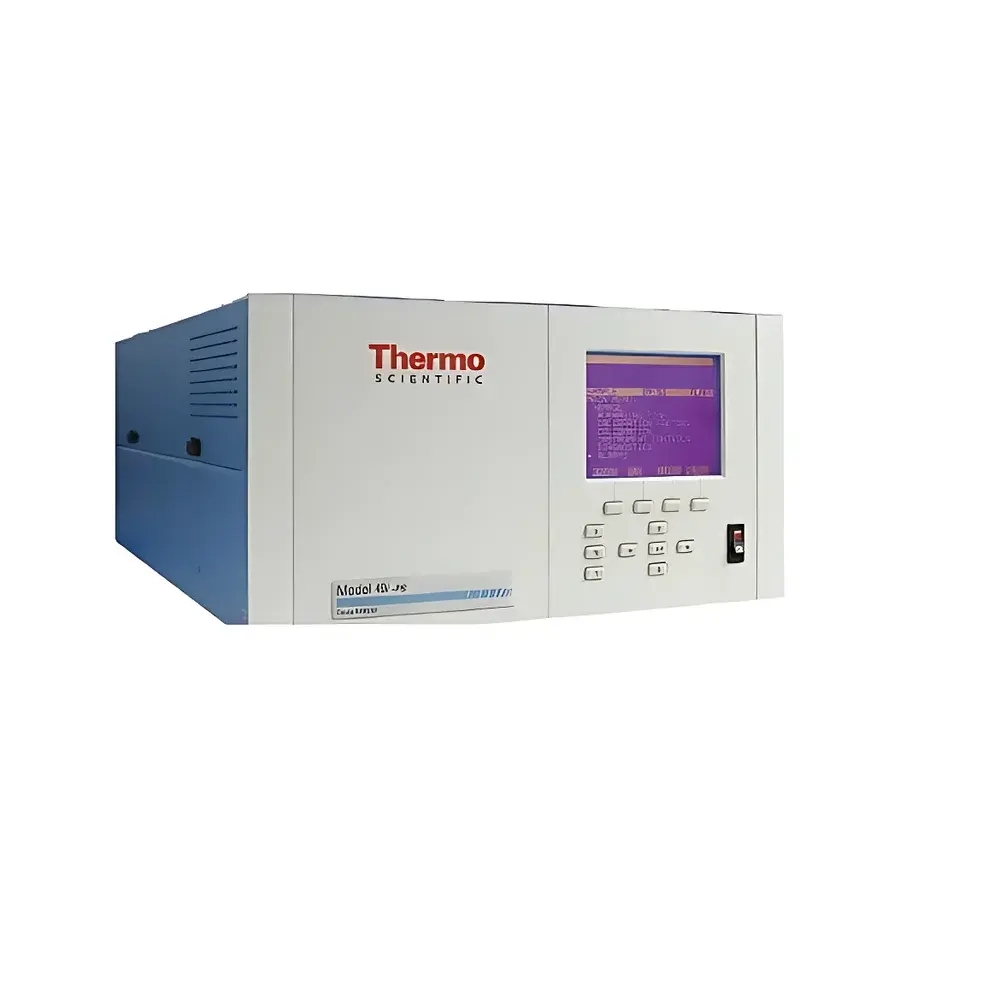
Thermo Fisher Scientific 49i-PS Ozone Calibrator
| Brand | Thermo Fisher Scientific |
|---|---|
| Origin | USA |
| Manufacturer Type | Original Equipment Manufacturer (OEM) |
| Import Status | Imported |
| Model | 49i-PS |
| Instrument Type | Online Calibrator |
| Measurement Range | 0–0.05, 0.1, 0.2, 0.5, 1.0, 2.0, 5.0 ppm |
| Detection Limit | 1.0 ppb |
| Response Time | 20 s |
| Zero Drift | 0.25 ppb RMS (60-s averaging) |
| Resolution | 1.0 ppb |
| Ozone Source Output | 0.25–1.000 ppm at 3–4 L/min |
| Ozone Source Stability | ±4 ppb or ±1% of reading (whichever is lower) |
| Linearity | ±1% of full scale |
| Accuracy | ±1.0 ppb |
Overview
The Thermo Fisher Scientific 49i-PS Ozone Calibrator is a high-precision, traceable ozone generation and delivery system engineered for primary and secondary calibration of ozone analyzers and transfer standards in ambient air monitoring networks, regulatory compliance laboratories, and reference measurement facilities. It operates on the principle of ultraviolet (UV) photometry at 254 nm—leveraging the well-characterized absorption cross-section of ozone—to generate certified ozone concentrations with metrological traceability to NIST Standard Reference Materials (SRMs). Unlike passive diffusion-based generators, the 49i-PS integrates a temperature- and pressure-compensated UV photometric ozone monitor within its closed-loop feedback architecture, enabling real-time, continuous verification of output concentration during calibration events. This dual-function design—serving simultaneously as both a stable ozone source and an internal reference standard—eliminates reliance on external ozone analyzers for verification, reducing uncertainty propagation and supporting ISO/IEC 17025-compliant calibration workflows.
Key Features
- Integrated UV photometric ozone monitor (254 nm) with NIST-traceable calibration for real-time output verification
- Seven user-selectable concentration ranges: 0–0.05, 0.1, 0.2, 0.5, 1.0, 2.0, and 5.0 ppm; equivalent mass-based scales available (0–0.1 to 10.0 µg/m³)
- Sub-part-per-trillion baseline stability: zero drift ≤ 0.25 ppb RMS over 60-second averaging interval
- Rapid dynamic response: <20 seconds T90 across all ranges, validated per EPA EQOA-0103 protocol
- High-resolution digital output: 1.0 ppb resolution with linearity error ≤ ±1% of full scale
- Onboard flash memory with timestamped data logging (≥30 days at 1-min intervals), supporting audit-ready record retention
- Remote operation via Ethernet (TCP/IP) and Modbus TCP; compatible with SCADA, LabVIEW, and EPA-approved data acquisition systems
- Modular internal layout with tool-less access to ozone generator cell, UV lamp, and optical bench—designed for field-serviceable maintenance under GLP/GMP conditions
Sample Compatibility & Compliance
The 49i-PS is optimized for calibration of UV-absorption ozone analyzers (e.g., Thermo 49i, 49iP, 49i-TEI, and equivalent instruments from Teledyne API, Horiba, and EcoChem), as well as electrochemical and chemiluminescence-based transfer standards. Its output gas stream meets EPA Performance Specification 2 (PS-2) requirements for ozone calibrators used in Federal Reference Method (FRM) and Federal Equivalent Method (FEM) monitoring networks. All critical performance parameters—including detection limit, linearity, and stability—are verified per ASTM D5012-22 and ISO 13964:2021. The instrument’s firmware supports 21 CFR Part 11-compliant electronic signatures, audit trails, and user-access controls when operated in regulated environments requiring FDA or EU Annex 11 adherence.
Software & Data Management
Calibration data, system diagnostics, and ozone generation logs are accessible through Thermo’s proprietary Instrument Manager software (v5.2+), which provides configurable reporting templates aligned with EPA QA Handbook Volume II and ISO/IEC 17025 Clause 7.7. Raw time-series data export is supported in CSV and XML formats, with embedded metadata including instrument ID, calibration gas certificate numbers, operator credentials, and environmental conditions (T, P, RH). Optional integration with LIMS platforms via HL7 or RESTful API enables automated calibration certificate generation and QC flagging based on pre-defined acceptance criteria (e.g., drift >0.5 ppb/24h triggers alert).
Applications
- Primary calibration of ambient ozone monitors in state/local air quality agencies (per 40 CFR Part 58 Appendix A)
- Verification and adjustment of ozone transfer standards in regional calibration centers
- Multi-point linearity validation for research-grade ozone sensors in atmospheric chemistry labs
- Field calibration support for mobile monitoring units deployed in EPA PM2.5/O3 co-location studies
- Traceability audits for ISO 17025-accredited laboratories conducting ozone analyzer certification
- Method validation studies requiring documented ozone concentration uncertainty budgets (k=2)
FAQ
What ozone generation method does the 49i-PS employ?
It uses a low-pressure mercury vapor UV lamp (185 nm) to photolyze oxygen in synthetic air, producing ozone via the Schumann–Runge mechanism. Concentration is controlled by precise UV intensity modulation and mass flow regulation.
Is the 49i-PS suitable for zero-air calibration?
Yes—the instrument includes a dedicated zero-air bypass path with integrated hydrocarbon scrubber and catalytic ozone destroyer, meeting EPA-defined zero-air specifications (<0.5 ppb ozone, <1 ppb NOx, <10 ppb THC).
How often does the UV lamp require replacement?
The lamp is rated for ≥12,000 hours of operation; typical replacement interval is 18–24 months under continuous use, with built-in lamp-hour counter and predictive maintenance alerts.
Can the 49i-PS be integrated into an existing networked calibration station?
Yes—it supports DHCP, static IP assignment, SNMP v3, and Modbus TCP, enabling seamless integration with centralized calibration management systems such as Thermo’s AirWatch or third-party enterprise platforms.
Does it comply with European Union calibration directives?
Yes—the 49i-PS conforms to EN 14625:2012 (ambient air—specification and calibration of ozone measuring instruments) and supports UKAS and DAkkS accreditation pathways for ozone calibration services.







