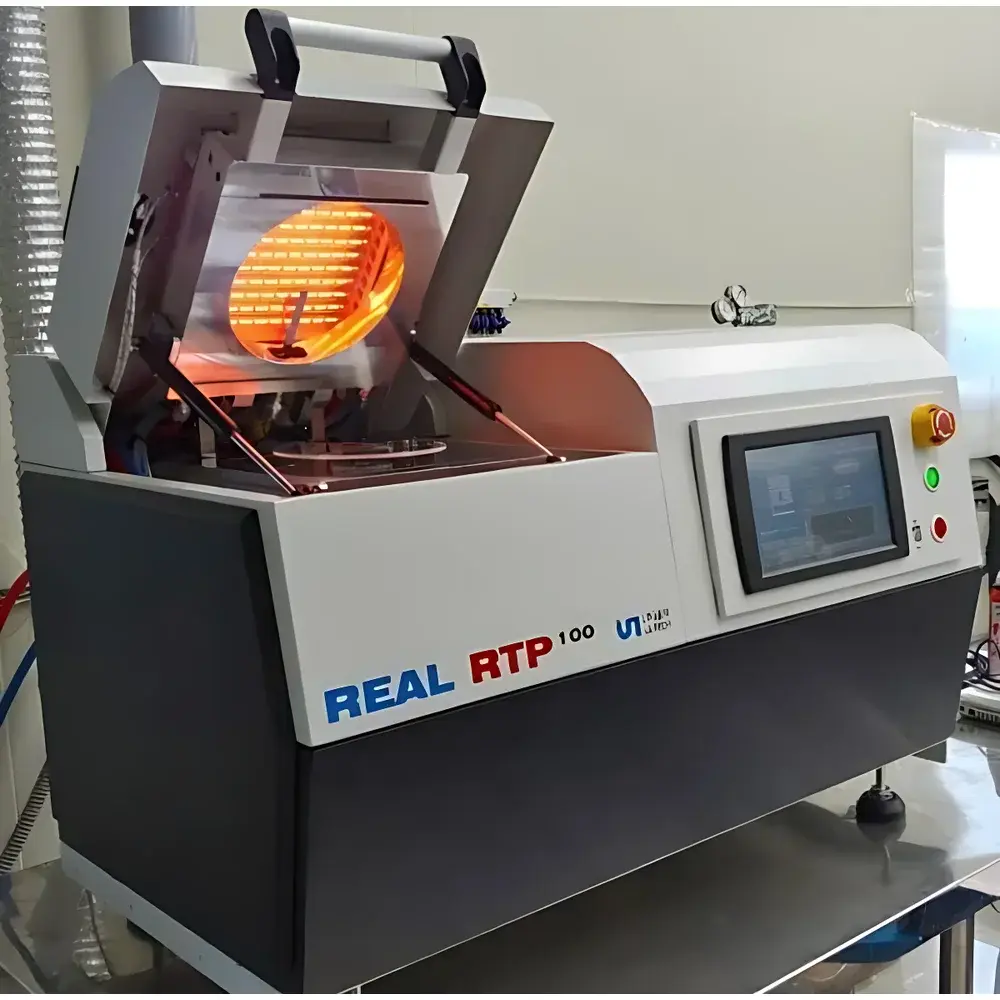
ULTECH REAL RTP-100 High-Vacuum Rapid Thermal Processing Furnace
| Brand | ULTECH |
|---|---|
| Origin | South Korea |
| Model | ULTECH REAL RTP-100 |
| Instrument Type | High-Vacuum Rapid Annealing Furnace |
| Sample Chamber Dimensions | 870 mm × 650 mm × 620 mm |
| Temperature Range | 100–1250 °C |
| Maximum Ramp Rate | 10–200 °C/s |
| Annealing Temperature Accuracy | ±1.5 °C |
| Temperature Uniformity | ±1.5 °C |
| Vacuum Base Pressure | 5×10⁻³ Torr (standard), down to 5×10⁻⁶ Torr (with dual-stage molecular pump) |
| Gas Lines | Up to 3 MFC-controlled channels |
| Substrate Compatibility | 4-inch wafers |
Overview
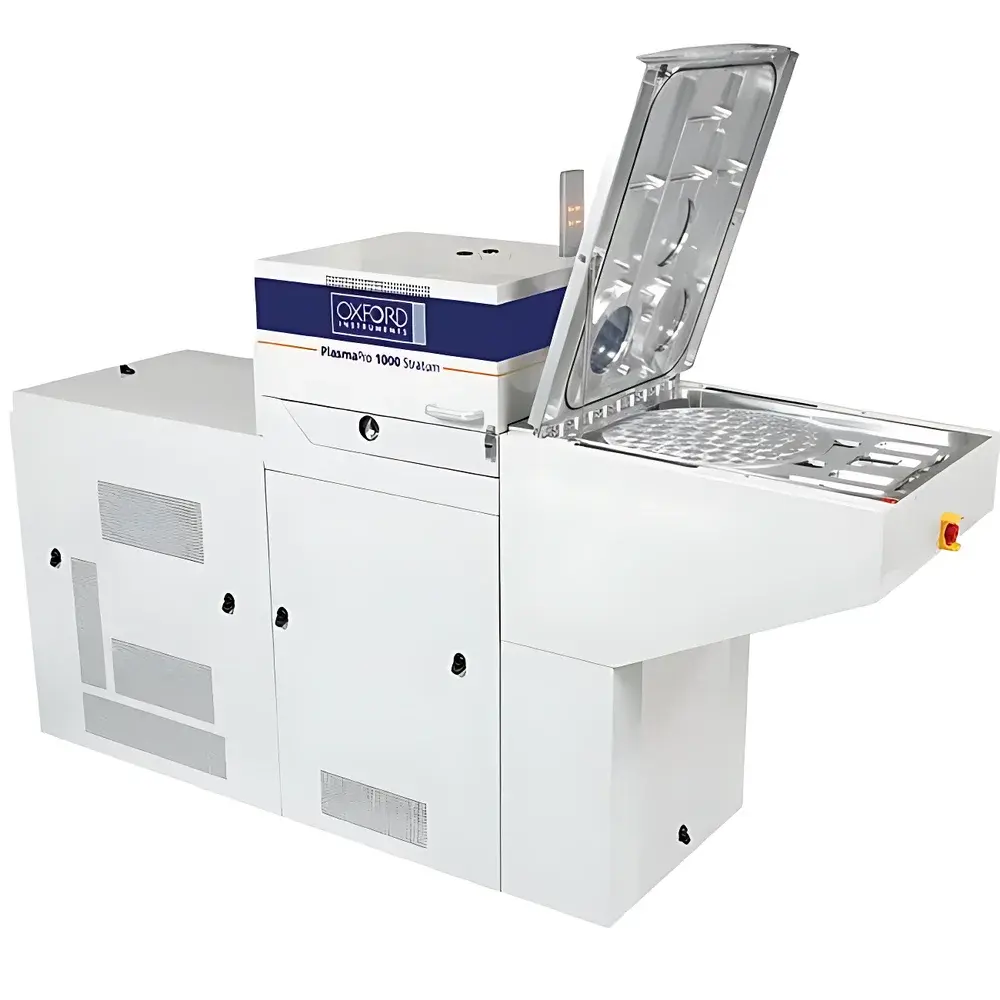
The ULTECH REAL RTP-100 is a high-vacuum rapid thermal processing (RTP) furnace engineered for precision semiconductor fabrication and advanced materials research. It employs a proprietary real-time substrate temperature measurement architecture—based on proximity-coupled, wafer-adjacent thermocouple sensing—to eliminate conventional emissivity-dependent compensation errors inherent in pyrometric or remotely mounted thermocouple systems. Unlike traditional RTP tools that infer substrate temperature from chamber wall or lamp housing readings, the REAL RTP-100 integrates a planar Real T/C Kit positioned millimeters above the sample surface. This design enables direct thermal equilibrium coupling between the sensor and the substrate, delivering true surface temperature feedback with minimal lag. The system operates on a cold-wall stainless-steel vacuum chamber heated by an array of high-intensity infrared halogen lamps, enabling ultra-fast thermal transients (up to 200 °C/s) while maintaining exceptional repeatability (< ±3 °C over repeated cycles) and spatial uniformity (±1.5 °C across 4-inch Si wafers at 800 °C). Its modular gas delivery (up to three MFC-controlled lines), dual-pressure vacuum capability, and compatibility with oxidizing, reducing, inert, and mixed atmospheres make it suitable for process-critical steps including rapid thermal annealing (RTA), rapid thermal oxidation (RTO), rapid thermal nitridation (RTN), silicide formation, dopant activation, and low-k dielectric densification.
Key Features
- True substrate temperature measurement via proximity-mounted Real T/C Kit—no emissivity correction or empirical calibration required
- Infrared halogen lamp array with digitally regulated power delivery for precise ramp/soak control
- Cold-wall stainless-steel vacuum chamber with quartz optical window and integrated water cooling
- Fast digital PID temperature controller with sub-second response time and programmable multi-segment thermal profiles
- Dual vacuum configuration: standard turbomolecular pumping achieves ≤5×10⁻³ Torr; optional dual-stage molecular pump extends base pressure to ≤5×10⁻⁶ Torr
- Touchscreen-enabled PC-based control interface with full data logging (time-stamped temperature, pressure, gas flow, power)
- Compact desktop footprint (870 × 650 × 620 mm) optimized for cleanroom integration and space-constrained labs
- Multi-atmosphere compatibility: N₂, O₂, H₂, Ar, forming gas, and custom blends—each independently controlled via mass flow controllers
Sample Compatibility & Compliance
The REAL RTP-100 accommodates 4-inch substrates across diverse material systems—including silicon, compound semiconductors (GaN, GaAs, InP), sapphire, SiC, poly-Si, glass, thin-film metals, and polymer films—without cross-contamination risk. Its all-quartz and SiC-coated graphite susceptor options ensure chemical inertness during high-temperature processing in reactive environments. The system meets key industry compliance requirements for semiconductor R&D and pilot-line manufacturing: vacuum integrity aligns with SEMI F20 standards for contamination control; thermal profiling supports ISO/IEC 17025 traceability when paired with calibrated reference sensors; and audit-ready operation logs satisfy GLP and GMP documentation expectations. Optional 21 CFR Part 11-compliant software modules are available for regulated environments requiring electronic signature, user access control, and immutable audit trails.
Software & Data Management
ULTECH’s proprietary RTP Control Suite provides intuitive graphical programming of thermal sequences—including ramp rates, soak durations, cooling profiles, and gas switching logic—with real-time visualization of all process parameters. All measurements are timestamped and stored in CSV-compatible format for post-process analysis in MATLAB, Python, or JMP. The software supports automated recipe execution, interlock monitoring (vacuum interlocks, over-temperature cutoffs, coolant flow verification), and remote diagnostics via Ethernet. For integration into factory automation frameworks, OPC UA and SECS/GEM interfaces are available as configurable options. Data export complies with ASTM E1996-21 guidelines for thermal process documentation, ensuring interoperability with MES and SPC platforms.
Applications
- Ion implant activation and contact annealing in CMOS and power device fabrication
- Rapid thermal oxidation of ultrathin gate oxides (RTO) and nitrogen incorporation (RTN)
- Silicide formation (NiSi, CoSi₂, TiSi₂) and alloying (SiAu, SiAl, SiMo)
- Crystallization of amorphous silicon, metal oxides, and chalcogenides
- Densification and stress relief of low-dielectric-constant (low-k) films
- LED epitaxial layer annealing on GaN/sapphire substrates
- Solar cell emitter formation and passivation layer optimization on poly-Si wafers
- Thermal bonding of heterogeneous stacks (e.g., Si-on-insulator, glass-to-silicon)
FAQ
How does the Real T/C Kit achieve higher accuracy than conventional pyrometry?
It establishes direct conductive-radiative thermal equilibrium with the substrate surface at sub-millimeter proximity—bypassing emissivity uncertainty and view-factor limitations inherent in non-contact methods.
Can the system operate under atmospheric pressure with inert gas purge?
Yes—the chamber supports both high-vacuum mode (≤5×10⁻⁶ Torr) and ambient-pressure operation using MFC-controlled N₂ or Ar purge, with automatic pressure regulation.
Is the quartz window rated for prolonged exposure to 1250 °C substrate temperatures?
The fused silica viewport is thermally isolated from the hot zone and actively cooled; its operational limit exceeds 1250 °C substrate processing without degradation.
What substrate heating uniformity can be expected on non-silicon materials such as GaN or SiC?
Uniformity remains within ±2.0 °C across 4-inch wafers when using SiC-coated graphite susceptors—verified per ASTM F1473 for compound semiconductor thermal mapping.
Does ULTECH provide calibration certificates traceable to NIST or KRISS standards?
Yes—factory calibration reports include uncertainty budgets and traceability to national metrology institutes; on-site recalibration services are available globally.