
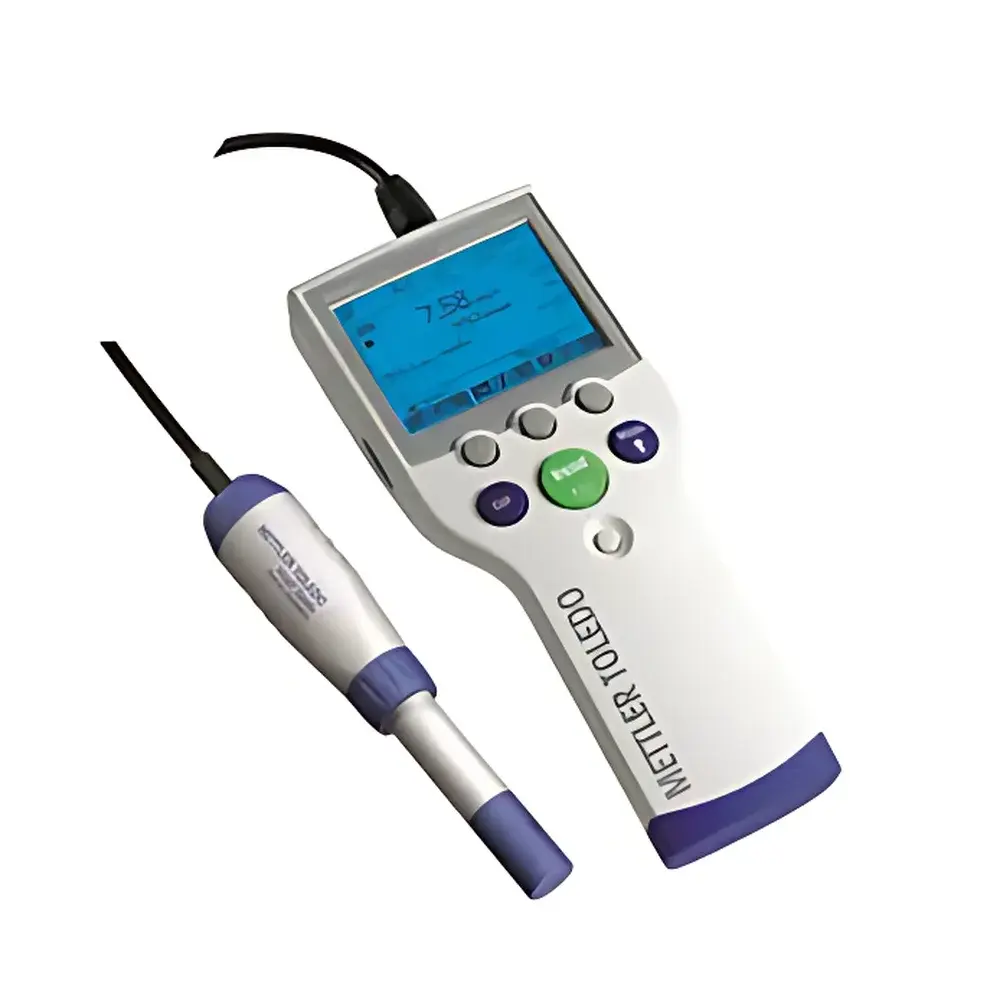
METTLER TOLEDO SevenGo Pro SG9 Optical Dissolved Oxygen Meter
| Brand | METTLER TOLEDO |
|---|---|
| Origin | Shanghai, China |
| Manufacturer Type | Authorized Distributor |
| Product Category | Domestic (China-manufactured) |
| Model | SG9 |
| Instrument Type | Laboratory-Portable |
| IP Rating | IP67 |
| Measurement Principle | Optical Luminescence (RDO® Technology) |
| DO Range | 0.00–80.00 mg/L (ppm) |
| Resolution | 0.01 mg/L |
| Accuracy | ±0.1 mg/L (0–8 mg/L), ±0.2 mg/L (8–20 mg/L), ±10% (20–80 mg/L) |
| Saturation Range | 0.0–50.0% |
| Saturation Resolution | 0.1% |
| Barometric Pressure Range | 500–1100 mbar |
| Pressure Resolution | 0.1 mbar |
| Data Storage | 500 GLP-compliant records |
| Calibration Management | ISM® Intelligent Sensor Management |
| Sensor Interface | Digital ISM-enabled OptiOx probe |
| Communication | Infrared (IR) interface |
| Operating Modes | Standard / Expert |
| Endpoint Options | Auto, Manual, Timed |
| Compliance | GLP, ISO/IEC 17025-supporting workflows, FDA 21 CFR Part 11-ready (with optional software) |
Overview
The METTLER TOLEDO SevenGo Pro SG9 Optical Dissolved Oxygen Meter is a laboratory-portable instrument engineered for high-precision, traceable dissolved oxygen (DO) measurement in aqueous samples using robust optical luminescence technology—specifically, the RDO® (Reliable Dissolved Oxygen) method. Unlike traditional electrochemical Clark-type sensors, the SG9 employs an optically excited ruthenium-based luminophore embedded in a gas-permeable polymer matrix on the InLab OptiOx sensor tip. Oxygen molecules quench the luminescence lifetime in a quantifiable, temperature-compensated manner—eliminating oxygen consumption during measurement, eliminating polarization time, and ensuring long-term signal stability. Designed for rigorous field and benchtop use, the SG9 meets the operational demands of environmental monitoring laboratories, municipal wastewater treatment plants, aquaculture facilities, food & beverage QC labs, and academic research settings where reproducibility, regulatory traceability, and ruggedness are non-negotiable.
Key Features
- Optical RDO® sensing principle: Zero oxygen consumption, no membrane replacement, no electrolyte refilling, and no warm-up delay—enabling immediate measurements after immersion.
- ISM® (Intelligent Sensor Management) integration: All calibration history—including date, offset, slope, user ID, and sensor serial number—is stored onboard the digital OptiOx probe chip. The meter auto-reads this data upon connection, guaranteeing measurement integrity and eliminating manual calibration entry errors.
- Dual-mode operation: Standard mode for routine analysis; Expert mode for advanced configuration including custom temperature compensation curves, user-defined alarm thresholds, and multi-point pressure correction protocols.
- IP67-rated housing and sensor: Fully submersible up to 1 m for 30 minutes—validated for outdoor deployment, riverbank sampling, and harsh industrial environments without protective enclosures.
- Integrated barometric pressure sensor: Automatic real-time compensation across 500–1100 mbar range, with optional manual override for fixed-altitude or controlled-chamber applications.
- GLP-compliant data handling: Stores 500 measurement records with timestamp, sample ID, operator ID, electrode ID, calibration status, and ambient pressure—each record cryptographically traceable per ISO/IEC 17025 documentation requirements.
Sample Compatibility & Compliance
The SG9 is validated for direct measurement in freshwater, seawater (with salinity compensation), wastewater effluents, fermentation broths, and potable water matrices. Its optical sensor exhibits minimal fouling sensitivity and is compatible with BOD incubation vessels via the dedicated BOD adapter—enabling static, non-stirred DO monitoring per ASTM D888 and ISO 5814 standards. The instrument supports full audit trail generation and meets foundational requirements for GLP and GMP-aligned workflows. When paired with METTLER TOLEDO’s LabX® software (optional), it achieves full 21 CFR Part 11 compliance—including electronic signatures, role-based access control, and immutable archive logging.
Software & Data Management
Data transfer occurs via infrared (IR) interface to Windows-based PCs or thermal printers—no cables or drivers required. Raw DO values, saturation %, temperature, pressure, and sensor diagnostics are exported in CSV format for LIMS integration or statistical process control (SPC) analysis. The built-in memory retains all GLP metadata without external dependency. For centralized fleet management, the SG9 integrates seamlessly into METTLER TOLEDO’s LabX® networked platform, enabling remote calibration scheduling, cross-instrument method synchronization, and automated report generation compliant with ISO 17025 clause 7.7 (result reporting).
Applications
- Environmental monitoring: Surface water DO profiling, eutrophication assessment, and EPA Method 360.1 validation.
- Wastewater treatment: Aeration basin optimization, nitrification/denitrification control, and discharge compliance per NPDES permits.
- Aquaculture: Real-time pond DO surveillance, feed-triggered oxygen dosing, and hypoxia event early warning.
- Food & beverage: Brew house wort aeration control, dairy pasteurization line verification, and bottled water shelf-life modeling.
- Academic research: Bioreactor DO kinetics, sediment-water interface flux studies, and climate-driven deoxygenation modeling.
FAQ
Does the SG9 require daily calibration?
No—due to the inherent stability of the RDO® optical system and ISM®-managed calibration history, recalibration is only required when sensor drift exceeds defined tolerance (typically every 7–30 days depending on usage intensity and matrix fouling risk).
Can the SG9 measure DO in high-salinity seawater?
Yes—the InLab OptiOx sensor supports automatic salinity compensation (0–70 g/kg) when paired with a conductivity module or manual salinity input, ensuring accuracy per ISO 5814 Annex B.
Is the IR interface compatible with modern operating systems?
Yes—the IR link operates independently of OS drivers and functions reliably with Windows 10/11, macOS (via third-party IR receivers), and Linux-based lab PCs equipped with standard IR transceivers.
What happens if the sensor chip memory fails?
The meter logs a diagnostic error and defaults to last-known valid calibration parameters while prompting immediate sensor replacement—ensuring continuity of measurement without data loss or protocol interruption.
How is temperature compensation handled?
A built-in NTC thermistor in the OptiOx probe provides simultaneous, co-located temperature measurement; compensation follows the Stern–Volmer equation with polynomial correction coefficients stored in the ISM chip—no user input required.
Related Products







