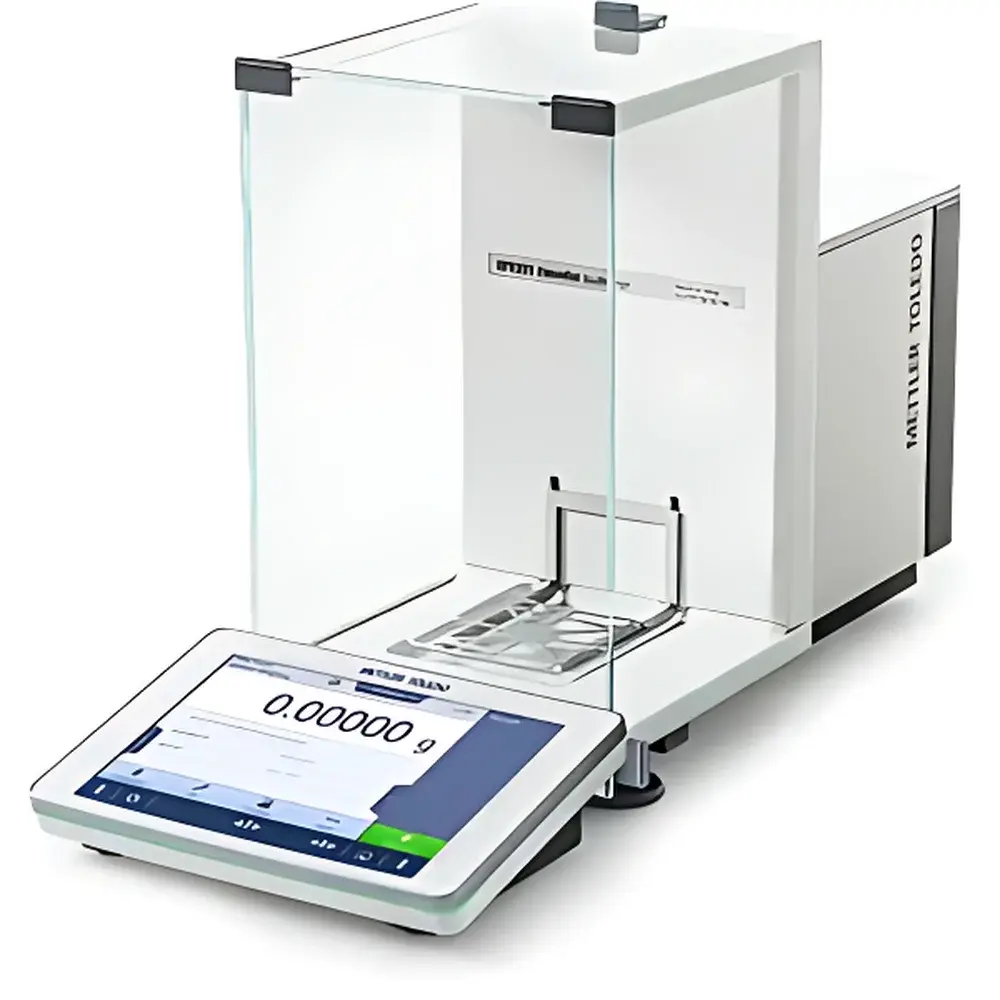
METTLER TOLEDO XPR205DUE/AC Advanced Analytical Balance
| Brand | METTLER TOLEDO |
|---|---|
| Origin | Switzerland |
| Instrument Type | Analytical Balance |
| Maximum Capacity | 220 g / 81 g (dual-range) |
| Readability | 0.1 mg / 0.01 mg |
| Repeatability (typ.) | 0.01 mg |
| Minimum Weight (U=1%, k=2, typ.) | 2 mg |
| Minimum Weight (USP <41>, 0.1% tolerance, typ.) | 20 mg |
| Stabilization Time | 1.5 s |
| Calibration | Internal, fully automatic (FACT) |
| Display | 7-inch color TFT touchscreen |
| Connectivity | RS232 (optional), USB-A, USB-B, Ethernet, Bluetooth (optional) |
| Pan Dimensions (W×D) | 78 mm × 73 mm |
| Dimensions (H×W×D) | 292 mm × 195 mm × 456 mm |
| Certified Readability | 1 mg |
| Series | XPR Essential |
| Regulatory Compliance | 21 CFR Part 11–compatible (with LabX), USP <41>, ISO/IEC 17025 support |
| User Management | Password-protected, unlimited users, role-based permissions |
| Static Detection | Not integrated |
| Industry Applications | Pharmaceuticals, Chemicals, Food & Beverage, Quality Control Laboratories |
Overview
The METTLER TOLEDO XPR205DUE/AC is a high-performance dual-range analytical balance engineered for precision mass measurement in regulated and research-intensive laboratory environments. Operating on electromagnetic force compensation (EMFC) technology, it delivers exceptional stability and reproducibility across its two distinct weighing ranges: 220 g at 0.1 mg readability and 81 g at ultra-fine 0.01 mg resolution. This dual-range architecture enables seamless transition between routine QC checks and high-sensitivity applications—such as active pharmaceutical ingredient (API) quantification or reference standard preparation—without compromising metrological integrity. The balance features an integrated FACT (Fully Automatic Calibration Technology) system with temperature-triggered internal calibration, ensuring continuous traceability and minimizing drift-induced uncertainty. Its compact, ergonomic design incorporates a robust monolithic weighing cell and optimized air-draft shielding to mitigate environmental perturbations—including convection currents and mechanical vibration—common in shared lab spaces.
Key Features
- Dual-range capability: 220 g / 0.1 mg and 81 g / 0.01 mg modes, each certified to OIML R 76 and NIST Handbook 44 requirements.
- 7-inch full-color TFT capacitive touchscreen with intuitive icon-driven interface, supporting multi-touch gestures and customizable home screens.
- Automated leveling guidance via built-in inclinometer and visual on-screen prompts—eliminating subjectivity in setup and reducing operator dependency.
- Comprehensive user management system compliant with ALCOA+ principles: password protection, unlimited user accounts, and granular role-based permissions (e.g., operator, supervisor, administrator).
- Rugged construction with corrosion-resistant stainless-steel pan (78 mm × 73 mm) and chemically resistant housing; IP54-rated against dust and splashes.
- Integrated connectivity suite: native USB-A (for printers/storage), USB-B (for PC/LabX integration), Ethernet (for network deployment), and optional RS232 and Bluetooth modules.
Sample Compatibility & Compliance
The XPR205DUE/AC supports a broad spectrum of sample types—from volatile solvents and hygroscopic powders to dense metallic standards—thanks to its fast stabilization time (1.5 s) and adaptive filtering algorithms that suppress transient disturbances. It meets critical regulatory thresholds defined in USP for minimum weight determination under 0.1% tolerance, with typical minimum weighable quantity of 20 mg. For GLP/GMP workflows, the balance is fully compatible with METTLER TOLEDO LabX software, enabling electronic signatures, audit trails, and full 21 CFR Part 11 compliance—including secure user authentication, immutable data archiving, and change control logging. All calibration and adjustment records are automatically timestamped and linked to user credentials, satisfying ISO/IEC 17025 documentation requirements for accredited testing laboratories.
Software & Data Management
When paired with LabX, the XPR205DUE/AC transforms into a networked, audit-ready instrument node. LabX provides centralized method management, real-time data validation, and automated report generation—including PDF export with embedded metadata (operator ID, timestamp, environmental conditions, calibration status). Raw weighing data is stored in encrypted SQLite databases with SHA-256 hashing; all actions—including tare, print, and calibration—are logged with digital signatures. Optional integration with LIMS and ERP systems via ODBC or RESTful API ensures end-to-end traceability from raw mass value to final quality release decision. Local operation remains fully functional without network dependency, preserving continuity during IT maintenance cycles.
Applications
This balance is routinely deployed in pharmaceutical formulation development (e.g., excipient blending verification), chemical synthesis (reaction stoichiometry validation), food safety labs (nutrient labeling compliance), and contract manufacturing organizations (CMOs) performing batch release testing. Its low minimum weight and high repeatability make it suitable for preparing certified reference materials (CRMs), calibrating volumetric glassware per ISO 1042, and conducting loss-on-drying (LOD) assays per USP . In academic settings, it serves as a teaching platform for metrology fundamentals—including uncertainty budgeting, measurement traceability, and GUM-compliant reporting.
FAQ
Is the XPR205DUE/AC compliant with 21 CFR Part 11?
Yes—when operated with LabX software and configured with appropriate user roles, electronic signatures, and audit trail settings.
Does it support external static elimination?
No—the model does not include built-in static detection or ionization; however, it is compatible with third-party antistatic devices via standard mounting interfaces.
Can the balance be integrated into a validated laboratory network?
Yes—Ethernet connectivity, TLS 1.2 encryption, and LabX’s IQ/OQ/PQ documentation templates facilitate qualification under GxP frameworks.
What is the recommended recalibration frequency?
Per ISO/IEC 17025, calibration interval must be risk-assessed; FACT ensures daily performance verification, but formal external calibration is advised at least annually—or after relocation, maintenance, or out-of-spec event.
Is the touchscreen glove-compatible?
Yes—the capacitive display responds reliably to standard laboratory nitrile gloves, supporting uninterrupted operation in controlled environments.