
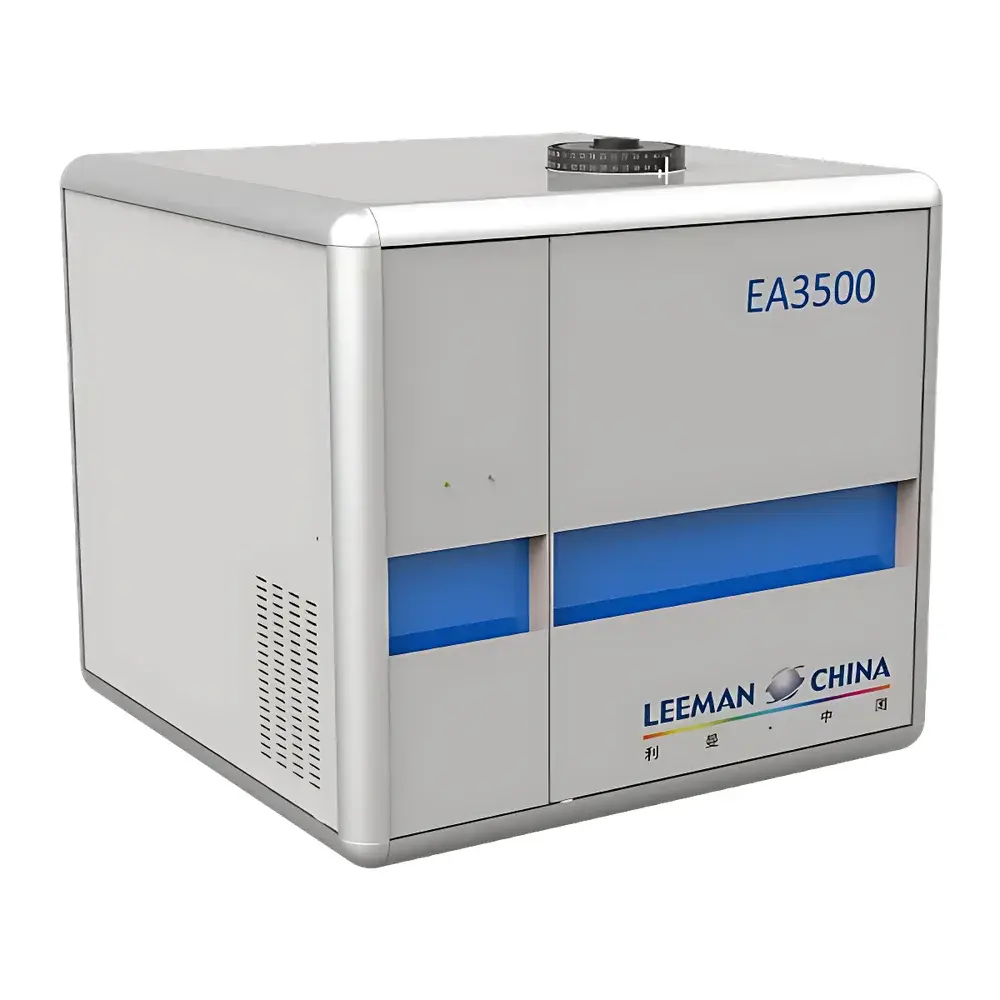
Teledyne Leeman Labs EA3500 Organic Elemental Analyzer
| Brand | Teledyne Leeman Labs |
|---|---|
| Origin | Beijing, China |
| Manufacturer Type | Authorized Distributor |
| Country of Origin | China |
| Model | EA3500 |
| Pricing | Upon Request |
Overview
The Teledyne Leeman Labs EA3500 Organic Elemental Analyzer is a high-performance combustion-based instrument engineered for precise quantification of carbon (C), hydrogen (H), nitrogen (N), sulfur (S), and oxygen (O) in solid and liquid organic samples. It operates on the principle of high-temperature catalytic combustion (typically 950–1150 °C) followed by gas chromatographic separation and thermal conductivity detection (TCD) or infrared (IR) detection—depending on configuration—for individual element quantification. The system conforms to internationally recognized methodologies including ASTM D5291, ISO 16968, USP , and EN 15407, ensuring data integrity and regulatory acceptability in GLP- and GMP-compliant laboratories. Designed with input from over two decades of application experience across >1,000 user sites in China and aligned with proven Italian elemental analysis architecture, the EA3500 delivers reproducible results with low detection limits (sub-μg level for C/H/N), robust baseline stability, and minimal operator intervention.
Key Features
- Dual-zone high-temperature furnace (up to 1150 °C) with independent temperature control, enabling flexible use of standard and extended-length reaction tubes for diverse sample matrices—including refractory organics and heterogeneous solids.
- Optimized oxygen injection geometry delivering pulsed O2 directly onto the sample surface prior to combustion, enhancing oxidation efficiency and minimizing incomplete combustion artifacts such as soot or char formation.
- Two-stage gas-phase separation system: first stage removes H2O and CO2 via selective absorbents; second stage employs chromatographic separation for N2, CO, NOx, and SO2, allowing simultaneous or sequential multi-element analysis without hardware reconfiguration.
- Dual mass flow controllers (MFCs) for precise, dynamic regulation of O2 and He carrier gas flows—maintaining ±0.5% setpoint accuracy across full operational range and reducing total gas consumption by up to 30% versus single-MFC systems.
- Integrated electronic leak detection subsystem continuously monitors system integrity during standby and analysis cycles, triggering real-time alerts and automatic shutdown if pressure deviation exceeds configurable thresholds.
- Intelligent auto-shutdown protocol initiates gas cutoff, furnace cooldown ramping, and vacuum release upon completion of sequence or power interruption—enabling unattended overnight operation while maintaining safety compliance per IEC 61010-1.
Sample Compatibility & Compliance
The EA3500 accommodates a broad spectrum of organic and organo-mineral matrices without derivatization or pre-treatment. Validated sample types include soils, sediments, coal and coke derivatives (e.g., needle coke, anode graphite), polymers, pharmaceutical intermediates, biomass, feedstuffs, catalysts, battery anode materials (e.g., synthetic graphite, silicon-carbon composites), rubber compounds, and environmental solid waste. Sample mass range: 0.1–500 mg (automatically adjusted based on expected C content). All hardware components contacting reactive gases are constructed from high-purity quartz, Inconel®, and sintered metal filters compliant with ISO 8573-1 Class 2 for compressed gas purity. Instrument firmware supports audit trail logging, user access levels, and electronic signature capability—fully compatible with FDA 21 CFR Part 11 requirements when deployed with validated LIMS integration.
Software & Data Management
Control and data acquisition are managed via EA-Connect™ software (v4.2+), a Windows-based platform supporting method templates, calibration curve management (linear, quadratic, or multi-point weighted), QC sample scheduling, and automated report generation in PDF/XLS formats. Raw chromatograms, peak integration parameters, and system diagnostic logs are stored in encrypted SQLite databases with timestamped metadata. Data export supports ASTM E1382-compliant ASCII output for third-party statistical analysis. Software validation documentation (IQ/OQ/PQ protocols) and CSV-based raw data export modules are available upon request for regulated environments.
Applications
The EA3500 serves as a core analytical tool in academic research (e.g., soil biogeochemistry, polymer degradation kinetics), petrochemical QA/QC (hydrocarbon composition, fuel heteroatom screening), environmental monitoring (TOC/TN in sludge and sediments), pharmaceutical development (elemental impurity profiling per ICH Q3D), and advanced materials R&D (C/H/N stoichiometry in graphene oxides, battery electrode formulations). Its ability to quantify oxygen—via pyrolytic reduction or direct combustion—is particularly valuable for characterizing oxidized carbon materials where conventional CHNS-only instruments fall short.
FAQ
Does the EA3500 support oxygen determination?
Yes—configured with optional oxygen module using tungsten oxide catalyst and CO detection, enabling accurate O quantification in organic matrices per ISO 17251.
What sample preparation is required?
Minimal: homogenized solids are weighed directly into tin or silver capsules; liquids are absorbed onto inert cellulose carriers. No acid digestion or derivatization is needed.
Is the system compliant with FDA 21 CFR Part 11?
Yes—when operated with EA-Connect™ v4.2+ and configured with role-based authentication, audit trail, and electronic signature modules.
Can it analyze volatile or low-melting-point compounds?
Yes—using low-temperature combustion protocols and cryogenic trapping options to prevent premature volatilization prior to oxidation.
What maintenance intervals are recommended?
Quarterly replacement of CO2/H2O absorbents, semi-annual inspection of combustion tube integrity, and annual MFC recalibration—documented in included PM checklist.
Related Products





