

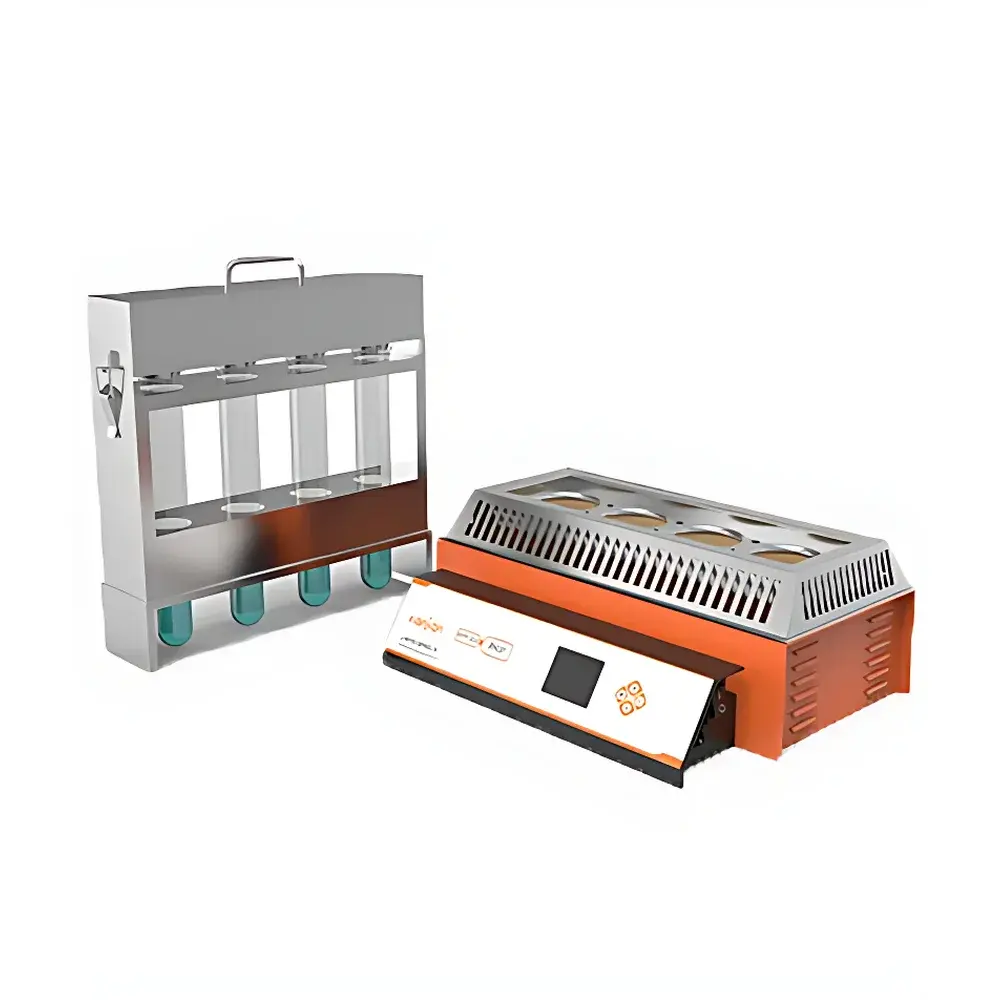
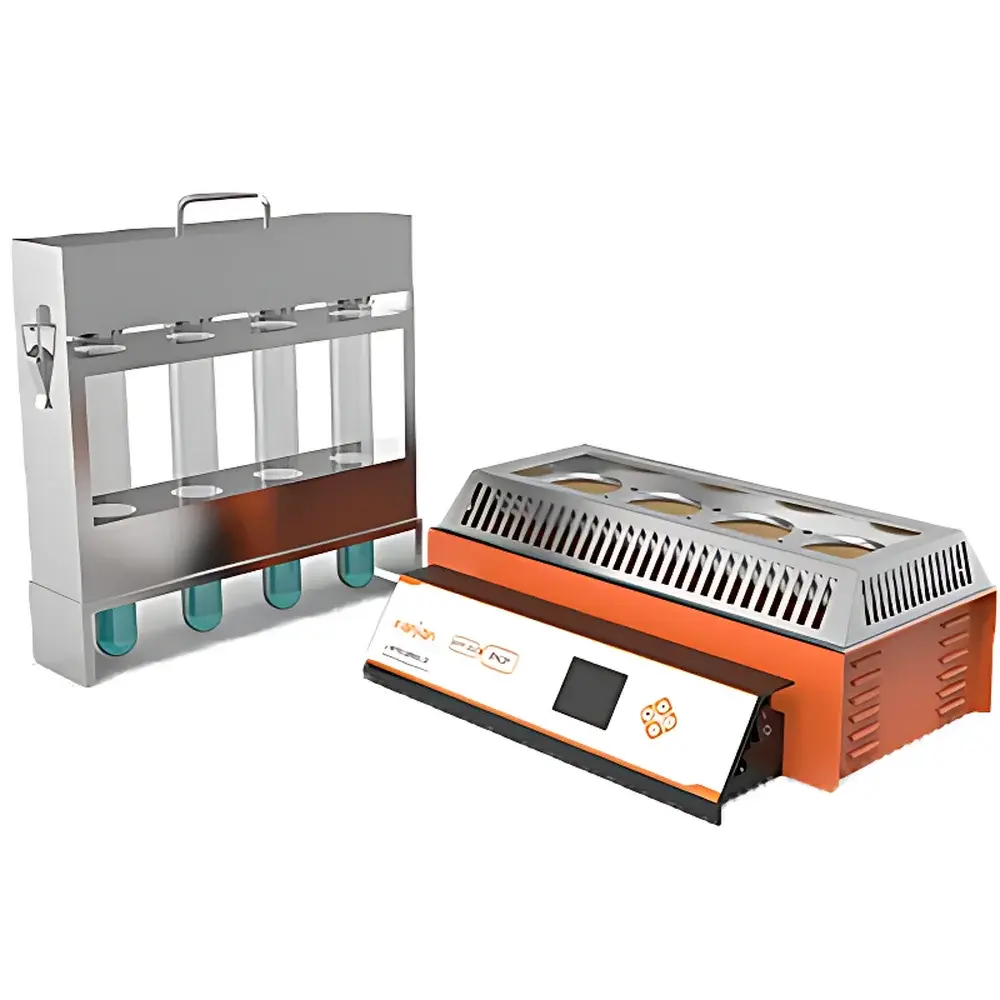
Shanghai Xianjian HYP-304 Intelligent Digestion Furnace
| Brand | Xianjian |
|---|---|
| Origin | Shanghai, China |
| Manufacturer Type | Direct Manufacturer |
| Region of Origin | Domestic (China) |
| Model | HYP-304 |
| Quotation | Upon Request |
| Temperature Control Range | Ambient to 600 °C |
| Temperature Accuracy | ±1 °C |
| Heating Rate | 30 °C/min (average) |
| Number of Digestion Positions | 4 |
| Digestion Tube Capacity | 250 mL |
| Nitrogen Determination Range | 0.1–240.0 mg N |
| Cycle Time | 45 min/batch |
| Display | 2.5-inch Blue LCD (simultaneous real-time temperature & hold time with countdown timer) |
| Heating Element | Ceramic Core Heater |
| Insulation Method | Split Air-Channel Thermal Isolation |
| Exhaust Sealing Material | Polytetrafluoroethylene (PTFE) |
| Safety Features | Programmable Upper-Temperature Limit with Auto-Cut-off and Audible Alarm |
| Control Modes | Dual-mode programmable ramping — linear and curve-based heating profiles |
| Rated Power | 1200 W |
| Voltage/Frequency | 220 V ±10%, 50–60 Hz |
| Dimensions (W×D×H) | 440 × 310 × 190 mm |
| Net Weight | 11 kg |
Overview
The Shanghai Xianjian HYP-304 Intelligent Digestion Furnace is a four-position, microprocessor-controlled thermal digestion system engineered for reproducible, high-efficiency sample mineralization in Kjeldahl nitrogen analysis and related wet-chemical digestion protocols. It operates on the principle of controlled conductive heating via high-stability ceramic core elements, enabling precise thermal ramping and sustained isothermal holds within a calibrated range of ambient to 600 °C. Designed for unattended operation, the HYP-304 implements dual-mode programmable temperature profiling—linear and non-linear (curve-based)—to accommodate thermally sensitive matrices such as dairy products, where foam formation and volatile loss must be mitigated through gradual, adaptive heating. Its integrated safety architecture—including hardware-enforced upper-temperature limit protection, automatic power cutoff, and audible alarm—ensures operational integrity during extended batch runs, aligning with laboratory requirements for process robustness and personnel safety.
Key Features
- Ceramic core heating elements delivering uniform thermal distribution and long-term stability across all four digestion positions
- Microprocessor-based dual-mode temperature programming: selectable linear or custom curve ramping for optimized decomposition kinetics
- 2.5-inch blue-backlit LCD interface displaying real-time temperature, elapsed hold time, and countdown timer; auto-termination with alarm upon cycle completion
- Thermally isolated control panel design minimizing heat transfer from furnace chamber to electronics, enhancing system longevity and signal fidelity
- PTFE-sealed exhaust manifold compatible with standard fume hood ducting or standalone toxic gas capture systems—reducing dependency on dedicated ventilation infrastructure
- Split air-channel insulation architecture providing effective thermal decoupling between heating zone and external housing
- Programmable upper-temperature limit safeguard: independent hardware-level cutoff prevents thermal runaway in case of sensor or controller failure
Sample Compatibility & Compliance
The HYP-304 supports digestion of organic matrices including foodstuffs (e.g., milk, meat, cereals), environmental samples (soils, sludges), and biological tissues using sulfuric acid-based reagents per AOAC 984.27, ISO 5983-1, and USP <467> residual catalyst protocols. Its 250 mL digestion tube capacity accommodates standard Kjeldahl vessels and conforms to ASTM D5133 requirements for volumetric consistency in nitrogen determination workflows. While not certified to IEC 61000-6-3 (EMC) or UL 61010-1 out-of-the-box, the unit meets CE-marking essential requirements for laboratory electrical equipment when installed per manufacturer-specified clearances and grounding practices. Its design facilitates audit readiness for GLP-compliant laboratories through deterministic, repeatable thermal profiles and timestamped event logging (via optional RS232/USB data export).
Software & Data Management
The HYP-304 operates via embedded firmware without proprietary PC software dependency. All program parameters—including up to six sequential temperature stages, ramp rates, hold durations, and safety thresholds—are stored in non-volatile memory and retained after power cycling. Optional serial (RS232) or USB interface modules enable integration with LIMS or custom SCADA platforms for remote parameter upload, real-time temperature telemetry, and electronic record generation. When paired with compliant data acquisition software, the system supports 21 CFR Part 11-aligned audit trails, including user ID, timestamp, parameter change history, and execution logs—essential for regulated QA/QC environments conducting nitrogen quantification under ISO/IEC 17025 or FDA inspection frameworks.
Applications
- Kjeldahl nitrogen determination in dairy, feed, and agricultural commodities per AOAC and ISO standards
- Heavy metal pre-digestion for ICP-OES/ICP-MS analysis in environmental and clinical laboratories
- Organic carbon matrix removal prior to sulfate or chloride quantification by ion chromatography
- Method development for thermally assisted hydrolysis of protein-bound analytes in pharmaceutical excipient testing
- Routine quality control in contract research organizations performing AOAC 992.15-compliant crude protein assays
FAQ
What is the maximum recommended operating temperature for continuous use?
The HYP-304 is rated for sustained operation up to 550 °C; 600 °C is specified as absolute upper limit for short-duration ramp phases only.
Can the HYP-304 be integrated into an automated Kjeldahl distillation workflow?
Yes—its programmable end-cycle signal output (dry contact relay) can trigger downstream distillation units or autosamplers equipped with TTL or 24 VDC input interfaces.
Is calibration traceable to national standards?
Temperature calibration is performed using NIST-traceable reference thermocouples; users receive a factory calibration certificate with as-found/as-left data at 200 °C, 400 °C, and 550 °C.
Does the unit comply with electromagnetic compatibility (EMC) directives?
It meets EN 61326-1:2013 Class A emission limits for laboratory use; immunity testing per EN 61326-2-1 is available upon request with third-party verification report.
What maintenance intervals are recommended for optimal performance?
Ceramic heater inspection and PTFE exhaust gasket replacement are advised every 12 months or after 1,000 digestion cycles, whichever occurs first.



