
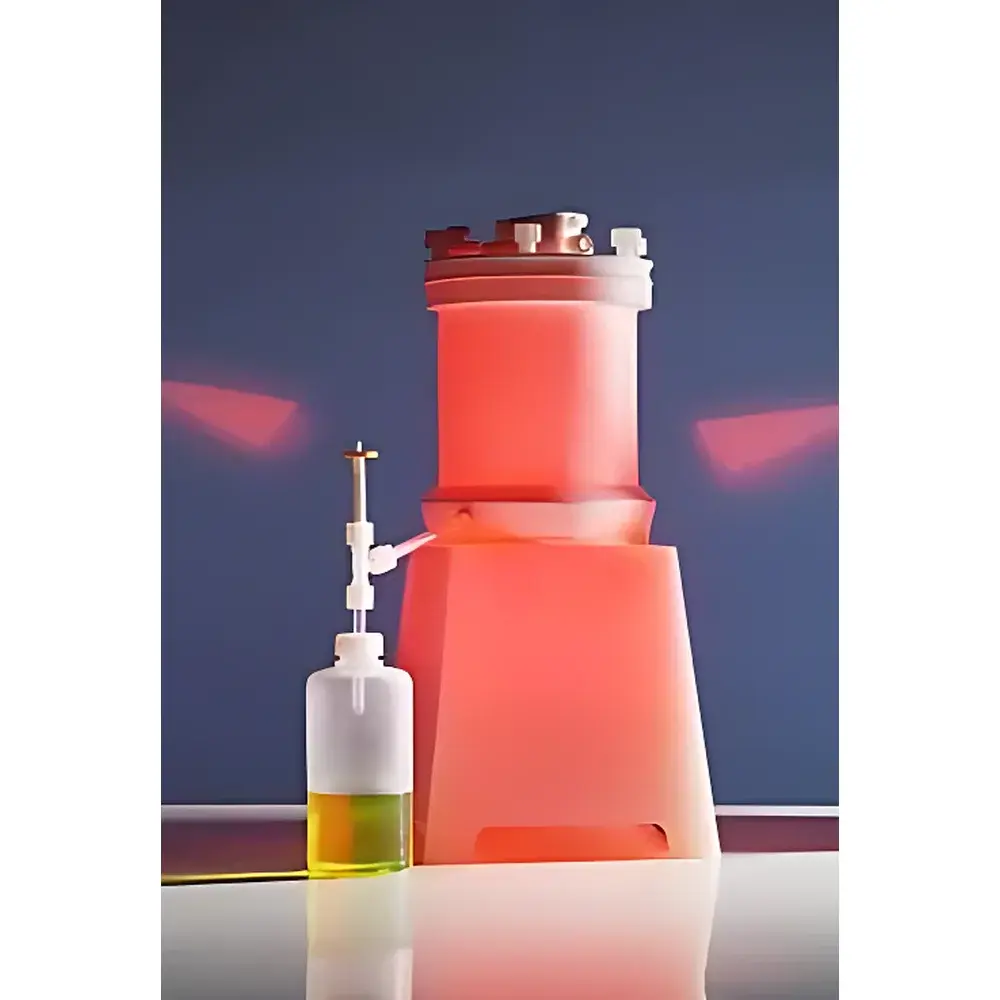
Berghof BSB-939-IR Sub-Boiling Acid Purification System
| Brand | Berghof |
|---|---|
| Origin | Germany |
| Model | BSB-939-IR |
| Instrument Type | Sub-boiling Distillation Apparatus |
| Construction Materials | TFM-PTFE, PTFE, and PFA only (no quartz or metal components) |
| Application | Ultra-high-purity acid production for trace elemental analysis |
Overview
The Berghof BSB-939-IR Sub-Boiling Acid Purification System is an engineered solution for the in-lab generation of ultra-trace–clean acids—specifically nitric acid (HNO₃), hydrochloric acid (HCl), hydrofluoric acid (HF), and other volatile mineral acids—required in high-sensitivity elemental analysis techniques including ICP-OES, ICP-MS, GF-AAS, AFS, and EPA Method 200.2 compliant testing. Unlike conventional boiling-point distillation, the BSB-939-IR employs sub-boiling (also termed “hotplate-free” or “infrared-controlled thermal gradient”) distillation: a precisely regulated infrared heating element maintains the acid surface at a temperature just below its atmospheric boiling point, inducing controlled evaporation while suppressing violent boiling, splashing, and aerosol carryover. This thermodynamically stable phase transition minimizes entrainment of non-volatile impurities—including metals (e.g., Al, Fe, Cr, Ni, Pb), anions (e.g., SO₄²⁻, PO₄³⁻), and particulates—that originate from reagent-grade acid stock or container leaching. The system operates without quartz, glass, or metallic wetted parts; all fluid-contact surfaces consist exclusively of high-purity fluoropolymers—TFM-PTFE for the distillation chamber, PTFE for condenser interfaces, and PFA for collection vessels—ensuring chemical inertness, low extractables, and long-term compatibility with aggressive media such as 49% HF.
Key Features
- Sub-boiling distillation principle with dynamic IR power modulation to sustain optimal vapor pressure gradients without nucleate boiling
- Full fluoropolymer construction: TFM-PTFE distillation reservoir, PTFE condenser assembly, and PFA collection bottles—certified to ISO 17025 traceable purity specifications
- Microprocessor-based controller with programmable ramp profiles, real-time temperature monitoring (±0.5 °C accuracy), and automatic shutdown on low-level detection or thermal anomaly
- No consumables required; maintenance limited to periodic visual inspection and rinsing of PFA vessels with high-purity water
- Low energy consumption: typical operational power draw ≤120 W during steady-state distillation
- Integrated safety interlocks prevent operation with open lid or misaligned condenser, complying with IEC 61010-1 for laboratory electrical equipment
Sample Compatibility & Compliance
The BSB-939-IR is validated for purification of concentrated HNO₃ (69–70%), HCl (37%), and HF (48–49%) at volumes ranging from 500 mL to 2 L per batch. It achieves consistent blank levels ≤10 pg/g for key contaminants (e.g., Cr, Cu, Ni, Pb, Zn) in distilled output, meeting stringent requirements of ASTM D5127 (Standard Guide for High-Purity Water Used in Semiconductor Processing) and USP for Conductivity of Purified Water. All materials comply with EU REACH Annex XIV restrictions and are non-leaching under ISO 10993-12 cytotoxicity screening. The system supports GLP-compliant workflows through configurable audit trail logging (optional firmware upgrade) and is compatible with 21 CFR Part 11–enabled LIMS integration via RS-232/USB interface.
Software & Data Management
While the base BSB-939-IR operates via embedded front-panel controls, optional firmware enables data export in CSV format via USB stick or serial connection. Logged parameters include batch ID, start/stop timestamps, cumulative IR duty cycle, peak surface temperature, and error codes. For laboratories requiring electronic records, Berghof provides a validated PC application (Berghof PurifyLink v3.1) supporting metadata tagging, electronic signatures, and PDF report generation aligned with ISO/IEC 17025 clause 7.7 on result reporting. All software modules undergo periodic cybersecurity review per NIST SP 800-53 Rev. 5 controls.
Applications
- Preparation of calibration standards and matrix-matched blanks for ICP-MS multi-element quantitation
- Generation of ultra-low-background rinse solutions for sample introduction systems (e.g., nebulizers, spray chambers, desolvation modules)
- Purification of acids used in semiconductor wafer cleaning protocols (SEMI F57)
- Recovery of high-value spent HF/HNO₃ etchants in microelectronics R&D labs
- Supporting EPA 6020B method validation where reagent blank contributions must remain <5% of method detection limit
FAQ
What acid types are compatible with the BSB-939-IR?
Nitric acid (69–70%), hydrochloric acid (37%), hydrofluoric acid (48–49%), and perchloric acid (70%)—subject to local regulatory approval and lab-specific risk assessment.
Can the system be used for sulfuric or phosphoric acid?
No. These non-volatile acids decompose or polymerize under sub-boiling conditions and are incompatible with fluoropolymer thermal limits.
Is operator training required before first use?
Yes. Berghof recommends completion of the certified 4-hour online training module covering thermal hazard mitigation, PFA handling protocols, and IR calibration verification procedures.
How often should the TFM-PTFE reservoir be replaced?
Under normal use (≤5 batches/week), replacement is recommended every 24 months or after 300 distillation cycles—whichever occurs first—as verified by FTIR spectral baseline drift analysis.
Does the BSB-939-IR meet ISO/IEC 17025 accreditation requirements for acid purification?
Yes. When operated per Berghof’s SOP-B939-IR-01 and maintained with documented calibration certificates, it satisfies ISO/IEC 17025:2017 clause 6.4.6 on equipment suitability for intended use.



