
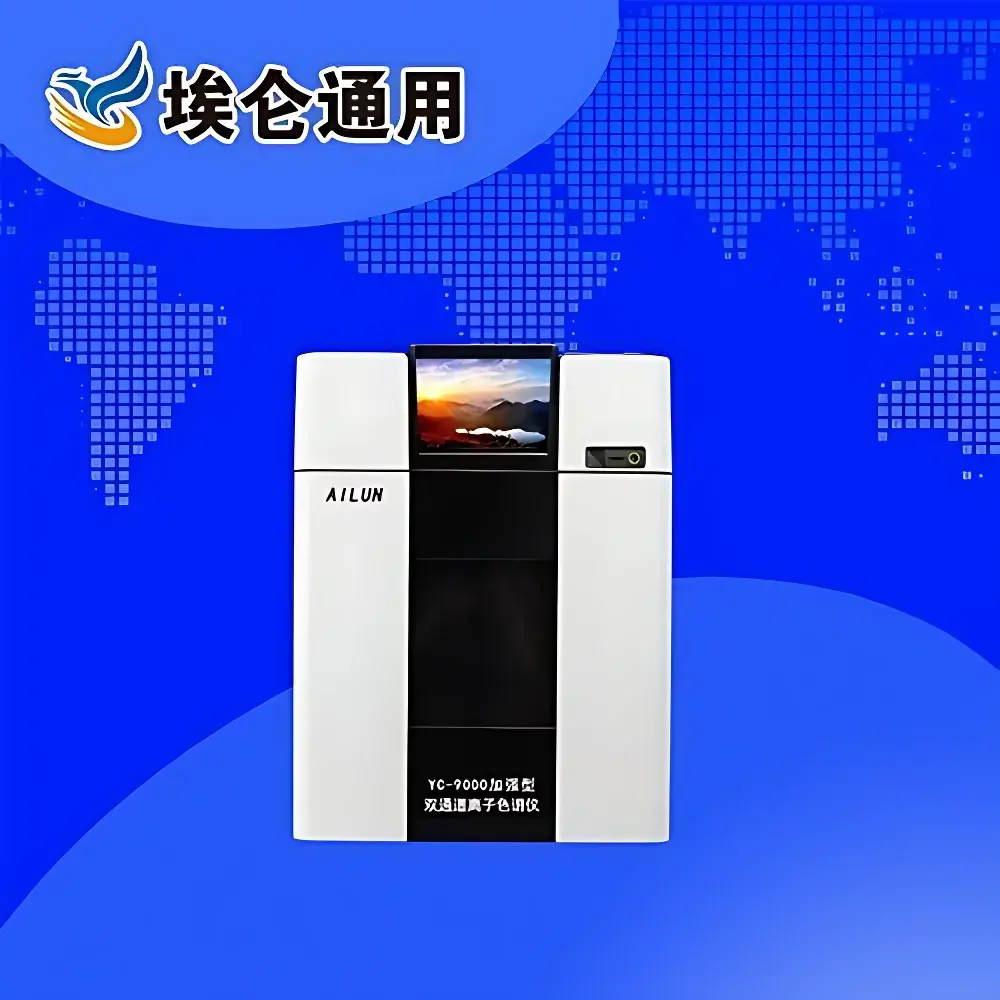
Ailun General YC9000 Enhanced Dual-Channel Intelligent Ion Chromatograph
| Brand | Ailun General / Qingdao Ailun |
|---|---|
| Origin | Shandong, China |
| Manufacturer Type | Authorized Distributor |
| Origin Category | Domestic |
| Model | YC9000 Enhanced |
| Instrument Type | Laboratory |
| Application Scope | General-Purpose |
| Pump Pressure Range | 0–37 MPa (0–5000 psi) |
| Flow Rate Range | 0.00–9.99 mL/min |
| Eluent Flow Rate | 0.1–3.0 mL/min |
| Maximum Operating Pressure | 21 MPa (3000 psi) |
| Column Oven Temperature Range | 30–60 °C (86–140 °F) |
| Temperature Reproducibility | ±0.1 °C |
| Eluent Concentration Range | 0.1–100 mM |
Overview
The Ailun General YC9000 Enhanced Dual-Channel Intelligent Ion Chromatograph is a high-integration laboratory-grade ion chromatography system engineered for simultaneous, independent analysis of anions and cations in a single instrument platform. Based on suppressed conductivity detection principles—complemented by optional amperometric and UV detection modules—the YC9000 Enhanced implements dual-core digital signal processing architecture to enable true parallel operation of two fully isolated chromatographic channels. Each channel maintains independent control over eluent delivery, column temperature regulation, detector configuration, and data acquisition timing. This architecture eliminates inter-channel synchronization constraints, allowing asynchronous sample injection and real-time method switching without hardware reconfiguration. Designed for compliance with ISO/IEC 17025 requirements for testing laboratories, the system supports trace-level quantification of inorganic ions (e.g., F⁻, Cl⁻, NO₂⁻, NO₃⁻, SO₄²⁻, Na⁺, NH₄⁺, K⁺, Mg²⁺, Ca²⁺) and low-molecular-weight organic acids (e.g., formate, acetate, oxalate) across environmental, pharmaceutical, food safety, and industrial QC applications.
Key Features
- Dual-Independent Channel Architecture: Two physically and electronically isolated flow paths—each with dedicated high-pressure piston pump, precision flow controller, thermostatically regulated column oven (30–60 °C, ±0.1 °C stability), and configurable detector module—enable concurrent anion and cation analysis without cross-talk or method interference.
- Flexible Autonomous Injection: Sample introduction is decoupled from channel sequencing; injection into either channel triggers immediate analysis initiation, eliminating forced wait states and maximizing throughput in multi-analyte workflows.
- Modular Detection Support: Standard conductivity detection with integrated CO₂ suppressor; optional integration of pulsed amperometric detection (PAD) for carbohydrate analysis or UV-Vis absorbance detection (190–400 nm) for non-conductive species.
- Multi-Mode Gradient Capability: Supports isocratic and multi-step linear or nonlinear gradient elution on both channels, enabling separation optimization for complex matrices including wastewater, soil extracts, and biological fluids.
- High-Integration Mechanical Design: All critical components—including dual high-pressure pumps, dual-column ovens, dual suppression units, dual detectors, online degasser, and embedded control electronics—are housed within a single compact chassis to minimize dead volume, thermal drift, and mechanical vibration effects.
- Full Remote Instrument Control: Ethernet-based bidirectional communication enables complete parameter configuration (flow rate, temperature, suppressor current, detector gain, injection volume), real-time chromatogram visualization, and audit-trail-enabled method execution via compliant LIMS or third-party CDS platforms.
Sample Compatibility & Compliance
The YC9000 Enhanced accommodates aqueous samples across wide concentration ranges—from sub-ppb environmental monitoring standards to high-salt industrial process streams—through selectable detection sensitivity modes and dynamic range extension via auto-ranging conductivity measurement. It supports common IC column chemistries (e.g., Dionex IonPac AS/CS series, Metrohm Suppressor columns) and integrates seamlessly with standard 4.0 mm or 2.0 mm ID analytical columns. The system meets essential regulatory alignment criteria for routine use in GLP-compliant laboratories: full electronic record retention (including raw detector signals, method parameters, and operator logs), time-stamped audit trails per FDA 21 CFR Part 11 Annex 11 guidance, and calibration verification protocols traceable to NIST SRMs. It is routinely deployed in accordance with ASTM D4327 (anions in water), ISO 10304-1 (determination of dissolved anions), and USP <645> (conductivity of purified water).
Software & Data Management
Built-in firmware provides native support for Ailun ChromoView Pro workstation software—a Windows-based application offering real-time chromatogram display, peak integration with customizable baseline algorithms (tangent skim, vertical drop, exponential skew), quantitative report generation (area/height normalization, internal standard correction, calibration curve fitting per ICH Q2(R2)), and export to CSV, PDF, and CDF formats. The software enforces role-based user access control, electronic signature capture for critical actions (e.g., method validation, report approval), and automatic backup of all acquisition files to network storage locations. Data integrity safeguards include write-once-read-many (WORM) archive options, immutable audit logs recording every parameter change and acquisition event, and timestamped versioning of all methods and sequences. Integration with enterprise LIMS systems is supported via ASTM E1384-compliant HL7 and ASTM E2500-07 data exchange protocols.
Applications
- Environmental monitoring: Quantification of regulated anions (Cl⁻, NO₃⁻, SO₄²⁻) and cations (Na⁺, Ca²⁺, Mg²⁺) in drinking water, surface water, groundwater, and wastewater per EPA Method 300.0 and ISO 10304-2.
- Pharmaceutical quality control: Testing of residual counterions (e.g., Na⁺, Cl⁻) in active pharmaceutical ingredients (APIs) and excipients per USP <645> and Ph. Eur. 2.2.38.
- Food and beverage safety: Analysis of preservatives (benzoate, sorbate), acidity regulators (acetate, citrate), and nutritional cations (K⁺, NH₄⁺) in dairy, beverages, and infant formula.
- Power generation: Monitoring of chloride and sulfate ingress in boiler feedwater and steam condensate to prevent corrosion-related turbine failure.
- Agricultural chemistry: Determination of nitrate and phosphate leaching in soil extracts and fertilizer formulations.
- Chemical manufacturing: In-process control of ionic impurities in electroplating baths, catalyst slurries, and polymerization reaction mixtures.
FAQ
Does the YC9000 Enhanced support gradient elution on both channels simultaneously?
Yes—each channel operates with independent gradient programming capability, allowing distinct eluent composition profiles and timing schedules to be executed concurrently.
Can the system perform qualitative identification without reference standards?
No—like all ion chromatographs, it requires retention time matching against certified reference materials under identical chromatographic conditions for unambiguous ion identification.
Is the CO₂ suppressor compatible with methanol-containing eluents?
The integrated membrane-based CO₂ suppressor is optimized for aqueous carbonate/bicarbonate and hydroxide eluents; methanol content exceeding 15% v/v is not recommended due to potential membrane swelling and reduced suppression efficiency.
What level of cybersecurity compliance does the embedded Ethernet interface provide?
The instrument firmware implements TLS 1.2 encryption for remote command transmission, supports IEEE 802.1X port-based network authentication, and disables unused services (e.g., FTP, Telnet) by default to meet IEC 62443-3-3 SL2 requirements for laboratory instrumentation.
How is detector baseline stability maintained during long-duration runs?
Conductivity detector zero-point auto-compensation occurs at user-defined intervals (e.g., every 30 minutes); thermal mass stabilization of the detection cell and suppression unit ensures drift <0.5 nS/h under constant ambient conditions.





