
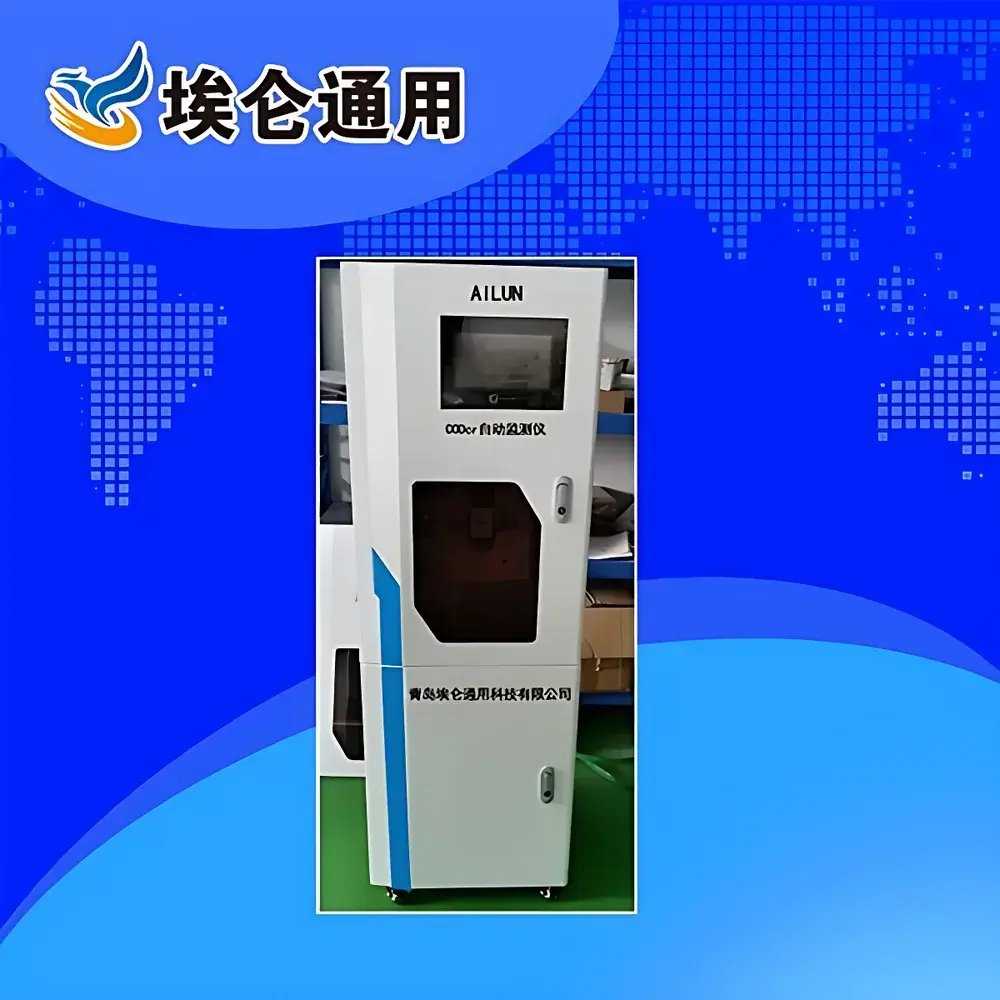
Ailun AL-AC120 Online COD Analyzer
| Brand | Ailun |
|---|---|
| Origin | Qingdao, Shandong, China |
| Model | AL-AC120 |
| Instrument Type | Online Water Quality Analyzer |
| Measuring Parameter | Chemical Oxygen Demand (COD) |
| Measurement Range | 0–5000 mg/L |
| LOD | ≤15 mg/L (±30% error at low end) |
| Repeatability | ≤±5% |
| Low-Concentration Drift | ±5 mg/L |
| High-Concentration Drift | ≤5% |
| Minimum Cycle Time | 20 min |
| Adjustable Sampling Interval | 10–9999 min |
| Digestion Time | Configurable per application |
| Calibration Interval | 1–99 days |
| Maintenance Interval | ~30 days (~60 min/session) |
| Output Interfaces | RS-232, RS-485, 4–20 mA (optional) |
| Operating Temperature | +5 to +28 °C (climate-controlled indoor environment) |
| Relative Humidity | ≤90% non-condensing |
| Power Supply | AC 220 V ±10%, 50 Hz ±10%, 5 A |
| Accuracy (Standard Solution Validation) | ±10.0% at 40.0 mg/L |
| Memory Effect | ±10.0% at 40.0 mg/L |
| Field Sample Comparison Tolerance | ≤5 mg/L for samples <50.0 mg/L |
| Chloride Interference Tolerance | Standard mode ≤2.5 g/L Cl⁻ |
| Control System | Panasonic PLC-based embedded controller |
Overview
The Ailun AL-AC120 Online COD Analyzer is a fully automated, laboratory-grade water quality monitoring system engineered for continuous, unattended measurement of Chemical Oxygen Demand (COD) in municipal and industrial wastewater streams. It implements the standardized dichromate oxidation method—aligned with ISO 6060 and EPA Method 410.4—with integrated high-temperature acid digestion, precise photometric detection, and real-time compensation for chloride interference. Designed for deployment in effluent discharge points, influent/effluent monitoring stations, and biological treatment process control loops, the AL-AC120 delivers traceable, auditable data under variable matrix conditions—including high-salinity or intermittently fluctuating organic loads. Its modular architecture supports long-term operational stability in ambient-controlled environments, meeting core requirements for regulatory reporting under national discharge permits and ISO 14001-compliant environmental management systems.
Key Features
- Chloride-tolerant digestion chemistry: Standard operation validated for Cl⁻ ≤2.5 g/L; optional reagent formulation and algorithm calibration extend compatibility to Cl⁻ ≤20 g/L without manual sample dilution or pretreatment.
- Panasonic PLC-based control core: Ensures deterministic timing, electromagnetic noise immunity, and fault-resilient sequencing—critical for 24/7 operation in electrically noisy plant environments.
- Adjustable measurement cycle: Full analytical cycle configurable from 20 minutes (minimum) to 120 minutes; sampling interval independently set between 10 and 9999 minutes, supporting both time-scheduled and event-triggered acquisition modes.
- Multi-point calibration and drift correction: User-defined calibration frequency (1–99 days), with automatic zero/span verification and slope adjustment; low- and high-concentration drift compensation algorithms maintain accuracy across full 0–5000 mg/L range.
- Robust hardware design: Corrosion-resistant fluidic path (PTFE/PFA tubing, ceramic valves); thermally stabilized digestion chamber; optical sensor with temperature-compensated LED source and dual-wavelength photodiode detection.
- Comprehensive diagnostics: Real-time status logging for reagent levels, digestion temperature, valve actuation, photometric signal integrity, and power supply stability—exportable via serial interface for predictive maintenance planning.
Sample Compatibility & Compliance
The AL-AC120 is validated for raw and treated wastewater matrices with suspended solids ≤100 mg/L and pH 4–10. It complies with key international performance criteria for online analyzers, including ISO 15839 (water quality—specifications and performance requirements for on-line analyzers) and EN 14181 (quality assurance of automated measuring systems). Its measurement uncertainty profile satisfies typical regulatory acceptance thresholds for discharge monitoring per EU Directive 2000/60/EC and China’s HJ 353–2019 standard for online water quality monitoring equipment. All firmware and calibration logs retain full audit trails compliant with GLP principles. Optional 4–20 mA output supports integration into DCS/SCADA platforms with SIL-2 compatible signal conditioning.
Software & Data Management
Local operation is managed through an intuitive LCD touchscreen interface with multilingual support (English, Chinese, Spanish). Remote configuration, real-time data viewing, and historical trend analysis are enabled via built-in Modbus RTU (RS-485) and ASCII protocol (RS-232). The device generates timestamped CSV files containing raw absorbance values, calculated COD concentrations, QC flags (e.g., “low signal”, “reagent exhausted”, “digestion timeout”), and diagnostic codes. Data export supports periodic FTP push or manual USB retrieval. Firmware updates are performed via secure signed binary upload, preserving calibration constants and user-defined schedules. No cloud dependency or proprietary software installation is required—full interoperability with third-party LIMS and EMS platforms is ensured through open protocol documentation.
Applications
- Continuous compliance monitoring at municipal wastewater treatment plant (WWTP) final effluent outfalls.
- Process control feedback for activated sludge, MBR, and SBR systems—enabling dynamic aeration optimization and nutrient dosing.
- Industrial pre-treatment verification for electroplating, petrochemical, pharmaceutical, and food processing facilities subject to chloride-rich influents.
- Early-warning detection of shock loads (e.g., accidental solvent spills or batch discharge events) via rapid-cycle trending and deviation alerts.
- Long-term trend analysis for environmental impact assessments and sustainability reporting (e.g., SDG Indicator 6.3.2).
FAQ
What COD measurement principle does the AL-AC120 employ?
It uses the closed-reflux colorimetric method based on potassium dichromate oxidation under acidic, high-temperature conditions (165 °C), followed by spectrophotometric quantification of Cr³⁺ at 600 nm.
Can the analyzer operate without daily operator intervention?
Yes—designed for unattended operation up to 30 days between routine maintenance cycles, assuming stable reagent supply and ambient environmental control.
Is the system compliant with FDA 21 CFR Part 11 for electronic records?
While not certified as Part 11–compliant out-of-the-box, its audit-trail functionality (time-stamped calibration logs, user access history, and change records) provides foundational elements that can be validated within a regulated GxP environment.
How is chloride interference mitigated during analysis?
Through a combination of mercury sulfate masking (in standard reagent kit) and adaptive algorithmic correction derived from dual-wavelength absorbance ratios—validated per HJ 353–2019 Annex B for high-chloride wastewater.
What is the minimum detectable COD concentration and associated uncertainty?
The limit of detection is ≤15 mg/L, with measurement uncertainty of ±30% at this level per ISO 8466-1; repeatability is ≤±5% RSD across the linear range.
Related Products







