
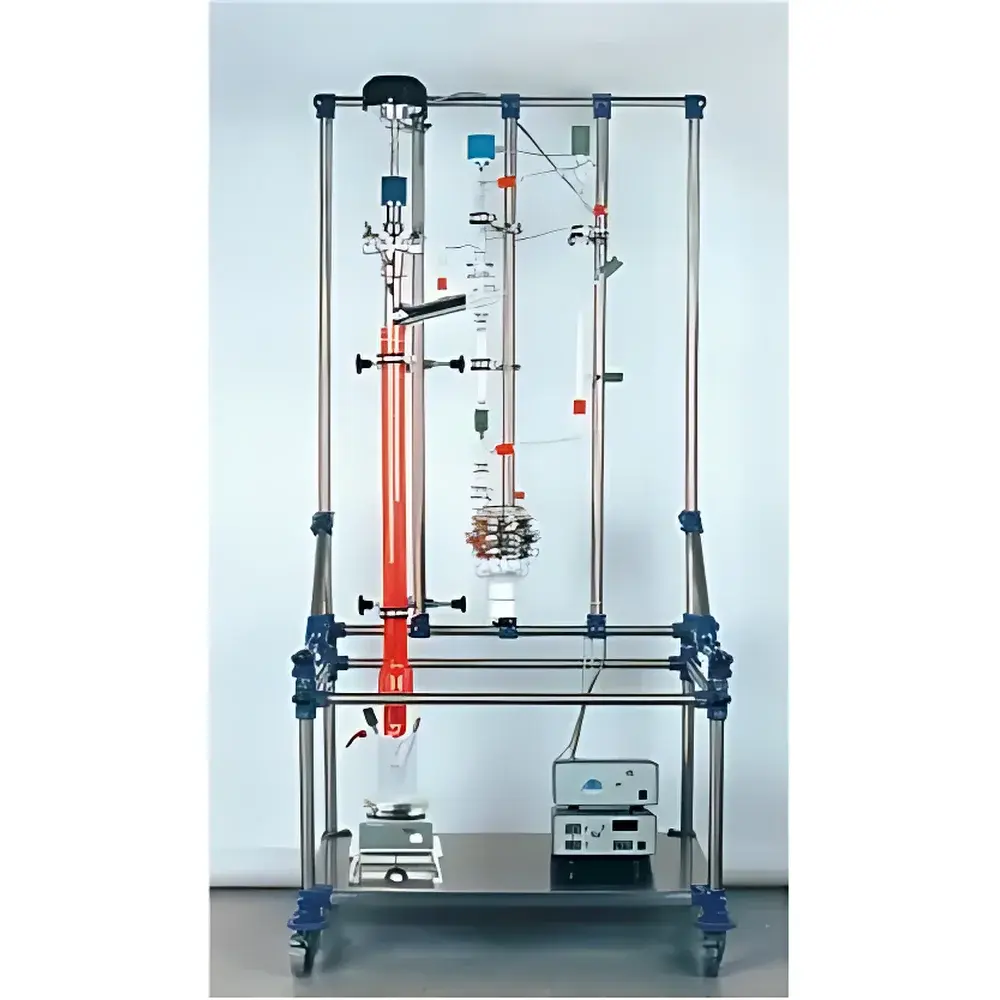
Normag Micro Spinning Band Column Distillation Apparatus
| Brand | NORMAG |
|---|---|
| Origin | Germany |
| Model | Normag Micro SBC-100 |
| Theoretical Plates (at 1 atm, total reflux) | 50 |
| Effective Column Height | 100 cm |
| Column Inner Diameter | DN6 (≈6 mm) |
Overview
The Normag Micro Spinning Band Column Distillation Apparatus is a high-precision, laboratory-scale fractional distillation system engineered for demanding separation tasks involving thermally sensitive, high-boiling, or low-volatility compounds. Based on the Couette-type spinning band principle, it employs a continuously rotating fluoropolymer (HOSTAFLON®) helical band within a vertically oriented, vacuum-jacketed column to generate highly efficient mass transfer between ascending vapor and descending liquid phases. Unlike conventional packed or plate columns, this design achieves up to 50 theoretical plates over a compact 100 cm effective height under atmospheric pressure and total reflux—enabling sharp-cut separations with minimal holdup volume (< 5 mL typical). Its core architecture integrates three advanced distillation configurations in one modular platform: micro spinning band column operation, mid-column still pot arrangement, and compatibility with dividing wall column (DWC) hydraulics—making it uniquely suited for R&D in petrochemical refining, specialty chemical synthesis, and high-purity solvent recovery.
Key Features
- Vacuum-jacketed DN6 (6 mm ID) silver-coated glass column ensures exceptional thermal insulation and optical clarity for real-time observation of band rotation and phase behavior.
- Electromagnetically actuated reflux head delivers precise, programmable reflux ratio control (0–100% continuous range) with integrated temperature monitoring at the column top.
- Mid-positioned still pot configuration eliminates long vapor path lengths and reduces residence time by up to 40% versus bottom-mounted designs—critical for minimizing thermal degradation of labile components such as olefins, esters, or pharmaceutical intermediates.
- Vacuum-compatible magnetic drive system powers the HOSTAFLON® spinning band without mechanical seals, ensuring leak-tight operation down to < 0.1 mbar while maintaining consistent rotational stability across extended runs.
- Modular Anschütz-Thiele receiver allows sequential collection of up to 6 fractions under inert atmosphere or controlled vacuum, with optional cryogenic traps for volatile light ends.
- Integrated PID-controlled heating mantle for the still pot (range: ambient to 300 °C, ±0.5 °C stability) and independent jacket temperature regulation support multi-zone thermal management.
Sample Compatibility & Compliance
The apparatus accommodates feed volumes from 10 mL to 150 mL and handles mixtures with boiling point differentials as low as 2–3 °C—ideal for isolating close-boiling hydrocarbons (e.g., C₆–C₁₀ naphtha cuts), functionalized aromatics, or bio-derived oxygenates. It complies with ASTM D2892 (Standard Test Method for Fractional Distillation of Petroleum Products at Atmospheric Pressure) and ASTM D5236 (for high-boiling materials), and its sealed, traceable operation supports GLP-compliant workflows. All wetted parts are constructed from borosilicate 3.3 glass and PTFE-compatible fluoropolymers, ensuring chemical resistance to strong acids, bases, and halogenated solvents. Vacuum integrity meets ISO 2859-1 sampling standards for leak rate verification (< 1×10⁻⁴ mbar·L/s).
Software & Data Management
While the base system operates via analog controls and calibrated mechanical indicators, optional digital retrofit kits provide RS485/Modbus RTU connectivity for integration into LabVantage, DeltaV, or custom SCADA environments. Logged parameters include column top/bottom temperatures, reflux ratio, vacuum level, heating power, and fraction collection timestamps. Audit trails comply with FDA 21 CFR Part 11 requirements when paired with validated third-party data acquisition software, supporting full traceability for regulatory submissions in API manufacturing or fuel specification validation.
Applications
- Development and optimization of multi-component separation sequences for refinery naphtha splitting and kerosene fractionation.
- Pilot-scale purification of catalyst residues, polymerization inhibitors, or reaction by-products in fine chemical synthesis.
- Thermodynamic parameter estimation (e.g., activity coefficients, VLE data) for process simulation using ASPEN Plus or CHEMCAD.
- Evaluation of DWC energy savings potential—validated against BASF’s industrial installations where DWC reduced CAPEX by 30% and OPEX by 28% for ternary (low/medium/high-boiling) separations.
- Stability testing of heat-sensitive natural extracts, essential oils, or fragrance compounds under controlled partial vacuum.
FAQ
What is the maximum operating vacuum level supported by the column system?
The silver-coated vacuum jacket and magnetic drive assembly are rated for continuous operation down to 0.05 mbar; ultimate vacuum depends on connected pump performance and system conditioning.
Can the mid-column still pot be retrofitted onto existing Normag columns?
No—the mid-position pot is an integral structural component requiring factory alignment of vapor lift lines and thermal expansion compensation; it is only available on new-build SBC-100 units.
Is the HOSTAFLON® spinning band replaceable in the field?
Yes, the band is user-replaceable using standard column disassembly procedures; replacement kits include calibration templates and torque specifications for reproducible installation.
Does the system meet ISO/IEC 17025 calibration requirements?
As supplied, the unit includes factory calibration certificates for temperature sensors and pressure transducers traceable to PTB (Physikalisch-Technische Bundesanstalt); full scope accreditation requires site-specific validation per ISO/IEC 17025 Clause 6.4.
How is the dividing wall column functionality implemented?
The apparatus provides hydraulic interfaces and flow-splitting manifolds to connect two parallel condensers and reboilers, enabling experimental emulation of DWC internal partitioning—supporting proof-of-concept studies prior to full-scale design.




