
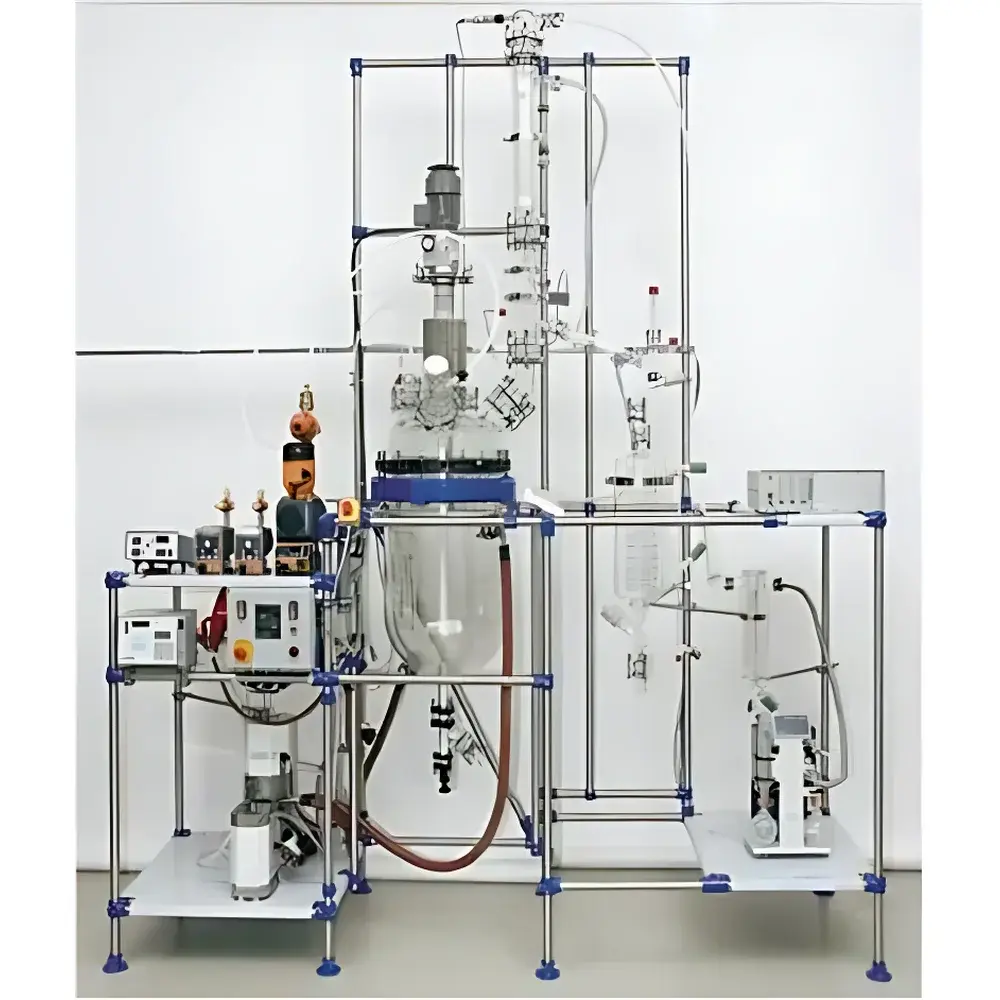
Normag 50L Reactive Distillation System
| Brand | NORMAG |
|---|---|
| Origin | Germany |
| Model | 50L Reactive Distillation System |
| Configuration | Integrated vacuum-rated reactor vessel, packed/tray distillation column, reflux separator, fraction receivers, programmable temperature & vacuum control unit, corrosion-resistant fluid handling system |
| Compliance | Designed per DIN EN ISO 9001 manufacturing standards |
| Control Architecture | PLC-based with HMI touchscreen interface and Ethernet-enabled data logging |
Overview
The Normag 50L Reactive Distillation System is an engineered laboratory-scale platform for simultaneous chemical reaction and separation under controlled thermal, pressure, and compositional conditions. Based on the principle of reactive distillation—where equilibrium-limited reactions are driven forward by continuous in-situ removal of volatile products—the system integrates a high-vacuum jacketed reactor with a structured or plate-type distillation column, enabling precise kinetic and thermodynamic studies of esterification, transesterification, hydrolysis, and catalytic condensation processes. Its design conforms to fundamental process intensification principles, minimizing holdup volume while maximizing mass transfer efficiency between liquid and vapor phases. The system operates across a vacuum range of 0.1–100 mbar (absolute) and temperature spans from –20 °C to +250 °C, supporting both batch and semi-continuous operation modes.
Key Features
- Stainless steel 316L vacuum-rated reaction vessel (50 L nominal capacity) with double-jacketed construction, rated for ≤1.6 bar(g) and full vacuum service; equipped with explosion-proof stirrer drive (IECEx certified), torque monitoring, and bottom discharge valve with sanitary tri-clamp connection.
- Modular distillation column (height: 1.2–2.0 m, diameter: 80–120 mm) configurable with structured packing (e.g., Sulzer BX) or sieve/tray plates; includes integrated reflux ratio controller and phase-separation decanter for liquid–liquid splitting.
- Automated vacuum management system comprising two-stage oil-lubricated rotary vane pump, digital pressure transducer (0.01 mbar resolution), and PID-controlled bypass regulation for stable sub-atmospheric operation.
- Circulating thermal fluid system (±0.1 °C stability) with dual-zone heating/cooling capability: electric heating elements (max 300 °C) and glycol–water chiller integration (–20 °C minimum).
- In-line process analytics: Pt100 temperature sensors (Class A, traceable calibration), ISFET-based pH probe (0–14 range, ±0.02 pH accuracy), and optional conductivity or density measurement ports.
- Industrial-grade control unit featuring Siemens SIMATIC S7-1200 PLC, 10.1″ resistive touchscreen HMI, real-time trend visualization, and configurable alarm thresholds with event logging.
Sample Compatibility & Compliance
The system accommodates heterogeneous reaction mixtures containing viscous liquids, suspended solids, catalysts (heterogeneous or homogeneous), and gaseous reagents (via mass-flow-controlled sparging). Wetted materials include Hastelloy C-276 for critical valves and probes where aggressive media (e.g., acetic acid, methanol, HCl) are present. All instrumentation complies with IEC 61000-6-2/4 EMC standards and meets CE marking requirements. Optional ATEX-certified components (e.g., motor, sensors, junction boxes) permit deployment in classified environments per Directive 2014/34/EU. Data integrity supports ALCOA+ principles via audit-trail-enabled logging, aligning with GLP and pre-GMP process development workflows.
Software & Data Management
The embedded control software provides synchronized acquisition of ≥16 analog/digital channels at 1 Hz sampling rate, with timestamped storage in CSV and SQL-compatible formats. Historical data export supports post-run analysis in MATLAB, Python (Pandas), or Aspen Custom Modeler. The system supports OPC UA server functionality for integration into enterprise MES or LIMS platforms. All parameter changes, operator logins, and alarm events are recorded with immutable timestamps and user IDs, satisfying FDA 21 CFR Part 11 requirements when paired with electronic signature modules and role-based access controls.
Applications
- Kinetic modeling of acid-catalyzed ester synthesis (e.g., ethyl acetate production) under varying reflux ratios and residence times.
- Process validation of biodiesel transesterification using immobilized lipase catalysts, including enzyme deactivation profiling under thermal stress.
- Removal of low-boiling inhibitors (e.g., water, HCl) during polycondensation reactions to shift equilibrium toward high-molecular-weight polymer formation.
- Separation–reaction coupling studies for azeotropic systems (e.g., ethanol–water) using entrainer-assisted reactive distillation.
- Scale-down correlation for pilot-plant reactive distillation columns, supporting QbD-based process design space definition.
FAQ
What is the maximum allowable operating pressure and vacuum level for the reactor vessel?
The vessel is designed for full vacuum (≤0.1 mbar abs) and positive pressure up to 1.6 bar(g), verified by ASME Section VIII Div. 1 equivalent pressure testing.
Can the system be configured for continuous feed and product withdrawal?
Yes—optional mass flow controllers and peristaltic pumps enable steady-state continuous operation with programmable feed rates and fraction cut scheduling.
Is third-party calibration documentation provided with the system?
Factory calibration certificates (traceable to DAkkS-accredited labs) are supplied for all primary sensors; on-site verification services are available upon request.
Does the control system support remote monitoring via secure network connection?
Standard Ethernet connectivity enables remote HMI access via VPN-tunneled VNC or web-based SCADA clients, subject to site IT security policies.
What maintenance intervals are recommended for the vacuum pump and thermal fluid system?
Rotary vane pump oil replacement every 2,000 operational hours; thermal fluid analysis annually or after 500 cycles, with replacement if oxidation index exceeds 1.5 mg KOH/g.




