
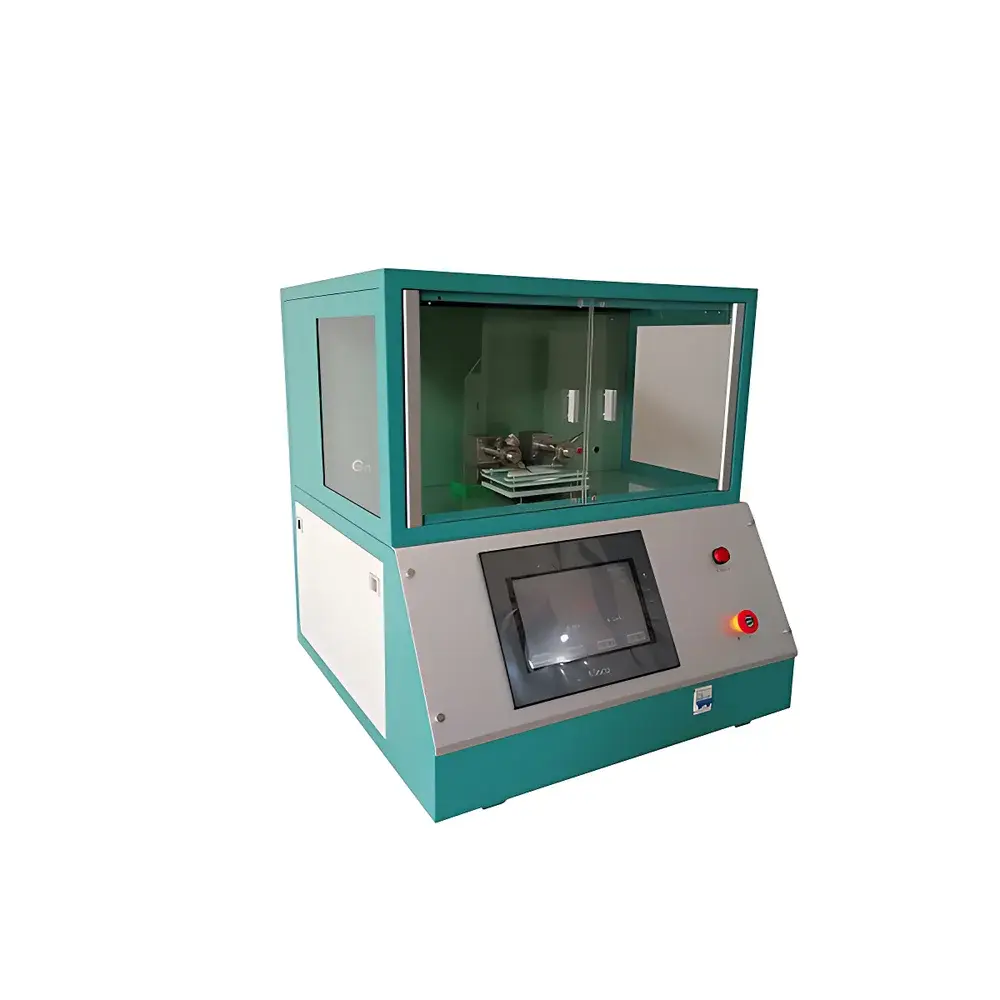
Zhonghang Shidai ZLD-600V Comparative and Proof Tracking Index Tester
| Brand | Zhonghang Shidai |
|---|---|
| Origin | Beijing, China |
| Manufacturer Type | OEM Manufacturer |
| Product Origin | Domestic (China) |
| Model | ZLD-600V |
| Price Range | USD 2,100 – 5,600 |
Overview
The Zhonghang Shidai ZLD-600V Comparative and Proof Tracking Index Tester is a precision-engineered instrument designed to evaluate the electrical tracking resistance of solid insulating materials under humid and contaminated conditions. It operates in strict compliance with internationally harmonized standards—including GB/T 4207–2012 (identical to IEC 60112), ASTM D3638, DIN 53480, and UL 746A—enabling standardized determination of both Comparative Tracking Index (CTI) and Proof Tracking Index (PTI). The instrument applies an AC voltage (25–600 V) across two platinum electrodes mounted on a test specimen surface while delivering calibrated droplets of ammonium chloride (NH₄Cl) solution (resistivity: 395 ± 5 Ω·cm) at controlled intervals. Electrical tracking—defined as the progressive formation of conductive carbonized paths due to localized surface discharges—is quantified by observing failure criteria: either 50 or 100 drops, or sustained leakage current ≥ 0.5 A for ≥ 2 s. This method provides objective, reproducible data essential for material qualification in electrical enclosures, connectors, PCB substrates, and high-voltage polymer components.
Key Features
- Integrated PLC + industrial-grade touch HMI control system enabling full parameterization of voltage, drop count, interval timing, and overcurrent protection thresholds.
- German-sourced precision pulse metering pump for highly stable, adjustable droplet volume (20.0–23.0 mm³ per drop), with <±1% repeatability and sealed reservoir design ensuring electrolyte concentration stability.
- Chemically inert PTFE-based fluid path components—including drip nozzles, tubing, and valve bodies—eliminating corrosion-induced drift and extending service life beyond stainless-steel alternatives.
- Adjustable electrode assembly featuring 99.95% pure platinum electrodes (2 mm × 5 mm, 30° beveled edge), 4.0 ± 0.1 mm inter-electrode spacing, and calibrated contact force (1.0 ± 0.05 N) via counterweight mechanism.
- Compact monolithic architecture integrating control cabinet and test chamber; stainless-steel structural frame with anti-corrosion finish and transparent acrylic viewing window for real-time observation.
- Dedicated exhaust duct integrated into the test chamber to evacuate ozone, NOₓ, and other decomposition byproducts—ensuring operator safety and long-term hardware integrity.
Sample Compatibility & Compliance
The ZLD-600V supports standardized testing of thermoplastics, thermosets, laminates, cast resins, elastomers, and composite insulators used in consumer electronics, automotive EV power modules, industrial switchgear, and aerospace wiring systems. Specimens must conform to dimensional requirements specified in IEC 60112: minimum 15 mm × 15 mm × 3 mm (or stacked to equivalent thickness), flat and free of surface contaminants. All operational parameters—including ambient temperature (23 ± 2 °C), relative humidity (50 ± 5 % RH), and airflow (< 0.2 m/s near sample surface)—are aligned with GLP-aligned laboratory practices. The instrument satisfies traceability requirements under ISO/IEC 17025 and supports audit-ready documentation for FDA 21 CFR Part 11–compliant environments when paired with validated software configurations.
Software & Data Management
The embedded HMI interface provides real-time monitoring of voltage, current, elapsed time, drop count, and system status (e.g., door interlock, zero-position, overcurrent flag). All test sequences are logged with timestamps, parameter sets, and pass/fail outcomes in non-volatile memory. Exportable CSV reports include raw voltage/current waveforms, drop timing deviations, and event-triggered termination records. Calibration functions support independent verification of voltage (AC), current (0.5 A / 1 A), and droplet volume using external certified instruments. Voltage and current scaling factors (K-values) are user-adjustable to compensate for transducer tolerances—ensuring metrological traceability without requiring firmware updates. Audit trails record all parameter modifications, calibration events, and emergency stop activations.
Applications
This tester is routinely deployed in R&D labs and QC departments to support material selection for UL recognition (UL 746A), IEC 60695 fire safety certification, and automotive OEM specifications (e.g., VW 80000, GMW 3172). Typical use cases include comparative evaluation of halogen-free flame-retardant polyamides versus brominated epoxy laminates; validation of silicone rubber gasket performance in outdoor photovoltaic junction boxes; qualification of bio-based polyesters for medical device housings; and root-cause analysis of field failures in molded insulation parts exposed to coastal humidity and salt spray. PTI/CTI data directly inform creepage and clearance calculations per IEC 60664–1 and IPC-2221B.
FAQ
What is the difference between CTI and PTI?
CTI (Comparative Tracking Index) identifies the highest voltage at which a material withstands 50 drops without tracking—determined iteratively across multiple specimens. PTI (Proof Tracking Index) verifies whether a material passes or fails at a single, pre-specified voltage (e.g., PTI 600 = passes at 600 V, 50 drops). CTI values are comparative; PTI values are pass/fail conformance metrics.
Can the ZLD-600V test non-standard electrolytes?
Yes—the system accepts any aqueous solution compatible with PTFE wetted parts. Standard Solution A (NH₄Cl, ρ = 395 ± 5 Ω·cm) is default; Solution B (with sodium alkylnaphthalene sulfonate) may be used for modified testing (reported as CTIxxxM per IEC 60112 Annex B).
How is electrode alignment verified?
A certified 4.0 ± 0.1 mm gauge block is supplied for inter-electrode spacing verification. Contact force is measured using a calibrated digital force gauge prior to each test series, per Clause 8.2 of GB/T 4207–2012.
Is remote operation supported?
The unit features RS-485 Modbus RTU output for integration into centralized lab automation systems. Ethernet or Wi-Fi connectivity requires optional third-party gateway hardware and custom SCADA configuration.
What maintenance intervals are recommended?
Daily: Clean electrodes with isopropyl alcohol; inspect drip nozzle for clogging. Weekly: Verify pump calibration using gravimetric drop measurement. Annually: Full electrical safety inspection (dielectric strength, grounding continuity) and recalibration against NIST-traceable references.
Related Products





