
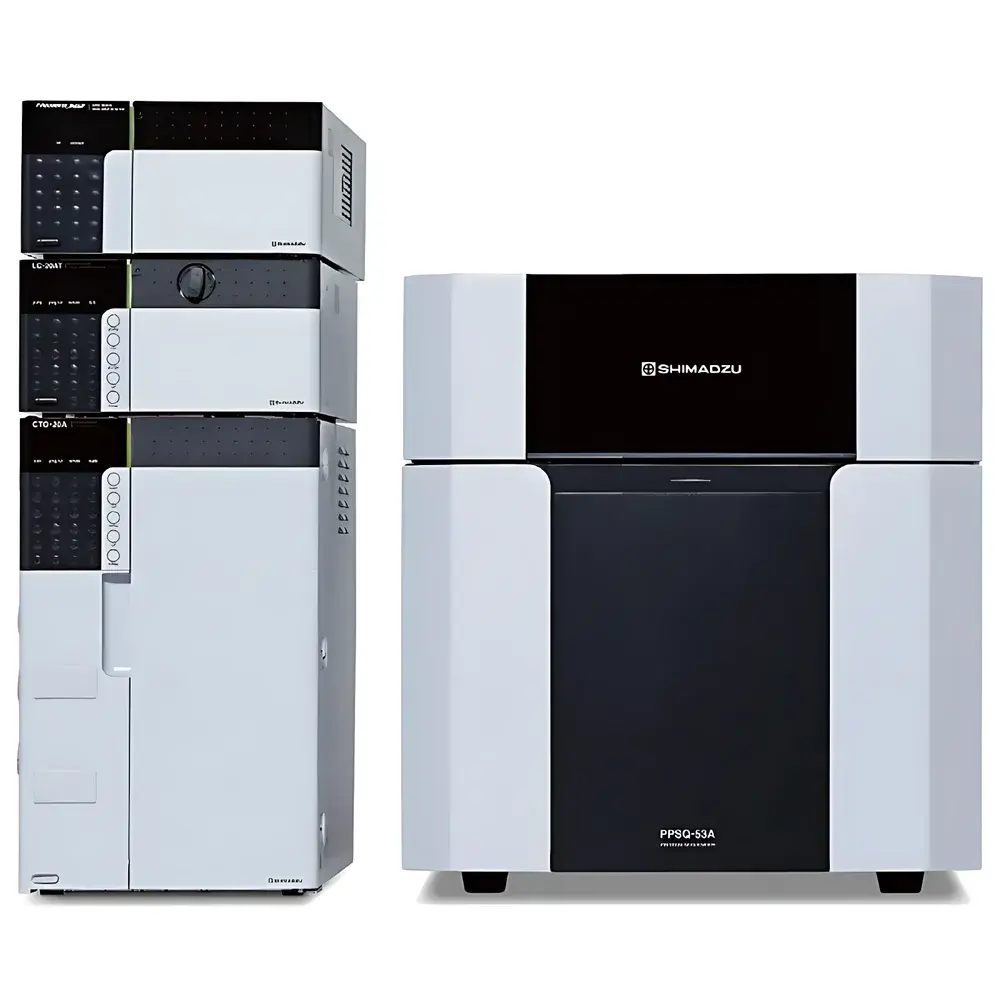
Shimadzu PPSQ-51A/53A Protein Sequencer
| Brand | Shimadzu |
|---|---|
| Origin | Japan |
| Manufacturer Type | Original Equipment Manufacturer (OEM) |
| Product Origin | Imported |
| Model | PPSQ-51A / PPSQ-53A |
| Pricing | Available Upon Request |
Overview
The Shimadzu PPSQ-51A and PPSQ-53A Protein Sequencers are automated Edman degradation-based analytical systems engineered for high-fidelity N-terminal amino acid sequencing of purified proteins and peptides. These instruments implement gas-phase or liquid-phase Edman chemistry—depending on configuration—to cleave and identify one residue per cycle, delivering unambiguous sequential data critical for structural validation, post-translational modification (PTM) mapping, and biopharmaceutical characterization. The PPSQ-51A employs a single-reaction chamber architecture optimized for routine sequencing workflows, while the PPSQ-53A integrates three parallel reaction cells to enable concurrent analysis of multiple samples or replicate runs—enhancing throughput without compromising cycle-to-cycle reproducibility. Both models utilize Shimadzu’s SPD-M30A photodiode array (PDA) detector with a newly designed capillary flow cell, achieving 10× higher detection sensitivity than legacy standard flow cells. This improvement directly extends reliable sequence read lengths beyond 40–50 residues under optimized conditions and improves signal-to-noise ratios for low-abundance or modified analytes.
Key Features
- Edman degradation platform with programmable reaction timing, coupling efficiency monitoring, and real-time cleavage verification via PTH-amino acid detection.
- Dual operational modes: isocratic elution for PTH-amino acid separation—ensuring retention time stability across cycles and enabling chromatographic subtraction to resolve overlapping peaks.
- Integrated HPLC module with gradient/isocratic pump control, autosampler, column oven, and PDA detection—all synchronized within a single instrument chassis.
- Reduced solvent consumption through isocratic elution and mobile phase recycling capability, lowering operational costs and environmental impact in compliance with green lab initiatives.
- Modular hardware design supports field-upgradability: existing PPSQ-31A, PPSQ-33A, PPSQ-51B, and PPSQ-53B users may retrofit detectors, flow cells, and control electronics to match PPSQ-51A/53A performance specifications.
Sample Compatibility & Compliance
The PPSQ-51A/53A accommodates a broad range of sample types—including reduced and alkylated proteins, enzymatically digested peptides, and synthetic oligopeptides—with minimum loading requirements as low as 1–5 pmol per run (dependent on purity and derivatization efficiency). Sample introduction is compatible with standard microcentrifuge tubes and pre-packed reaction cartridges. All hardware and firmware comply with ISO 9001 quality management standards. Software operation adheres to FDA 21 CFR Part 11 requirements for electronic records and signatures, including role-based user authentication, secure audit trails, electronic signature capture, and immutable data archiving. System validation documentation supports GLP and GMP environments, and method templates are configurable to meet ICH Q5E, USP , and ASTM E2577 guidelines for protein characterization.
Software & Data Management
PPSQ Software v5.x provides a unified interface for instrument control, real-time chromatogram visualization, and post-run sequence interpretation. It includes native support for chromatographic subtraction, overlay of multiple runs, baseline correction, peak integration with customizable thresholds, and automated amino acid assignment based on retention time libraries calibrated against PTH-standard mixtures. Sequence estimation algorithms incorporate cycle-specific yield correction and ambiguity flagging for low-intensity or co-eluting residues. Reporting modules generate PDF and CSV outputs compliant with internal SOPs or regulatory submissions, featuring customizable headers, metadata embedding (e.g., operator ID, timestamp, instrument serial number), and traceable revision history. Both Standard Edition (local database) and Client-Server Edition (SQL-based central repository) are available, with full Part 11 compliance enabled via optional license activation.
Applications
- Primary structure confirmation of recombinant therapeutic proteins (e.g., monoclonal antibodies, fusion proteins).
- Identification of N-terminal heterogeneity, truncations, or cyclization events in biologics manufacturing.
- Verification of cloning fidelity and expression vector integrity during upstream development.
- Characterization of proteolytic processing sites in endogenous or disease-associated proteins.
- Supporting orthogonal methods in multi-attribute monitoring (MAM) strategies for quality-by-design (QbD) frameworks.
FAQ
What is the maximum reliable sequence read length achievable with the PPSQ-51A/53A?
Under optimal sample purity and coupling conditions, consistent identification of 45–55 consecutive residues is routinely observed; extended reads beyond 60 cycles require rigorous optimization of coupling chemistry and sample handling.
Can the PPSQ-51A/53A detect post-translational modifications (PTMs)?
Yes—through deviations in PTH-amino acid retention time, peak shape, or mass shift (when coupled with optional LC-MS verification); common PTMs such as acetylation, pyroglutamation, and oxidation can be inferred or confirmed.
Is method transfer supported from legacy PPSQ models?
Yes—chromatographic methods, calibration tables, and sequence interpretation rules are backward-compatible; upgrade packages include migration utilities and validation protocols.
Does the system support 21 CFR Part 11 compliance out-of-the-box?
Compliance features are embedded in firmware and software; however, full implementation requires site-specific configuration of user roles, electronic signature policies, and audit trail retention settings per organizational SOPs.
What maintenance intervals are recommended for the reaction module and HPLC components?
Reaction chamber cleaning is advised after every 10–15 runs; PDA flow cell inspection and column equilibration checks are recommended weekly; annual preventive maintenance by Shimadzu-certified engineers ensures long-term precision and regulatory readiness.






