
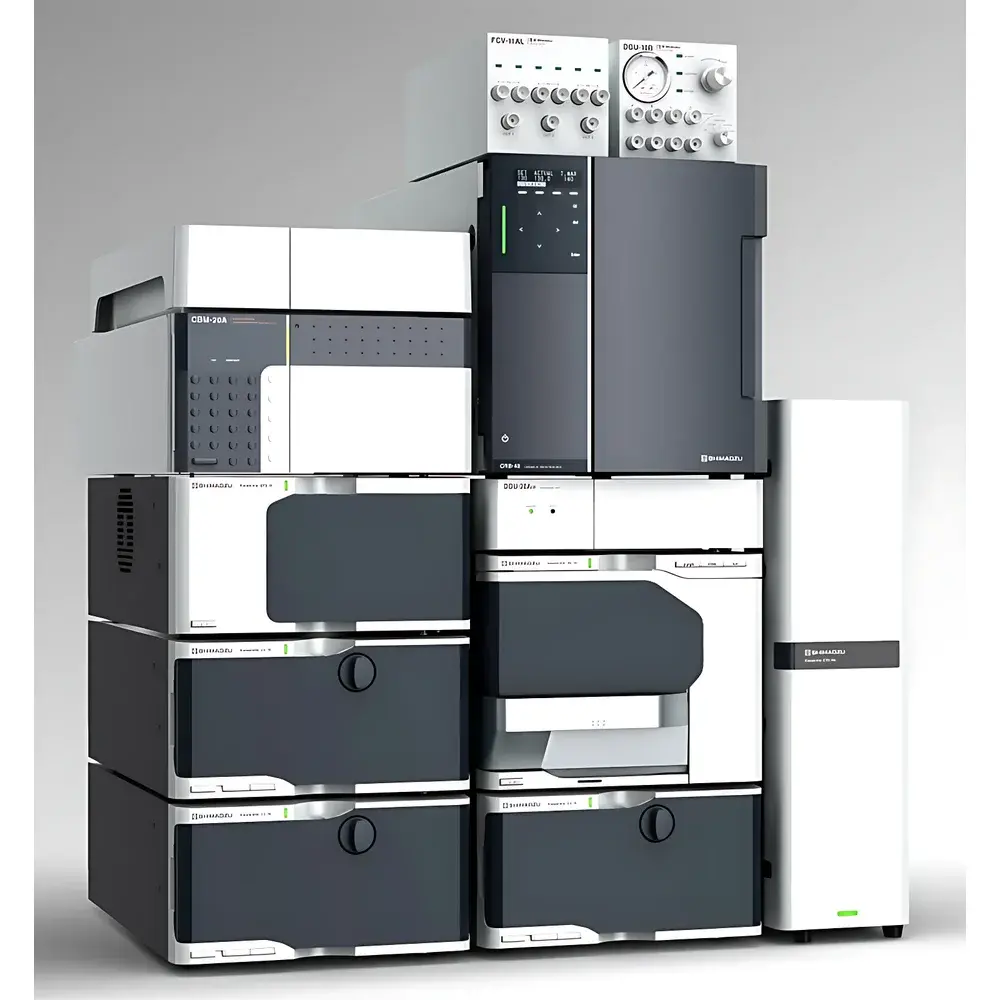
Shimadzu Essentia LC-16AAA Amino Acid Analyzer
| Brand | Shimadzu |
|---|---|
| Origin | Jiangsu, China |
| Manufacturer Type | Original Equipment Manufacturer (OEM) |
| Product Origin | Domestic (China) |
| Model | Essentia LC-16AAA |
| Instrument Type | Post-Column Derivatization System |
| Pump Flow Rate | 0.001–10.00 mL/min |
| Maximum Pump Pressure | 40 MPa |
| Autosampler Injection Volume | 0.1–100 µL |
| Autosampler Temperature Control | Ambient |
| Post-Column Reactor Temperature Range | (Ambient + 10 °C) to 150 °C |
| Detection Wavelengths | 570 nm and 440 nm (full range: 190–700 nm) |
| Flow Cell Volume | 8 µL |
Overview
The Shimadzu Essentia LC-16AAA Amino Acid Analyzer is a dedicated high-performance liquid chromatography (HPLC) system engineered for the precise separation, identification, and quantification of proteinogenic and non-proteinogenic amino acids in complex biological, food, and pharmaceutical matrices. It operates on the well-established cation-exchange chromatographic principle, coupled with post-column derivatization using ninhydrin reagent and dual-wavelength photometric detection. This configuration ensures high selectivity for α-amino acids and primary/secondary amines, delivering robust resolution under standardized regulatory conditions. The system integrates seamlessly with Shimadzu’s Essentia LC-16 platform—featuring a low-pulsation quaternary gradient pump, high-precision autosampler, and thermally stabilized column compartment—while incorporating purpose-built modules including the CRB-40 chemical reaction block, intelligent valve switching unit, and nitrogen sparging module to optimize derivatization kinetics, minimize carryover, and enhance baseline stability.
Key Features
- Optimized post-column derivatization architecture: CRB-40 reactor enables precise temperature control (±0.1 °C) across a wide operational range (ambient +10 °C to 150 °C), ensuring consistent ninhydrin–amino acid condensation kinetics and reproducible chromophore formation.
- High-resolution cation-exchange separation: Capable of resolving ≥17 standard amino acids with resolution (Rs) >1.2 under validated gradient methods compliant with GB 5009.124–2016 and AOAC Official Method 994.12.
- Exceptional retention time stability: Arginine retention time repeatability <0.01% RSD (n=6), meeting and exceeding requirements specified in JJG 1064–2011 Verification Regulation for Amino Acid Analyzers.
- Full-system automation: Integrated valve sequencing, nitrogen-assisted reactor purging, and timed derivatization reagent delivery eliminate manual intervention during method execution.
- Robust fluidic design: 40 MPa maximum pressure tolerance supports use of sub-3 µm particle-packed cation-exchange columns for accelerated analysis; total cycle time—including equilibration—is ≤45 minutes.
Sample Compatibility & Compliance
The LC-16AAA accommodates hydrolyzed protein samples (e.g., acid- or enzymatic-digested tissues, dairy, soy, and cereal extracts), physiological fluids (plasma, urine), and purified peptide fractions. Sample preparation follows standardized protocols per GB 5009.124–2016, USP , and ISO 13903:2005. The system supports GLP-compliant operation through audit-trail-enabled software, electronic signature capability, and instrument parameter locking. All critical analytical parameters—including flow rate, gradient profile, reactor temperature, and detection wavelength—are fully traceable and exportable in CSV or PDF formats for regulatory submission.
Software & Data Management
Chromatographic acquisition and quantitative analysis are managed via Shimadzu LabSolutions LC software (v5.9 or later), configured with pre-validated amino acid analysis workflows. The interface provides drag-and-drop method building, real-time peak tracking, automated calibration curve generation (linear, quadratic, or weighted), and direct calculation of mass percentage or concentration relative to internal standards (e.g., norleucine or α-aminobutyric acid). Raw data files (.lcd) are stored with full metadata (instrument ID, operator, timestamp, sequence log), supporting 21 CFR Part 11 compliance when deployed with network authentication and role-based access control.
Applications
- Food safety and nutrition labeling: Quantitative profiling of essential amino acids in infant formula, dairy products (milk, whey), eggs, fermented sauces (soy sauce, fish sauce), and plant-based proteins.
- Pharmaceutical quality control: Assay of amino acid composition in parenteral nutrition formulations, peptide APIs, and hydrolyzed gelatin excipients.
- Clinical research: Monitoring plasma/urine amino acid patterns in inborn errors of metabolism (e.g., phenylketonuria, maple syrup urine disease).
- Biotechnology: Verification of amino acid yield in microbial fermentation broths and cell culture media optimization studies.
- Academic research: Method development for novel amino acid analogs, D-amino acid detection (with chiral derivatization adaptation), and redox-sensitive amino acid quantification (e.g., cysteine/cystine ratio).
FAQ
What derivatization chemistry does the LC-16AAA employ?
Ninhydrin-based post-column derivatization at elevated temperature (typically 130–140 °C), producing purple (Ruhemann’s purple, λmax = 570 nm) and yellow (λmax = 440 nm) chromophores for primary and secondary amines respectively.
Is the system compatible with o-phthalaldehyde (OPA) or fluorenylmethyloxycarbonyl chloride (FMOC) pre-column derivatization?
No—the LC-16AAA is purpose-built for ninhydrin post-column chemistry and does not support pre-column derivatization workflows; alternative Shimadzu HPLC systems (e.g., Nexera X2 with fluorescence detection) are recommended for OPA/FMOC applications.
Can the system be validated per ICH Q2(R2) guidelines?
Yes—method validation parameters (specificity, linearity, accuracy, precision, LOD/LOQ, robustness) can be fully assessed using built-in software tools and documented in accordance with ICH Q2(R2) and ISO/IEC 17025 requirements.
What maintenance intervals are recommended for the CRB-40 reactor and reagent lines?
Reactor tubing should be inspected weekly; reagent lines require flushing with deionized water after each batch and replacement every 6 months under continuous operation; detailed PM schedules are provided in the Instrument Maintenance Manual (IMM-LC16AAA-EN).





