
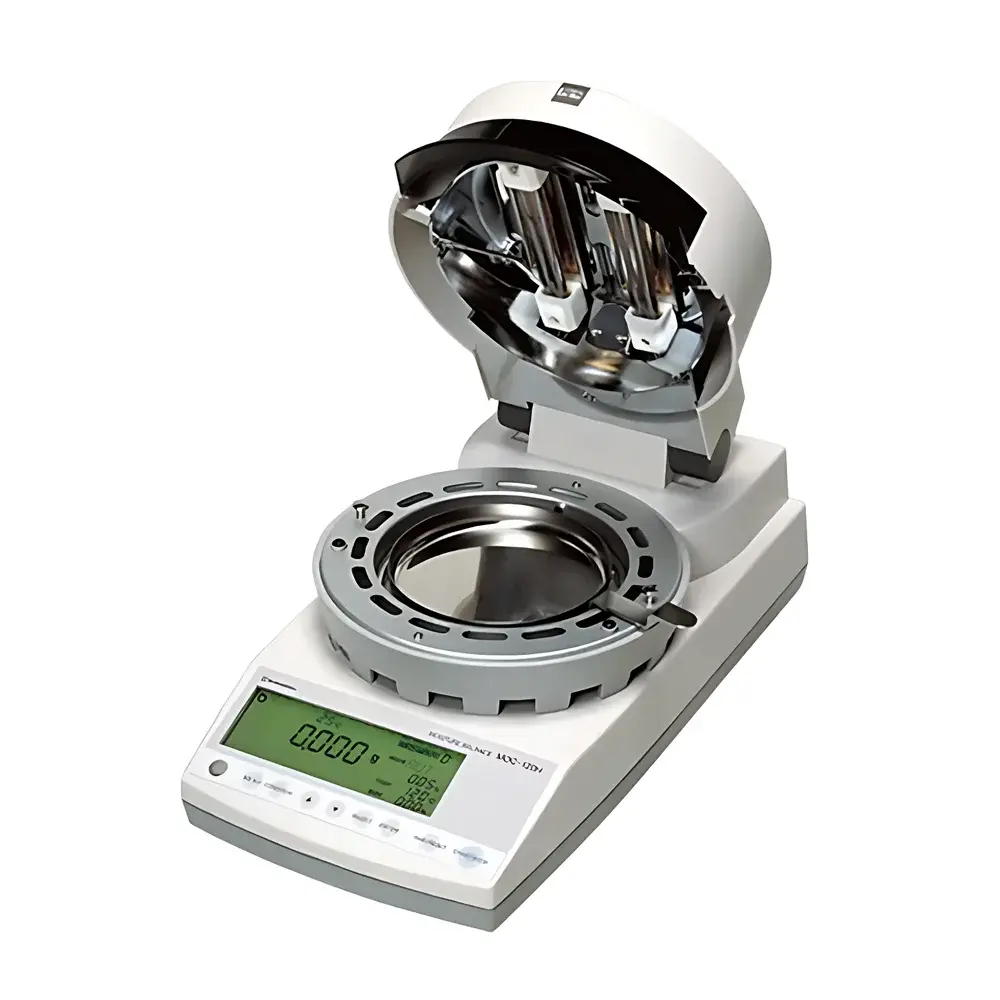
Shimadzu MOC-120H Infrared Moisture Analyzer
| Brand | Shimadzu |
|---|---|
| Origin | Japan |
| Manufacturer Type | Original Equipment Manufacturer (OEM) |
| Product Category | Imported Instrument |
| Model | MOC-120H |
| Price Range | USD 1,400 – 4,200 |
Overview
The Shimadzu MOC-120H Infrared Moisture Analyzer is a high-precision, thermogravimetric moisture determination system engineered for laboratory and quality control environments requiring rapid, repeatable, and traceable water content analysis. It operates on the principle of infrared drying coupled with real-time mass loss monitoring—measuring moisture content by quantifying the weight difference before and after controlled thermal dehydration. Unlike conventional halogen-based analyzers, the MOC-120H employs a proprietary medium-wave infrared (MWIR) quartz heating element, delivering uniform radiant energy absorption across diverse sample matrices while minimizing surface charring or thermal degradation. Its core innovation lies in the Unibloc monolithic sensor module—a fully integrated load cell, temperature sensor, and heater assembly designed by Shimadzu to eliminate mechanical drift and thermal coupling errors common in multi-component sensor architectures. This architecture ensures long-term stability and measurement reproducibility under ambient temperature fluctuations (±0.5 °C), making it suitable for regulated environments where environmental variability cannot be tightly controlled.
Key Features
- Unibloc monolithic sensor module: Integrated weighing cell, IR heater, and temperature sensor in a single rigid structure—eliminates thermal expansion-induced zero drift and improves long-term calibration stability.
- Medium-wave infrared (MWIR) quartz heating system: Optimized spectral output (peak ~2.5–3.5 µm) for efficient absorption by O–H and H–O–H vibrational modes; rated operational lifetime of 20,000–30,000 hours.
- Programmable drying protocols: Supports Auto-Stop (based on mass change rate threshold), Time-Stop, and multi-stage drying profiles—including Standard, Rapid, Slow, and Stepwise modes—to accommodate hygroscopic, thermally sensitive, or heterogeneous samples.
- Real-time analog bar graph display: Visualizes mass loss kinetics during drying, enabling immediate assessment of drying progress and empirical endpoint prediction.
- Windows Direct Interface (WDI): Native COM-port communication protocol allowing seamless data streaming into Microsoft Excel, LabVIEW, or LIMS without third-party drivers—supports automated timestamped logging and formula-based post-processing.
- Auto-Tare function: Concurrent zero-point compensation and sample weighing—ensures accuracy during extended operation or repeated batch measurements without manual intervention.
- Bias correction utility: Allows user-defined offset adjustment to harmonize results with reference methods (e.g., Karl Fischer titration, ASTM D6304, or USP <921>) via stored correction factors applied in real time.
- Backlit LCD display (128 × 64 pixels): High-contrast graphical interface operable under low-light conditions; displays current mass, moisture %, dry residue %, time elapsed, and active drying mode.
Sample Compatibility & Compliance
The MOC-120H accommodates solid, semi-solid, and powdered samples with initial mass ranging from 0.001 g to 120 g (depending on pan geometry and density). It complies with key international standards governing moisture analysis methodology, including ISO 12099:2017 (Animal feeding stuffs — Determination of moisture content), AOAC Official Method 950.46 (Moisture in Feed), and ASTM D4457 (Standard Test Method for Determination of Dichloromethane and Trichloroethylene in Paints and Coatings by Direct Injection into a Gas Chromatograph). While not inherently 21 CFR Part 11 compliant out-of-the-box, its WDI interface supports integration with validated electronic lab notebook (ELN) or LIMS platforms that provide audit trail, electronic signature, and data integrity controls required under GLP and GMP frameworks.
Software & Data Management
Data acquisition and reporting are managed through Shimadzu’s dedicated PC software (optional), which enables method storage, result export in CSV/Excel formats, statistical summary (mean, SD, RSD), and customizable report templates. All raw mass-vs.-time datasets are timestamped and retain full metadata (operator ID, method name, calibration date, ambient humidity/temperature if logged externally). When used with Windows Direct Interface, users retain full control over data handling—enabling direct embedding of live values into Excel worksheets for dynamic calculation of moisture loss rate (mg/min), residual solvent equivalence, or batch release criteria compliance.
Applications
The MOC-120H is routinely deployed in pharmaceutical QC labs for excipient moisture verification per ICH Q5C guidelines; in food manufacturing for shelf-life modeling and HACCP critical limit validation; in polymer processing for resin drying validation prior to extrusion; and in academic research for kinetic studies of desorption isotherms (e.g., BET-type analysis). Its robustness and repeatability make it especially valuable for routine testing of herbal powders, dairy powders, catalyst supports, and lithium battery electrode materials—where consistent thermal exposure and minimal sample oxidation are critical.
FAQ
What is the minimum sample weight the MOC-120H can accurately measure?
The instrument achieves reliable resolution down to 0.001 g (1 mg) under standard operating conditions with proper draft shield use and stabilized ambient temperature.
Does the MOC-120H require annual recalibration?
While internal self-diagnostics verify sensor linearity daily, Shimadzu recommends external calibration using certified weights at least every 6 months—or per internal SOP—especially when used in regulated environments.
Can the MOC-120H be connected to a networked LIMS?
Yes, via RS-232 or USB-to-serial adapter, using Shimadzu’s ASCII command protocol or third-party middleware supporting Modbus RTU or HL7-compliant wrappers.
Is the MWIR heating system compatible with volatile organic compounds (VOCs)?
It is suitable for low-boiling solvents (e.g., ethanol, acetone) when operated below their flash points and within closed-draft-shield configurations—but not recommended for highly flammable or reactive vapors without additional safety interlocks.
How does the bias correction function align with Karl Fischer results?
Users input a correction factor derived from parallel testing (e.g., slope from linear regression of MOC-120H vs. KF data); the analyzer applies this multiplicatively to all subsequent % moisture outputs in real time.





