
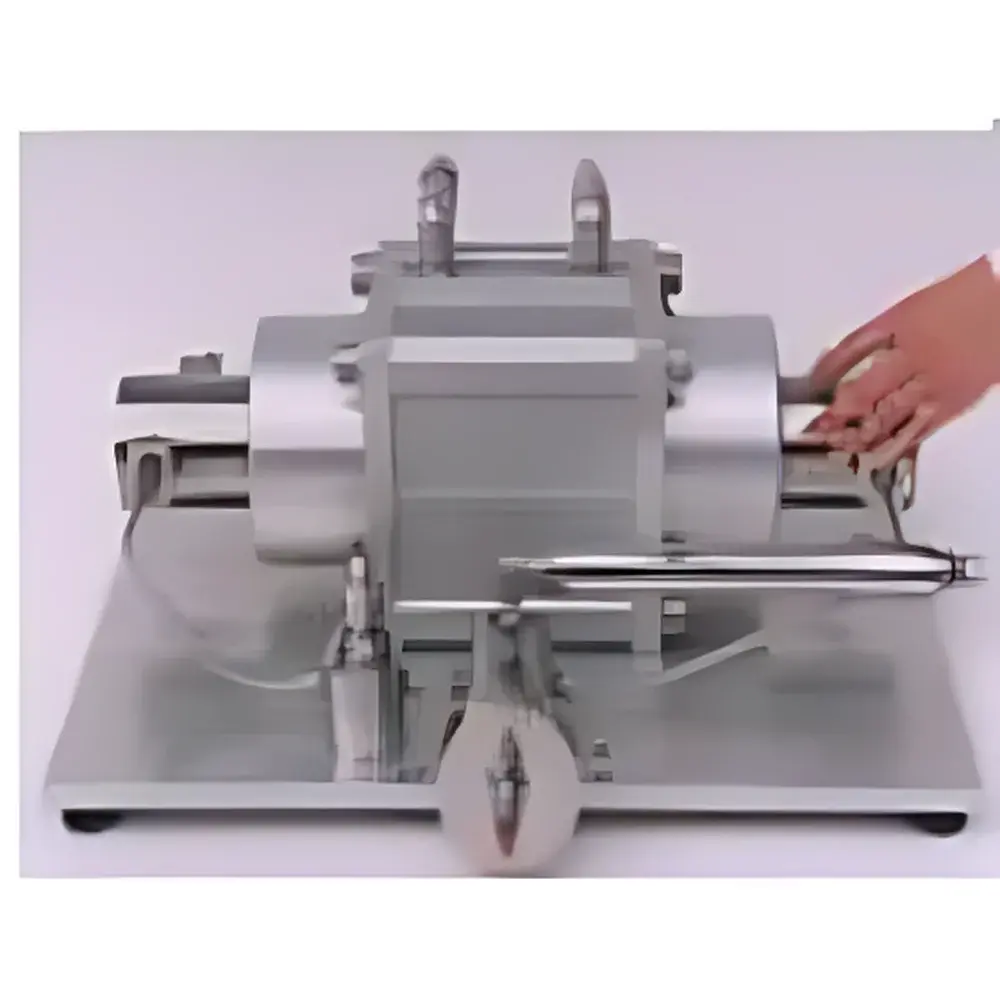
Avestin EmulsiFlex-D20 High-Pressure Homogenizer
| Brand | Avestin |
|---|---|
| Origin | Canada |
| Manufacturer | Avestin Inc., Ottawa, Canada |
| Model | EmulsiFlex-D20 |
| Instrument Type | High-Pressure Homogenizer |
| Operating Pressure | 35,000 psi (2,413 bar), typical working pressure up to 30,000 psi (2,070 bar) |
| Flow Rate | 20 L/h |
| Minimum Sample Volume | 50 mL |
| Residual Volume | < 1 mL |
| Drive System | Electric single-plunger pump |
| Dimensions | 730 × 600 × 640 mm |
| Weight | 120 kg |
| Power Supply | 3-phase, 50/60 Hz, 230/400 V |
| Safety Features | Automatic circuit cutoff, transient overpressure tolerance up to +20% |
| Construction Material | 316L stainless steel (entire fluid path) |
| Compliance | GMP-compliant design, FDA-compliant materials per 21 CFR Part 11 and USP <1058>, zero elastomeric seals in product-contact zones |
| Optional Accessories | Sterile filtration extruder, integrated heat exchanger |
Overview
The Avestin EmulsiFlex-D20 is a high-precision, industrial-grade high-pressure homogenizer engineered for reproducible nano-scale particle size reduction and cell disruption under strictly controlled process conditions. Utilizing the principle of microfluidic cavitation and turbulent shear within a fixed-geometry interaction chamber, the EmulsiFlex-D20 subjects samples to controlled pressure-induced mechanical stress—enabling consistent lysis of microbial, mammalian, or plant cells, as well as the formation of sub-100 nm liposomes, nanoemulsions, and nanosuspensions. Its maximum rated pressure of 35,000 psi (2,413 bar), with sustained operational capability at 30,000 psi (2,070 bar), places it among the highest-performing laboratory-scale homogenizers available for GMP-aligned development workflows. Designed and assembled in Ottawa, Canada, the system meets stringent requirements for biopharmaceutical process development—including sterile processing, cleanability validation, and material traceability.
Key Features
- True GMP-compliant fluid path: Entire sample contact surface constructed from electropolished 316L stainless steel; no O-rings, gaskets, or polymer seals in the product zone—eliminating leachables and enabling full CIP/SIP compatibility.
- Ceramic-reinforced interaction chamber and valve seat: Engineered for extended service life under continuous high-pressure operation, minimizing maintenance intervals and batch-to-batch variability.
- Precision low-volume processing: Minimum sample requirement of 50 mL with residual volume < 1 mL—critical for early-stage formulation development using high-value APIs or clinical-grade excipients.
- Integrated safety architecture: Real-time pressure monitoring with automatic circuit cutoff; certified transient overpressure tolerance up to +20% for brief operational contingencies without compromising structural integrity.
- Modular expandability: Compatible with optional sterile-grade filtration extruders (0.1–0.45 µm) and thermostatically regulated heat exchangers for temperature-sensitive biologics processing.
Sample Compatibility & Compliance
The EmulsiFlex-D20 supports a broad range of biopharmaceutical and nutraceutical matrices—including bacterial and yeast lysates, mammalian cell suspensions, lipid dispersions, protein-based colloids, and viscous food emulsions. All wetted materials comply with FDA 21 CFR Part 11 requirements for electronic records and signatures, and are validated per USP Analytical Instrument Qualification protocols. The absence of elastomeric components in the fluid path satisfies ISO 13485:2016 and EU Annex 1 criteria for aseptic processing equipment. Equipment documentation includes full material certifications (EN 10204 3.1), surface roughness reports (Ra ≤ 0.4 µm), and cleaning validation support data.
Software & Data Management
While the EmulsiFlex-D20 operates via a dedicated industrial control panel with analog pressure feedback and digital flow monitoring, it is fully compatible with third-party SCADA and MES integration via 4–20 mA analog outputs and Modbus RTU communication. Process parameters—including pressure setpoint, actual pressure, total processed volume, and runtime—are logged with timestamped audit trails meeting ALCOA+ principles. When paired with optional Avestin-certified data acquisition modules, the system supports 21 CFR Part 11-compliant electronic signatures, role-based access control, and encrypted data export for regulatory submissions (e.g., IND, BLA, or MA dossier packages).
Applications
- Cell disruption for recombinant protein recovery (E. coli, Pichia, CHO)
- Liposome and lipid nanoparticle (LNP) formulation for mRNA delivery systems
- Nanosuspension preparation of BCS Class II/IV compounds
- Stable oil-in-water and water-in-oil nanoemulsions for topical or oral delivery
- Homogenization of vaccine adjuvants and virosomes
- Standardized particle size reduction in QC release testing per USP and Ph. Eur. 2.9.33
FAQ
What is the minimum sample volume required for method development?
The EmulsiFlex-D20 requires a minimum of 50 mL per run, with less than 1 mL retained in the system—ideal for feasibility studies with limited API supply.
Can the unit be sterilized in place (SIP)?
Yes—the entire fluid path supports direct steam sterilization at 121°C for 30 minutes, validated per ASME BPE-2022 and EU GMP Annex 1 guidelines.
Is the system compliant with FDA 21 CFR Part 11 for electronic records?
When equipped with Avestin’s optional data logger module, the system provides full Part 11 compliance including audit trail, electronic signatures, and secure user authentication.
What maintenance intervals are recommended for continuous operation?
Ceramic valve components require inspection every 500 hours of cumulative operation; pump plunger seals (non-product-contact) are replaced annually or after 2,000 hours—documentation included in the IQ/OQ/PQ package.
Does Avestin provide installation qualification (IQ) and operational qualification (OQ) support?
Yes—factory-authorized qualification protocols, executed by certified field service engineers, are available globally and aligned with ISO/IEC 17025-accredited laboratories.



