
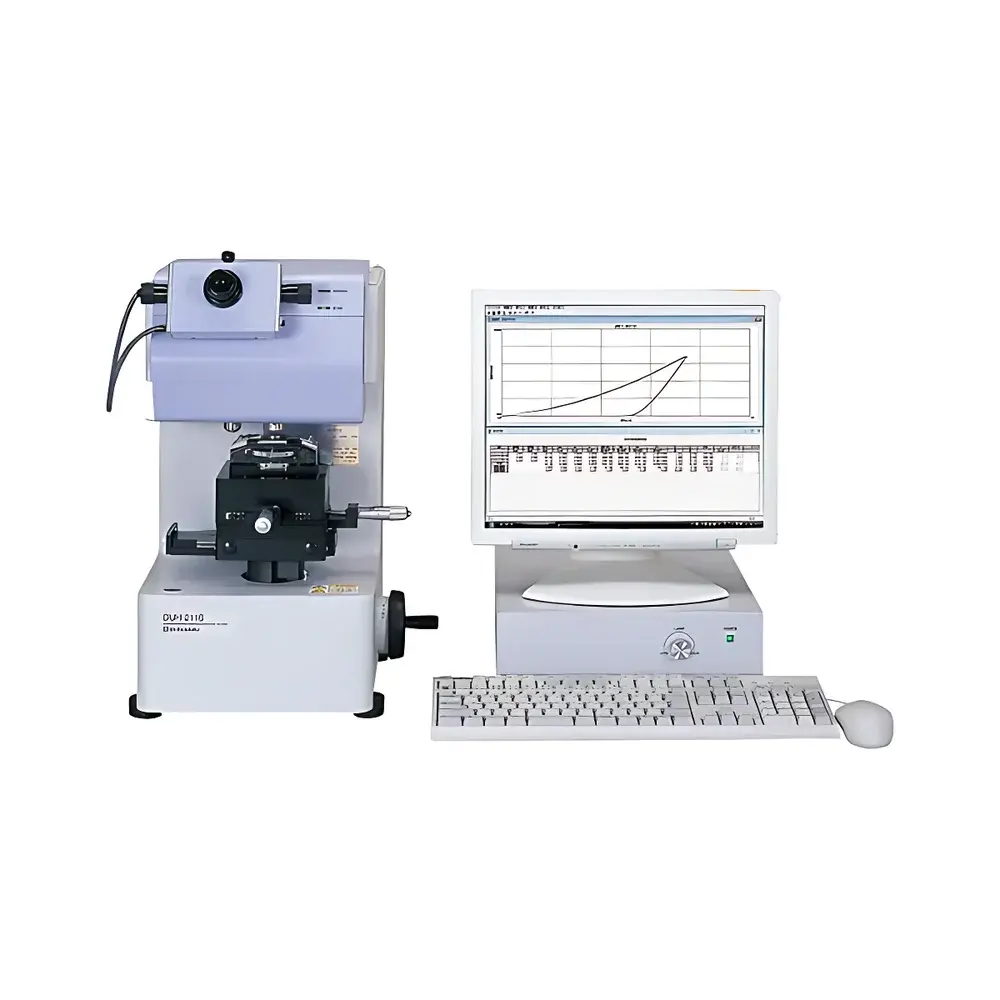
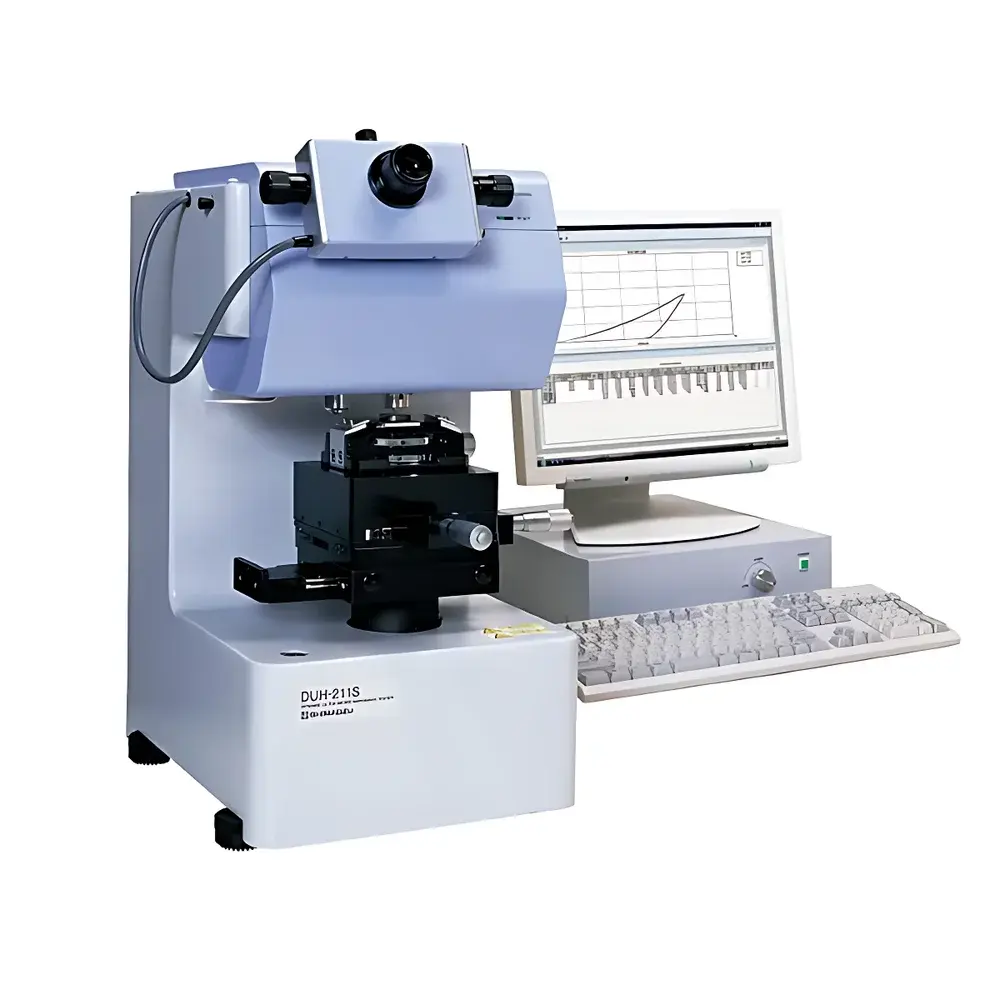
Shimadzu DUH-211/211S Dynamic Ultra-Micro Hardness Tester
| Brand | Shimadzu |
|---|---|
| Origin | Japan |
| Manufacturer | Shimadzu Corporation |
| Product Type | Imported Instrument |
| Model | DUH-211/211S |
| Instrument Category | Microhardness Tester |
| Force Range | 0.1–1961 mN |
| Maximum Test Load | 1961 mN |
| Force Resolution | 0.196 mN |
| Force Accuracy | ±1% of displayed value |
| Displacement Measurement Range | 0–10 µm |
| Displacement Resolution | 0.0001 µm |
| Indenter | 115° triangular pyramid (Berkovich-type) |
| Optical Magnification | ×500 (with ×50 objective lens) |
| Compliance Standard | ISO 14577-1 Annex A (Martens hardness & material parameter evaluation) |
Overview
The Shimadzu DUH-211/211S Dynamic Ultra-Micro Hardness Tester is a high-precision instrument engineered for depth-sensing indentation testing at micro- and sub-micron force levels. Based on the quasi-static and dynamic nanoindentation principle—where controlled electromagnetic actuation applies precisely regulated load while simultaneously measuring real-time displacement—the system enables quantitative evaluation of Martens hardness, elastic modulus, creep behavior, and plastic deformation parameters in accordance with ISO 14577-1 Annex A. Unlike conventional Vickers or Knoop testers relying solely on optical impression measurement, the DUH-211/211S integrates high-resolution capacitive displacement sensing (0.0001 µm resolution) and closed-loop electromagnetic force control to deliver reproducible mechanical property data from ultra-thin films, surface-modified layers, and brittle substrates where traditional indentation methods fail.
Key Features
- Electromagnetic loading mechanism ensuring fast response, minimal thermal drift, and high force stability across the full 0.1–1961 mN range
- Ultra-fine force resolution of 0.196 mN—enabling reliable characterization of nanoscale coatings such as ALD-grown oxides, PVD metallic interlayers, and atomic-layer-deposited barrier films
- Berkovich-type 115° triangular pyramid indenter optimized for depth-controlled indentation and compliant with ISO 14577 geometry requirements
- Real-time load–displacement curve acquisition with up to 10 kHz sampling rate for dynamic modulus and viscoelastic parameter extraction
- Multi-segment loading/unloading protocols—including constant strain-rate, hold-at-maximum-load, and cyclic indentation—for comprehensive mechanical profiling
- Integrated ×500 optical magnification system (×50 objective lens) with motorized stage and auto-focus support for rapid, repeatable positioning over heterogeneous sample surfaces
Sample Compatibility & Compliance
The DUH-211/211S is validated for use with a broad spectrum of advanced materials requiring non-destructive, localized mechanical assessment. These include vacuum-deposited thin films (e.g., TiN, SiO₂, DLC), semiconductor passivation layers (Si₃N₄, Al₂O₃), ion-implanted diffusion zones, thermally grown oxide scales, polymer thin films (<1 µm), elastomeric coatings, optical fibers, carbon fiber composites, and low-fracture-toughness ceramics and glasses. All test procedures adhere to ISO 14577-1 Annex A for Martens hardness calculation and material parameter derivation. The system supports traceable calibration via NIST-traceable reference standards and meets requirements for GLP-compliant laboratories through audit-ready test log generation and user-access-level permission controls.
Software & Data Management
Operation is managed via Shimadzu’s proprietary DUH Analysis Software, which provides intuitive workflow-driven test setup, real-time curve visualization, and automated post-processing for hardness, reduced modulus, contact stiffness, and time-dependent recovery metrics. Raw load–displacement datasets are stored in vendor-neutral ASCII format for third-party analysis (e.g., MATLAB, Python-based indentation modeling). The software supports 21 CFR Part 11 compliance features including electronic signatures, audit trails, and role-based access control—essential for regulated environments in semiconductor manufacturing QA, medical device coating validation, and pharmaceutical packaging R&D. Export functions include PDF reports with embedded metadata (operator ID, timestamp, environmental conditions, calibration status).
Applications
- Quantitative hardness mapping of wafer-scale ALD dielectric stacks in advanced logic node development
- Evaluation of interfacial adhesion strength and delamination thresholds in multilayer optical coatings
- Mechanical degradation monitoring of polymer electrolyte membranes under humidity cycling
- Creep resistance assessment of high-temperature ceramic matrix composites (CMCs)
- Correlation of indentation-derived elastic modulus with AFM-based nanomechanical mapping results
- Validation of surface hardening treatments (e.g., nitriding, carburizing) in aerospace-grade titanium alloys
FAQ
What distinguishes the DUH-211/211S from conventional Vickers microhardness testers?
Unlike optical impression-based systems, the DUH-211/211S employs continuous depth-sensing indentation with electromagnetic force control—providing direct access to elastic recovery, plastic work ratio, and time-dependent deformation behavior.
Can the system perform compression testing on micro-pillars or MEMS structures?
Yes—by equipping optional flat-punch compression fixtures and dedicated compression analysis modules, the DUH-211/211S supports uniaxial micro-compression down to ~1 µN load resolution.
Is ISO 14577-1 Annex A compliance verified by independent certification?
Shimadzu provides factory verification documentation aligned with ISO/IEC 17025-accredited calibration practices; end-user validation is supported via certified reference materials (e.g., fused silica, sapphire, and tungsten carbide standards).
How is thermal drift mitigated during long-duration hold tests?
The instrument incorporates active temperature stabilization of the load frame and dual-stage vibration isolation, achieving <0.02 nm/s thermal displacement drift under 60-second hold conditions.
Does the system support automated grid-based mapping?
Yes—integrated XYZ motorized stage with programmable pattern definition enables fully automated hardness and modulus mapping across areas up to 100 × 100 mm with positional repeatability of ±0.5 µm.



