
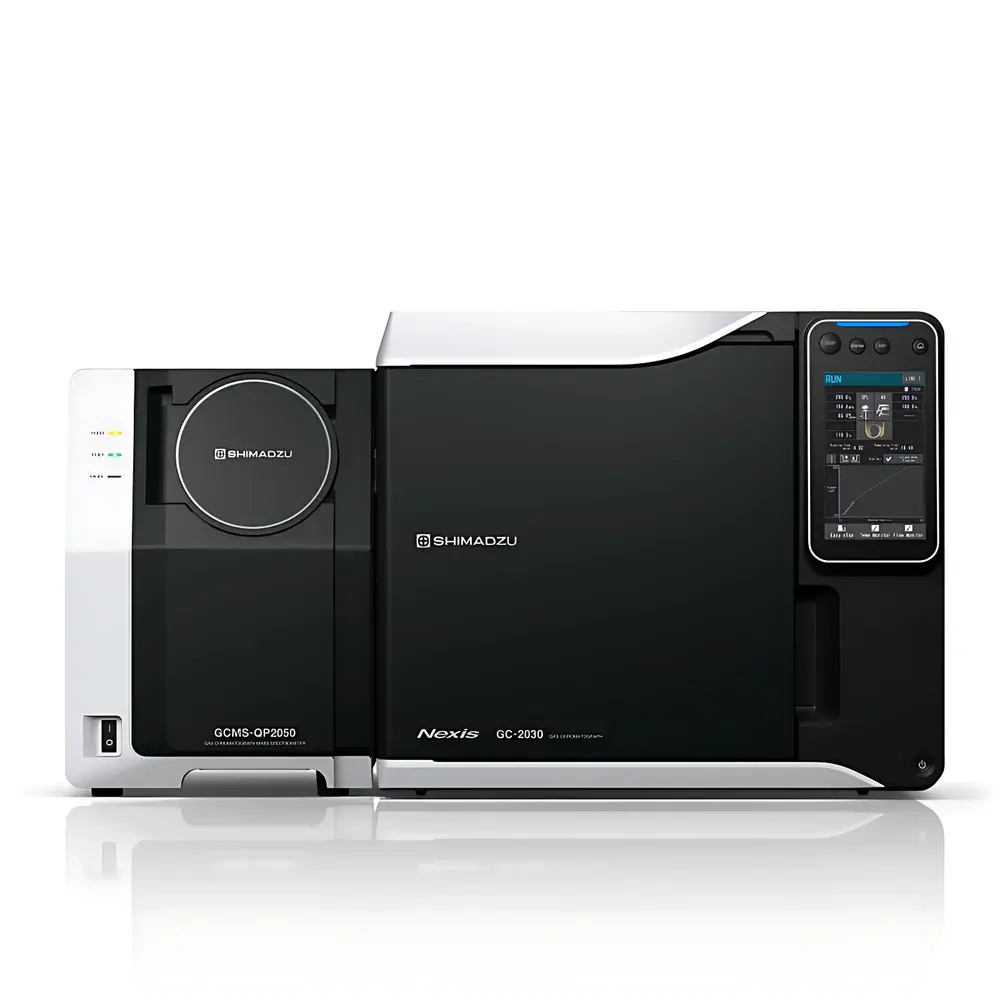
Shimadzu GCMS-QP2050 Single Quadrupole Gas Chromatography Mass Spectrometer
| Brand | Shimadzu |
|---|---|
| Origin | Japan |
| Manufacturer | Shimadzu Corporation |
| Instrument Type | Single Quadrupole GC-MS |
| GC Configuration | Conventional Capillary GC-MS |
| Mass Range | 1.5–1090 u |
| Resolution | Unit Mass Resolution |
| Scan Speed | 30,000 u/sec |
Overview
The Shimadzu GCMS-QP2050 is a high-performance single quadrupole gas chromatography mass spectrometer engineered for robustness, operational simplicity, and analytical reliability in regulated and research laboratory environments. It operates on the fundamental principle of electron ionization (EI) coupled with quadrupole mass filtering, where volatile and semi-volatile organic compounds are separated by capillary gas chromatography and subsequently ionized, mass-filtered, and detected in real time. Designed to meet evolving demands in environmental monitoring, food safety, forensic toxicology, and pharmaceutical impurity profiling, the GCMS-QP2050 integrates hardware innovations—including a low-contamination ion optics architecture and advanced scan-speed control—with intelligent software workflows to deliver reproducible qualitative and quantitative results across diverse sample matrices.
Key Features
- DuraEase Inert Ion Source: A redesigned, temperature-optimized EI source minimizing active surface area and thermal gradients to enhance sensitivity for labile and adsorptive analytes while extending service intervals.
- Pre-Quadrupole Integrated Quadrupole Mass Filter: Built-in pre-filter reduces neutral and photon-induced background noise, suppresses contamination accumulation on the main quadrupole rods, and eliminates the need for routine heating-based cleaning—enabling true maintenance-free quadrupole operation.
- Extended-Life Filament: Proprietary filament design delivers up to five times longer operational lifetime compared to standard tungsten filaments, reducing downtime and consumables cost in high-throughput labs.
- 1-Minute Ion Source Exchange: Tool-free, modular ion source assembly allows full replacement without breaking vacuum or recalibrating the mass spectrometer.
- ClickTek™ Smart-Lock Inlet: One-touch inlet access enables rapid septum and liner replacement without tools—fully compatible with Shimadzu’s Easy sTop™ protocol for maintenance under vacuum.
- Integrated Touchscreen Control: Local 7-inch capacitive touchscreen provides direct control over vacuum pump sequencing, instrument startup/shutdown, and guided maintenance routines—reducing dependency on external PCs.
- High-Speed Scan Architecture: Sustained acquisition at 30,000 u/sec supports both FASST™ (Fast Automated SIM and Scan Technique) and ASSP™ (Advanced Scan Speed Processing) modes, preserving sensitivity during wide-scan acquisitions and enabling concurrent SIM/Scan data collection for confirmatory analysis.
Sample Compatibility & Compliance
The GCMS-QP2050 demonstrates exceptional stability in continuous analysis of challenging matrices—including aqueous volatile organic compounds (VOCs), complex environmental extracts, and thermally labile pesticides—without significant signal drift or column bleed interference. Its inert flow path and optimized interface minimize cold spots and analyte adsorption, ensuring peak symmetry and retention time reproducibility. The system complies with key regulatory frameworks including EPA Methods 502.2, 524.4, 8260D, and 8270E; ISO 17025-accredited laboratories routinely deploy it for GLP-compliant studies. Data integrity is supported through LabSolutions GCMS software with audit trail, electronic signatures, and configurable user permissions aligned with FDA 21 CFR Part 11 requirements.
Software & Data Management
- LabSolutions GCMS: Unified platform integrating instrument control, method development, acquisition, processing, and reporting. Supports automated method generation via Smart SIM™+, which intelligently selects optimal dwell times, retention windows, and ion ratios based on compound library entries.
- Peak Intelligence™: AI-driven peak detection and integration algorithm trained on thousands of chromatograms; delivers consistent integration results independent of analyst experience level.
- LabSolutions Insight: Multi-sample quantitation module enabling batch processing, component filtering, peak comparison, and trend visualization—reducing post-run analysis time by >60% in residue screening workflows.
- Real-Time Workflow Monitoring: Dashboard displays instrument status, scheduled run completion estimates, warm-up/cool-down timers, and vacuum health metrics—facilitating proactive resource planning in core facilities.
- Remote Access & Eco Mode: LAN-enabled remote operation from desktops, laptops, or tablets; Eco Mode reduces power consumption by up to 40% during standby without compromising readiness or calibration stability—certified as a Shimadzu Eco Products Plus device.
Applications
The GCMS-QP2050 is validated for trace-level analysis across multiple domains: environmental testing (PAHs, PCBs, chlorinated hydrocarbons, VOCs in water/soil); food and beverage (pesticide residues, flavor compounds, packaging migrants); clinical and forensic toxicology (drugs of abuse, metabolites, volatiles in blood/headspace); and polymer/additive characterization (plasticizers, stabilizers, residual monomers). Its compatibility with helium-, hydrogen-, and nitrogen-based carrier gases—managed via optional gas selection valve and integrated H2 sensor—ensures operational continuity amid global helium supply constraints while maintaining separation efficiency and detection limits per USP and ICH Q2(R2) guidelines.
FAQ
Can the GCMS-QP2050 operate with hydrogen carrier gas?
Yes—the system supports hydrogen as a carrier gas without hardware modification. An optional hydrogen sensor triggers automatic transition to safe standby mode upon leak detection.
Is vacuum maintenance required between ion source replacements?
No—Easy sStop™ functionality permits inlet and ion source maintenance without venting the mass spectrometer vacuum chamber.
Does the instrument support 21 CFR Part 11 compliance?
Yes—LabSolutions GCMS includes role-based access control, full audit trail, electronic signature capability, and data immutability features required for regulated environments.
What is the typical mass calibration stability interval?
Under standard operating conditions, mass calibration remains valid for ≥72 hours; automated calibration checks can be scheduled prior to each sequence.
How does ASSP™ mitigate sensitivity loss during high-speed scanning?
ASSP dynamically adjusts quadrupole DC/RF voltage profiles in real time to maintain ion transmission efficiency across the full mass range at scan speeds up to 30,000 u/sec.




