
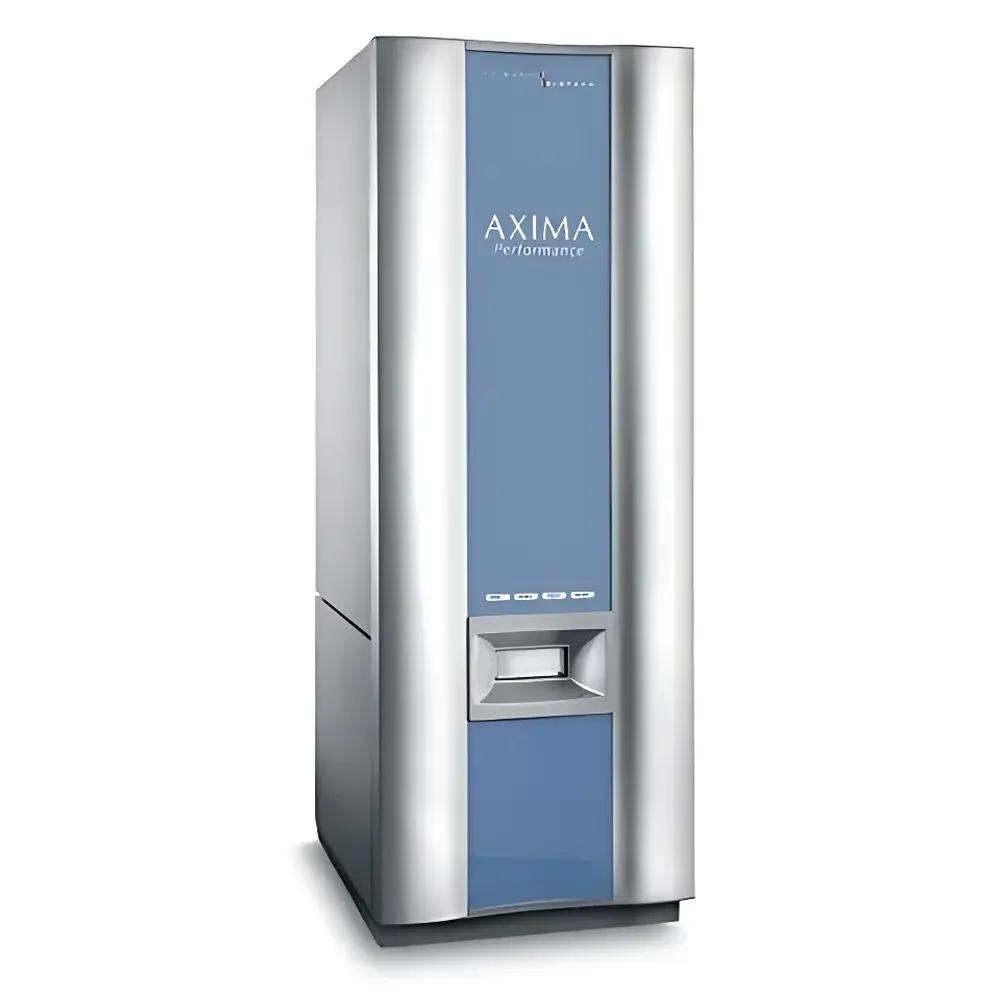
Shimadzu AXIMA Performance MALDI-TOF Mass Spectrometer
| Brand | Shimadzu |
|---|---|
| Origin | Japan |
| Manufacturer Type | Original Equipment Manufacturer (OEM) |
| Import Status | Imported Instrument |
| Model | AXIMA Performance |
| Pricing | Available Upon Request |
Overview
The Shimadzu AXIMA Performance is a high-sensitivity, research-grade Matrix-Assisted Laser Desorption/Ionization Time-of-Flight (MALDI-TOF) mass spectrometer engineered for precise molecular weight determination and structural characterization of large biomolecules, synthetic polymers, dendrimers, and other non-volatile, thermally labile compounds. Operating on the fundamental principle of pulsed laser-induced ionization in the presence of a UV-absorbing matrix—followed by orthogonal acceleration and time-resolved ion flight measurement—the system delivers high mass accuracy, excellent signal-to-noise ratio, and robust reproducibility across wide mass ranges (typically m/z 100–600,000 under optimized conditions). Its integrated vacuum architecture, delayed extraction capability, and reflectron mode enable resolution exceeding 15,000 (FWHM) and mass accuracy within ±0.1 Da for peptides and ±0.01% for polymers when calibrated with appropriate standards.
Key Features
- High-energy nitrogen laser (337 nm, 1–200 Hz repetition rate) with adjustable fluence and beam homogenization for consistent ion yield and reduced fragmentation.
- Orthogonal acceleration TOF analyzer with dual-stage reflectron for enhanced mass resolution and sensitivity.
- Automated sample stage with high-precision XYZ positioning (±1 µm repeatability) compatible with standard 96- and 384-well MALDI target plates.
- Dedicated polymer analysis mode featuring automatic peak detection, polydispersity index (PDI) calculation, and repeat unit identification via isotopic pattern deconvolution.
- Integrated delayed extraction electronics enabling fine-tuning of ion extraction timing to maximize resolution for heterogeneous samples such as branched or multi-modal polymers.
- Modular design supporting optional add-ons including an external LC interface for online coupling with size-exclusion chromatography (SEC-MALDI), and a high-throughput robotic autosampler.
Sample Compatibility & Compliance
The AXIMA Performance accommodates a broad range of sample types—including proteins, peptides, oligonucleotides, synthetic polymers (e.g., PEG, PMMA, PS), glycoconjugates, and nanoparticles—when prepared using standard MALDI matrices (e.g., α-cyano-4-hydroxycinnamic acid, sinapinic acid, dithranol). It supports both dried-droplet and thin-layer preparation methods and integrates seamlessly with gel-permeation chromatography (GPC/SEC) systems via automated fraction collection and direct spotting onto MALDI targets. The instrument complies with IEC 61010-1 (safety requirements for electrical equipment), meets electromagnetic compatibility (EMC) standards per EN 61326-1, and supports audit-trail-enabled operation under GLP and GMP environments when used with compliant software configurations.
Software & Data Management
Controlled by Shimadzu’s proprietary LaunchPad™ software, the AXIMA Performance provides intuitive acquisition, real-time spectral preview, and advanced post-processing tools including baseline subtraction, smoothing, peak integration, and statistical comparison. LaunchPad supports ASTM E2602-compliant spectral metadata tagging and exports data in open formats (mzML, ASCII) for third-party analysis. For regulated laboratories, optional 21 CFR Part 11-compliant modules are available, delivering electronic signatures, user access controls, change history logging, and secure audit trails. Data integrity is further reinforced through automated calibration verification and QC sample tracking protocols aligned with ISO/IEC 17025 quality management requirements.
Applications
- Characterization of synthetic polymer molecular weight distribution (Mw, Mn, PDI) without column calibration bias.
- Routine analysis of protein primary structure, post-translational modifications (PTMs), and intact monoclonal antibody subunit profiling.
- Quality control of oligonucleotide therapeutics and lipid nanoparticles (LNPs) in biopharmaceutical development.
- Identification of polymer additives, degradation products, and contaminants in materials science R&D.
- High-throughput screening of peptide libraries and combinatorial synthesis outputs.
- Supporting regulatory submissions requiring orthogonal mass measurement techniques per ICH Q5E and USP .
FAQ
What sample preparation methods are recommended for polymer analysis?
Standard protocols include solvent-based co-crystallization with appropriate matrices (e.g., dithranol for high-MW polymers); thin-layer preparation is preferred for improved shot-to-shot reproducibility.
Can the AXIMA Performance be coupled with liquid chromatography?
Yes—via optional SEC-MALDI interface kits that synchronize fraction elution with automated target spotting and timed MS acquisition.
Is calibration required before each analysis?
External calibration is performed daily using polymer or peptide standards; internal calibration using matrix cluster ions is supported for rapid verification.
Does the system support quantitative analysis?
Semi-quantitative comparisons are enabled via relative peak intensity normalization and internal standard addition; absolute quantification requires method validation per ISO 17025 guidelines.
What maintenance intervals are recommended for optimal performance?
Laser optics inspection every 6 months, vacuum pump oil replacement quarterly, and detector gain recalibration annually—documented in the instrument’s built-in service log.




