
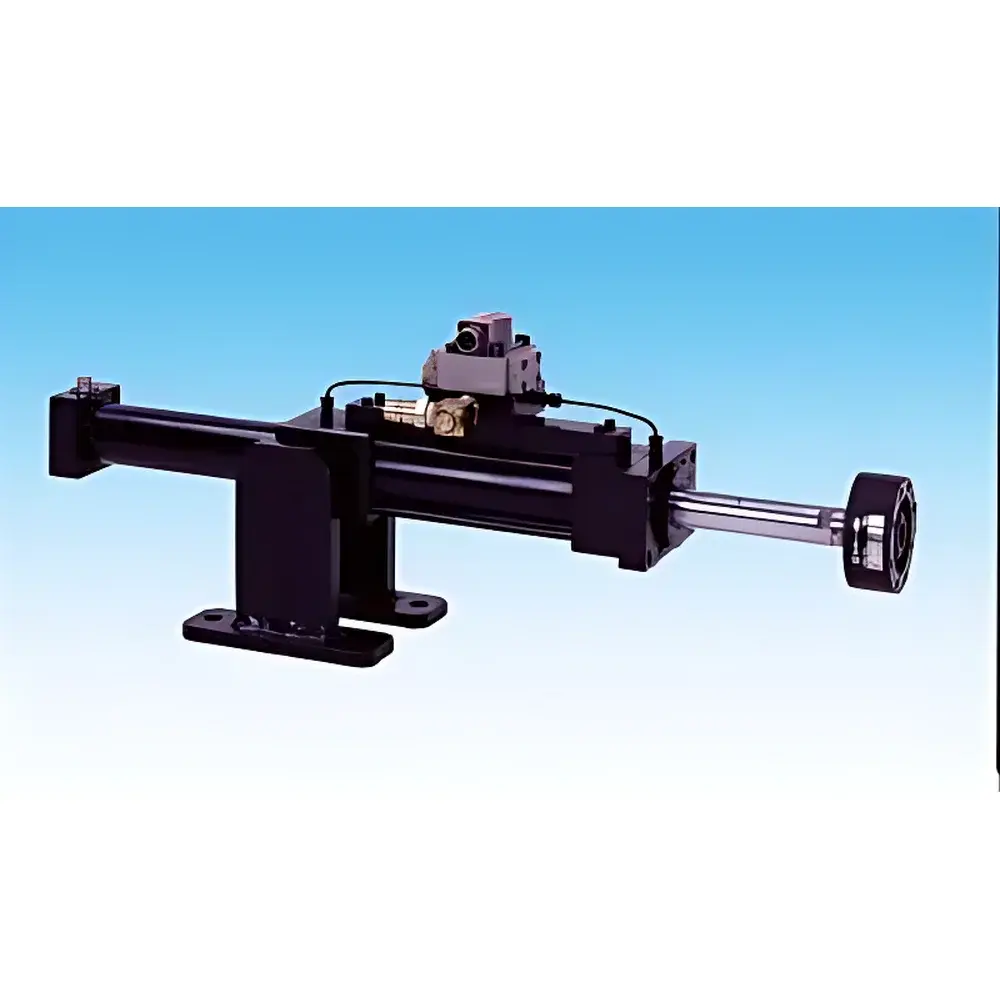
Shimadzu EHF-JF Series Electro-Hydraulic Servo Actuator
| Brand | Shimadzu |
|---|---|
| Origin | Japan |
| Manufacturer Type | Original Equipment Manufacturer (OEM) |
| Origin Category | Imported |
| Model | EHF-JF |
| Control Systems | Compatible with Shimadzu 4890 and 4830 Digital Controllers |
| Load Capacity | ±5 kN, ±10 kN, ±20 kN, ±30 kN, ±50 kN |
| Piston Stroke | ±50 mm, ±100 mm, ±150 mm |
| Load Accuracy | ±0.5% of full-scale reading |
| Control Architecture | Two-degree-of-freedom adaptive PID control |
| Data Acquisition Resolution | 20-bit (4890), 24-bit (4830) |
| Interface | PC-connected via Ethernet/USB (4890) |
Overview
The Shimadzu EHF-JF Series Electro-Hydraulic Servo Actuator is a high-performance, closed-loop dynamic testing system engineered for controlled application of cyclic mechanical loads in structural durability and fatigue evaluation. Operating on the principle of electro-hydraulic servo control, the actuator converts electrical command signals into precise hydraulic pressure differentials across a double-acting piston, enabling bidirectional force generation with high fidelity waveform replication (e.g., sine, trapezoidal, random, or user-defined profiles). Designed specifically for laboratory-based component-level validation, the EHF-JF series supports rigorous reliability assessment of automotive subassemblies (e.g., suspension links, seat mechanisms, pedal assemblies), industrial machinery joints, and load-bearing furniture frames under ISO 8608, ASTM E466, and SAE J2234-compliant test protocols. Its modular architecture integrates seamlessly with Shimadzu’s proprietary digital controllers—either the PC-hosted 4890 system or the standalone 4830 controller—ensuring traceable, repeatable, and auditable test execution across R&D, QA, and certification environments.
Key Features
- Two-degree-of-freedom adaptive PID control algorithm enables real-time parameter auto-tuning, minimizing overshoot and phase lag during high-frequency sinusoidal or transient loading (up to 100 Hz typical, dependent on load/stroke configuration).
- Modular mechanical design: compact footprint and low mass inertia facilitate benchtop, vertical, or inverted mounting using optional support brackets—ideal for constrained test cell layouts.
- Rapid hydraulic coupling via standardized quick-connect fittings (DIN 2353 metric) reduces setup time and eliminates leakage-prone threaded connections during fixture changes.
- Dual-controller compatibility: The 4890 controller features 20-bit analog-to-digital conversion with true “no-range-switching” operation—maintaining ±0.0015% FS resolution across full load capacity without manual range selection. The 4830 controller employs 24-bit A/D resolution and an integrated 7-inch color LCD touchscreen for fully autonomous test definition, real-time waveform visualization, and on-device data review.
- Robust hydraulic power unit integration (external or cabinet-mounted) ensures stable oil temperature regulation and contamination control per ISO 4406:2017 Class 18/16/13 specifications.
Sample Compatibility & Compliance
The EHF-JF series accommodates specimens ranging from small automotive fasteners (<50 mm gauge length) to large structural chassis members (up to 1.2 m span), provided appropriate custom fixtures and load train alignment are implemented. All standard configurations comply with mechanical safety requirements per ISO 12100 and electromagnetic compatibility standards EN 61326-1. When operated with validated software and calibrated load cells (traceable to NMIJ/JCSS), test reports meet GLP documentation integrity requirements—including audit trails, electronic signatures, and version-controlled procedure files—as stipulated under FDA 21 CFR Part 11 when deployed in regulated automotive Tier-1 supplier validation labs.
Software & Data Management
Control and data acquisition are managed via Shimadzu’s TRAPEZIUM X platform (for 4890) or embedded firmware (for 4830), both supporting IEEE 1588 Precision Time Protocol synchronization for multi-channel correlation. Raw sensor data (load, displacement, strain) is acquired at up to 10 kHz sampling rate and stored in HDF5 format—enabling post-processing in MATLAB, Python (h5py), or third-party fatigue analysis tools (nCode DesignLife, fe-safe). All systems generate timestamped, checksum-verified test logs compliant with ISO/IEC 17025 clause 7.5.2 for measurement traceability and data integrity verification.
Applications
- Automotive component fatigue life prediction under road-simulation spectra (e.g., MIRA, VDA 405)
- Vibration endurance testing of HVAC actuators, door latches, and seat recliner mechanisms
- Cyclic compression/tension evaluation of polymer-composite furniture joints per ANSI/BIFMA X5.1
- High-cycle fatigue characterization of welded or riveted structural brackets under variable-amplitude loading
- Calibration and verification of reference load cells and extensometers in metrology laboratories
FAQ
What is the maximum recommended operating frequency for the EHF-JF actuator at ±50 kN load capacity?
At full-scale ±50 kN, the practical upper limit for sinusoidal excitation is 30 Hz under standard oil temperature and stroke conditions; higher frequencies require derating or active cooling optimization.
Can the EHF-JF be integrated into an existing MTS or Instron test frame?
Yes—via Shimadzu’s analog I/O interface (±10 V command/feedback) or EtherCAT protocol (with optional gateway), enabling synchronized multi-axis control in hybrid test systems.
Is firmware update support available for the 4830 controller?
Yes—Shimadzu provides quarterly firmware releases through authorized service channels, including enhanced FFT-based spectral analysis and ISO 10816-3 vibration severity mapping.
Does the system support closed-loop displacement control in addition to load control?
Yes—dual-sensor feedback (load cell + LVDT or magnetostrictive position transducer) enables simultaneous or switchover control modes per ASTM E606 Annex A3.
What calibration intervals are recommended for ISO/IEC 17025 compliance?
Annual full-system calibration is required; load cell and displacement transducer verification should occur every 6 months or after 500 hours of cumulative operation, whichever occurs first.



