
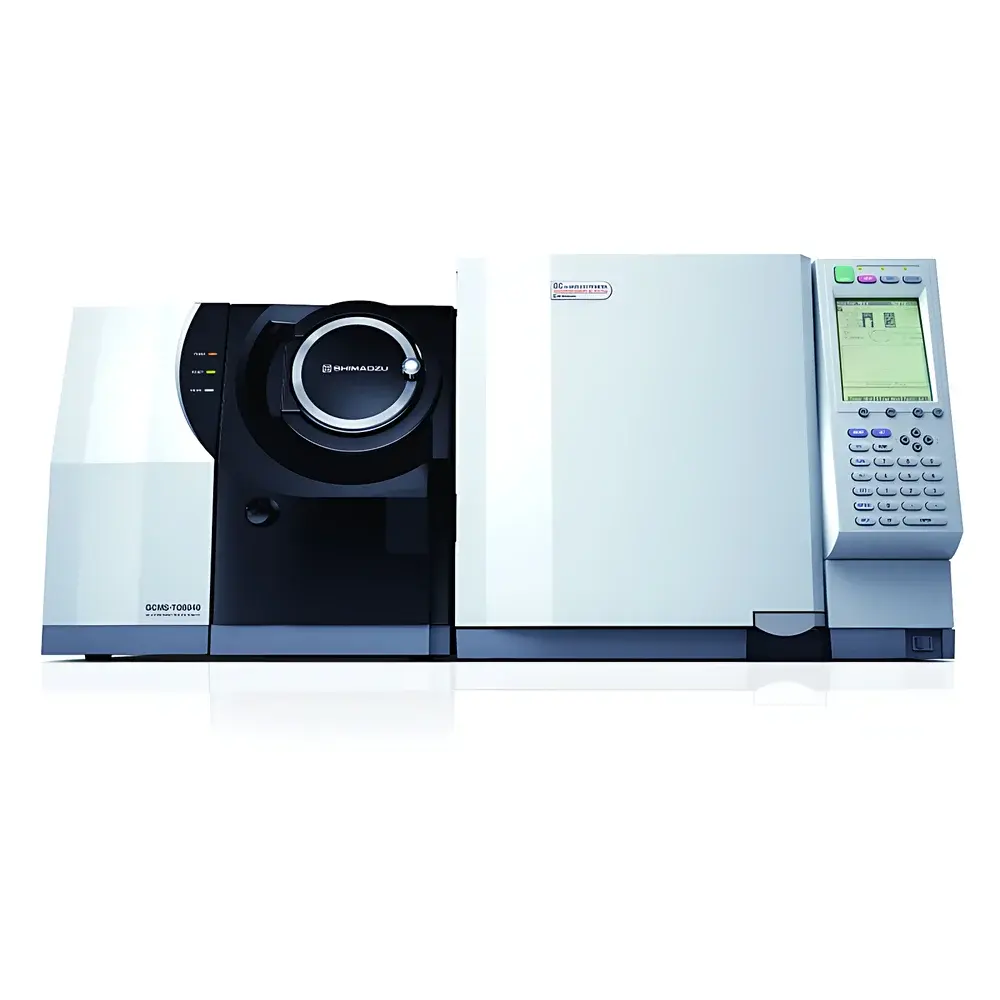
Shimadzu GCMS-TQ8040 Triple Quadrupole Gas Chromatography Mass Spectrometer
| Brand | Shimadzu |
|---|---|
| Origin | Japan |
| Manufacturer Type | Original Equipment Manufacturer (OEM) |
| Import Status | Imported Instrument |
| Instrument Type | Triple Quadrupole Mass Spectrometer |
| GC Configuration | Conventional Gas Chromatograph Coupling |
| MRM Channel Capacity | Up to 32,768 per run |
| Ion Source | Patented High-Efficiency Ion Source |
| Collision Cell | Optimized RF-Only Collision Cell |
| Scan Modes | Simultaneous Scan and MRM Acquisition |
| Software Platform | GCMSsolution with Smart MRM Automation |
Overview
The Shimadzu GCMS-TQ8040 is a high-performance triple quadrupole gas chromatography mass spectrometer engineered for rigorous quantitative and confirmatory analysis in regulated and research-intensive laboratories. It operates on the principle of tandem mass spectrometry (MS/MS) via three quadrupole mass filters—Q1 (mass selection), Q2 (collision-induced dissociation cell), and Q3 (mass analysis)—enabling highly selective multiple reaction monitoring (MRM) detection. This architecture delivers exceptional specificity, sensitivity, and reproducibility for trace-level analytes in complex matrices such as environmental extracts, food residues, clinical biofluids, and pharmaceutical impurities. Designed and manufactured in Kyoto, Japan, the system integrates robust hardware engineering with intelligent software automation to meet the evolving demands of modern analytical workflows under GLP, GMP, and ISO/IEC 17025 compliance frameworks.
Key Features
- Smart MRM Automation: Fully automated method development and optimization—including compound-specific MRM transition selection, dwell time allocation, and collision energy tuning—reducing manual intervention and inter-operator variability.
- High-Throughput MRM Capacity: Supports up to 32,768 MRM transitions per acquisition cycle, enabling comprehensive multi-analyte quantification without sacrificing cycle time or sensitivity.
- Patented Ion Source Design: A high-efficiency electron ionization (EI) source with optimized geometry and temperature control ensures stable ion currents and extended operational lifetime—even under continuous high-sample-load conditions.
- Advanced Collision Cell Technology: An RF-only quadrupole collision cell with precisely tuned gas dynamics maximizes precursor-to-product ion transmission and minimizes cross-talk between adjacent MRM channels.
- ASSP (Advanced Scanning Speed Protocol): Enables real-time switching between full-scan MS and MRM modes within a single run, facilitating both library-searchable identification and high-precision quantitation without compromise.
- Robust GC Interface: Compatible with standard Shimadzu GC-2010 Plus and GC-2030 systems, supporting split/splitless injection, PTV, and direct capillary coupling with active flow control.
Sample Compatibility & Compliance
The GCMS-TQ8040 accommodates a broad range of volatile and semi-volatile organic compounds—including pesticides, polycyclic aromatic hydrocarbons (PAHs), endocrine disruptors, residual solvents, and metabolites—following derivatization where required. Sample introduction supports liquid injection (via autosampler), headspace analysis, and thermal desorption modules. The system complies with key regulatory requirements for data integrity and auditability, including FDA 21 CFR Part 11 (with electronic signature and audit trail enabled in GCMSsolution v5.1+), EU Annex 11, and ISO/IEC 17025:2017 clause 7.7 on result reporting. Routine performance verification follows ASTM D7011 and EPA Method 8270E protocols.
Software & Data Management
GCMSsolution software provides an integrated environment for instrument control, method development, data acquisition, processing, and reporting. Smart MRM functionality includes auto-optimization of retention times, peak width adaptation, and dynamic dwell time assignment based on signal intensity and number of concurrent transitions. All raw data are stored in vendor-neutral ANDI/NetCDF format alongside proprietary .qgd files. Audit trails record all user actions—including method edits, reprocessing events, and calibration updates—with timestamps and operator IDs. Data export supports CSV, PDF, and XML formats for LIMS integration and external statistical analysis.
Applications
- Environmental monitoring: Quantification of organochlorine pesticides, PCBs, dioxins (as TCDD equivalents), and brominated flame retardants in soil, water, and biota.
- Food safety testing: Multi-residue analysis of >500 pesticides in fruits, vegetables, and processed foods per EN 15662:2018 workflow.
- Pharmaceutical quality control: Detection and quantification of genotoxic impurities (GTIs) at sub-ppb levels per ICH M7 guidelines.
- Clinical toxicology: Targeted quantitation of drugs of abuse, therapeutic drug monitoring (TDM) analytes, and endogenous biomarkers in plasma and urine.
- Forensic chemistry: Confirmatory identification and quantitation of controlled substances using NIST MS Search with MS/MS spectral libraries.
FAQ
What regulatory standards does the GCMS-TQ8040 support for data integrity?
It supports FDA 21 CFR Part 11, EU Annex 11, and ISO/IEC 17025:2017 through configurable audit trails, electronic signatures, and secure user access controls in GCMSsolution.
Can the system perform both qualitative identification and quantitative analysis in one run?
Yes—via simultaneous Scan/MRM acquisition enabled by ASSP technology, allowing full-spectrum library matching and targeted MRM quantitation without method duplication.
Is method transfer possible from other Shimadzu GC-MS platforms?
Methods developed on GCMS-QP2010 Ultra or GCMS-TQ8030 can be migrated with minimal re-optimization due to consistent ion optics and software architecture.
What maintenance intervals are recommended for routine operation?
Ion source cleaning every 2–4 weeks (depending on sample load), vacuum pump oil change every 6 months, and annual calibration verification using perfluorotributylamine (PFTBA) standard.
Does the system support remote monitoring and diagnostics?
Yes—via Shimadzu’s LabSolutions Remote Service (LRS) module, which enables secure cloud-based instrument status tracking, predictive maintenance alerts, and remote expert assistance.
Related Products





