
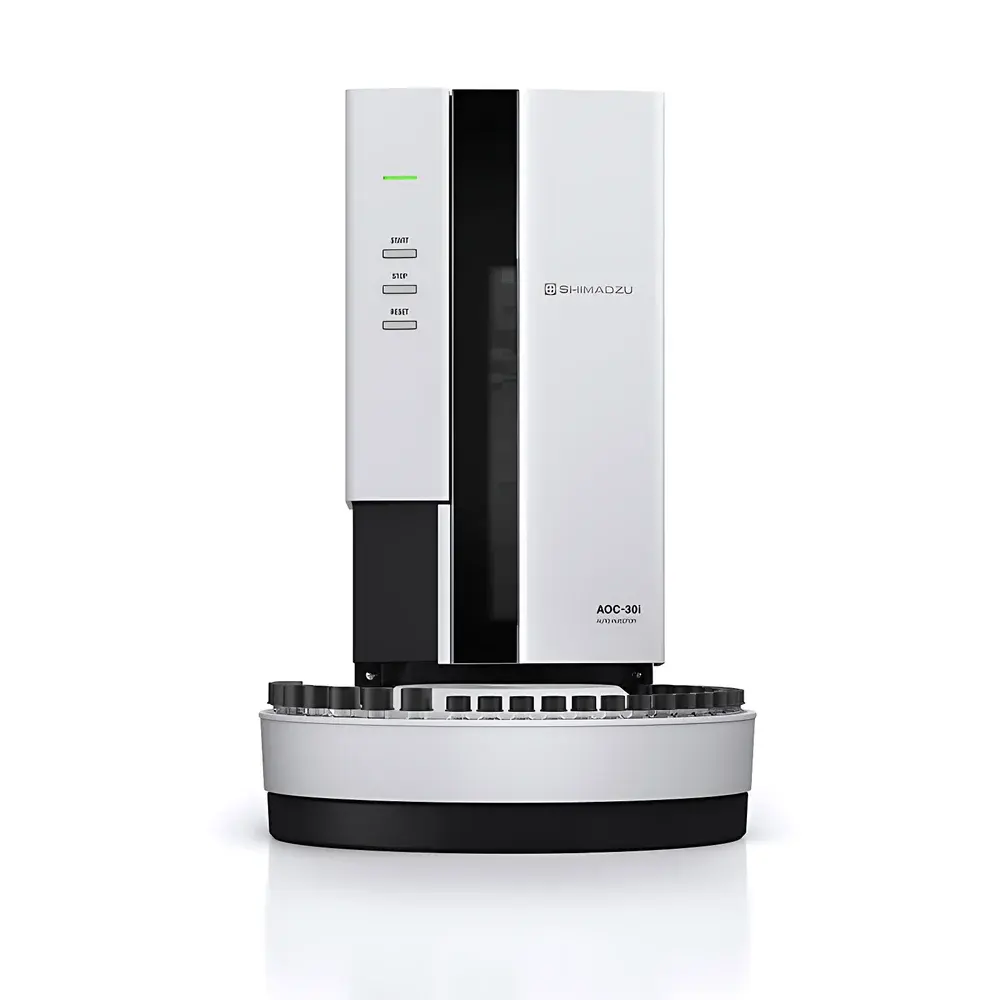
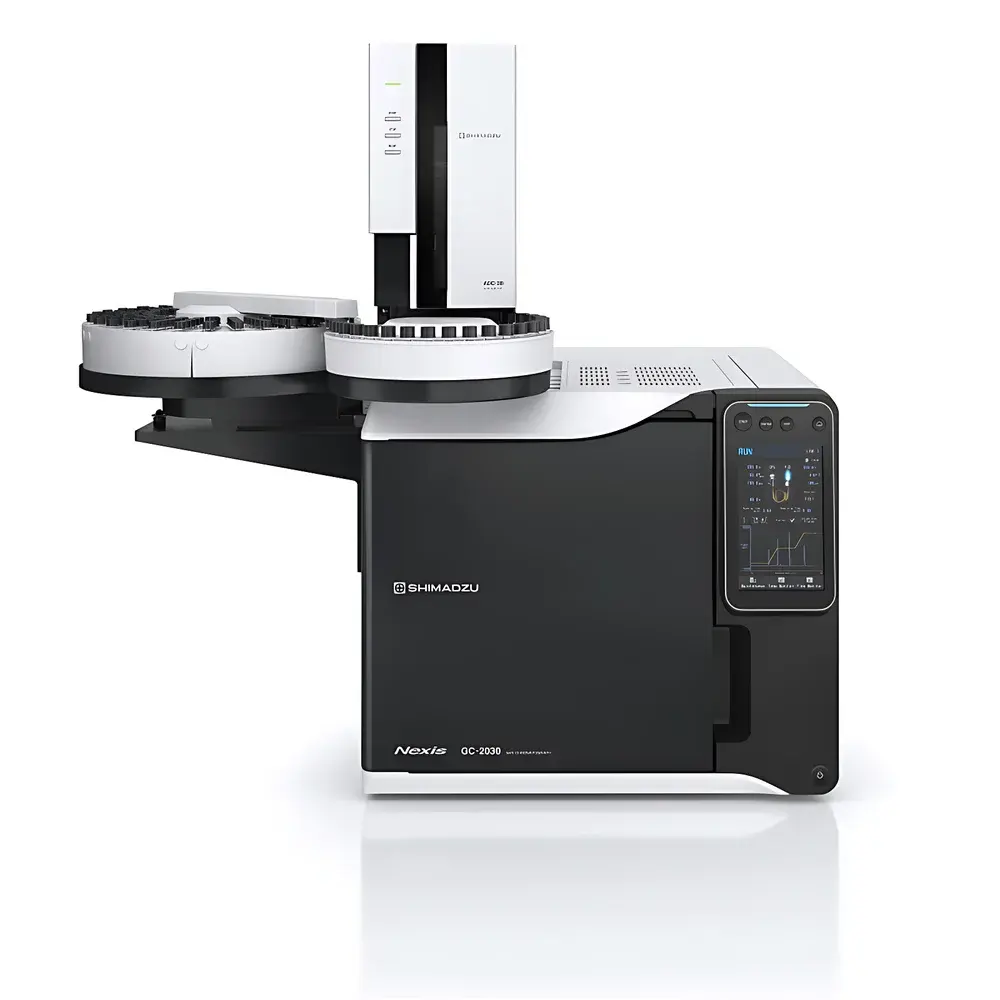
Shimadzu AOC-30 Series Multifunctional Liquid Autosampler for GC/GC-MS
| Brand | Shimadzu |
|---|---|
| Origin | Japan |
| Manufacturer | Shimadzu Corporation |
| Product Type | Imported Instrument |
| Model | AOC-30 Series |
| Instrument Category | Gas Chromatography Autosampler |
| Maximum Sample Capacity | 150 positions (1.5 mL vials) |
| Minimum Injection Volume | 10 nL |
| Injection Needle Volume | Standard 10 µL (exchangeable with optional syringes) |
| Positioning Accuracy | Adjustable |
| Motion System | XYZ three-axis robotic arm |
| Needle Wash Modes | Six preconfigured wash methods + user-defined protocols |
| Replicate Injections per Sample | Up to 99 times |
Overview
The Shimadzu AOC-30 Series Multifunctional Liquid Autosampler is an engineered solution for high-throughput, high-reproducibility sample introduction in gas chromatography (GC) and gas chromatography–mass spectrometry (GC-MS) systems. Designed on the foundation of over five decades of Shimadzu’s expertise in autosampler development, the AOC-30 implements precision liquid-phase injection via a programmable XYZ robotic arm and micro-volume syringe-based delivery. Its core architecture supports quantitative analysis under regulated and research-grade conditions, where consistent injection volume, minimized carryover, and long-term operational stability are critical performance requirements. The system operates on the principle of positive-displacement syringe aspiration and controlled plunger advancement—ensuring accurate metering across a wide dynamic range—from trace-level (10 nL) to large-volume injections—without reliance on loop-based sampling or external pressure sources.
Key Features
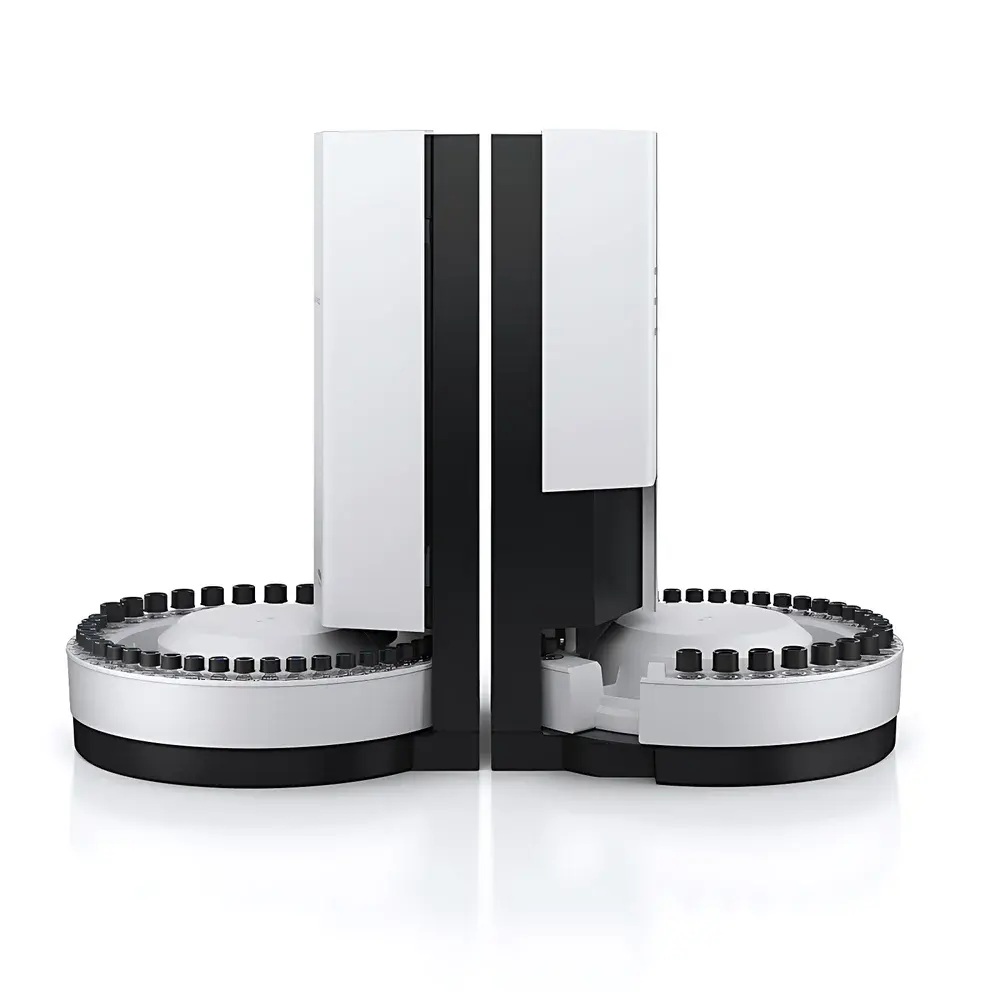
- Precision XYZ robotic motion system with adjustable positioning accuracy, enabling reliable access to 150-position 1.5 mL vial racks or custom configurations including dual-tower, tower-plus-tray, and dual-tower-plus-tray layouts.
- Modular syringe design: standard 10 µL needle included; compatible with interchangeable syringes for method-specific volume optimization and extended lifetime operation.
- Multi-solvent needle wash capability: up to four independent wash solvents per sequence, supporting complex cleaning protocols—including sequential solvent rinses, air-drying steps, and post-wash purging—to achieve cross-contamination levels below 0.01% (validated per ASTM D7097 and ISO 17025 guidelines).
- Corrosion-resistant mechanical construction: sealed drive mechanisms and chemically inert fluid-path materials ensure sustained reliability in humid, dusty, or solvent-rich laboratory environments.
- Intelligent “Injection Assistant” software interface: preloaded with application-optimized injection templates (e.g., volatile organics, residual solvents, pesticide screening), allowing rapid method setup via intuitive icon-driven workflow navigation and one-click parameter inheritance.
- Expandable functionality: optional modules include refrigerated sample tray (4–40 °C), heated sample tray (up to 150 °C), barcode reader integration for LIMS traceability, and remote monitoring via Ethernet-connected status reporting.
Sample Compatibility & Compliance
The AOC-30 accommodates standard 1.5 mL crimp-top or screw-cap vials, as well as alternative formats via adapter kits (e.g., 2 mL vials, micro-inserts). It supports aqueous, organic, and mixed-phase samples—including viscous matrices when paired with appropriate needle gauge and aspiration speed tuning. All firmware and control logic comply with IEC 61508 functional safety principles. Data integrity features align with FDA 21 CFR Part 11 requirements—including electronic signature support, audit trail logging, and user-access level management—enabling deployment in GLP, GMP, and ISO/IEC 17025-accredited laboratories. Routine performance verification follows Shimadzu’s internal SOPs based on USP and ASTM E2655 protocols.
Software & Data Management
Controlled via Shimadzu’s GCsolution or LabSolutions software platforms, the AOC-30 integrates natively into method development, sequence definition, and post-run review workflows. Method files include full metadata capture: injection volume, wash solvent sequence, dwell times, plunger speed profiles, and replicate count. Audit trails record all parameter changes, user logins, and instrument state transitions with timestamped entries. Raw data export supports CSV, XML, and vendor-neutral .cdf formats for third-party statistical analysis or LIMS ingestion. Remote diagnostics and firmware updates are supported through secure HTTPS-based communication channels without requiring local administrative privileges.
Applications
The AOC-30 serves diverse analytical domains requiring robust, automated sample introduction: environmental testing (EPA Method 502.2, 8260D, 8270E), pharmaceutical residual solvent analysis (ICH Q2(R2), USP ), food safety screening (pesticides, mycotoxins, flavor compounds), petrochemical hydrocarbon profiling, forensic toxicology, and academic research in separation science. Its flexibility in injection volume, wash strategy, and thermal conditioning makes it suitable for both routine QC/QA operations and exploratory method development.
FAQ
What is the minimum detectable injection volume supported by the AOC-30?
The system achieves reproducible delivery down to 10 nL using optimized syringe calibration and low-speed plunger advancement.
Can the AOC-30 be used with non-Shimadzu GC or GC-MS instruments?
Yes—via TTL trigger compatibility and RS-232/Ethernet command sets, though full feature integration (e.g., real-time status feedback, error recovery) is guaranteed only with Shimadzu GC/GC-MS platforms.
Is method validation documentation available for regulatory submissions?
Shimadzu provides IQ/OQ documentation packages, along with application notes demonstrating linearity, precision, carryover, and ruggedness per ICH Q2(R2) criteria.
How does the AOC-30 handle viscous or particulate-containing samples?
By adjusting aspiration speed, needle immersion depth, and incorporating optional filter tips or ultrasonic vial agitation accessories—not supplied standard but validated for use.
What maintenance intervals are recommended for routine operation?
Needle replacement every 5,000–10,000 injections depending on matrix; syringe seal inspection quarterly; full robotic arm calibration annually or after mechanical impact events.




