
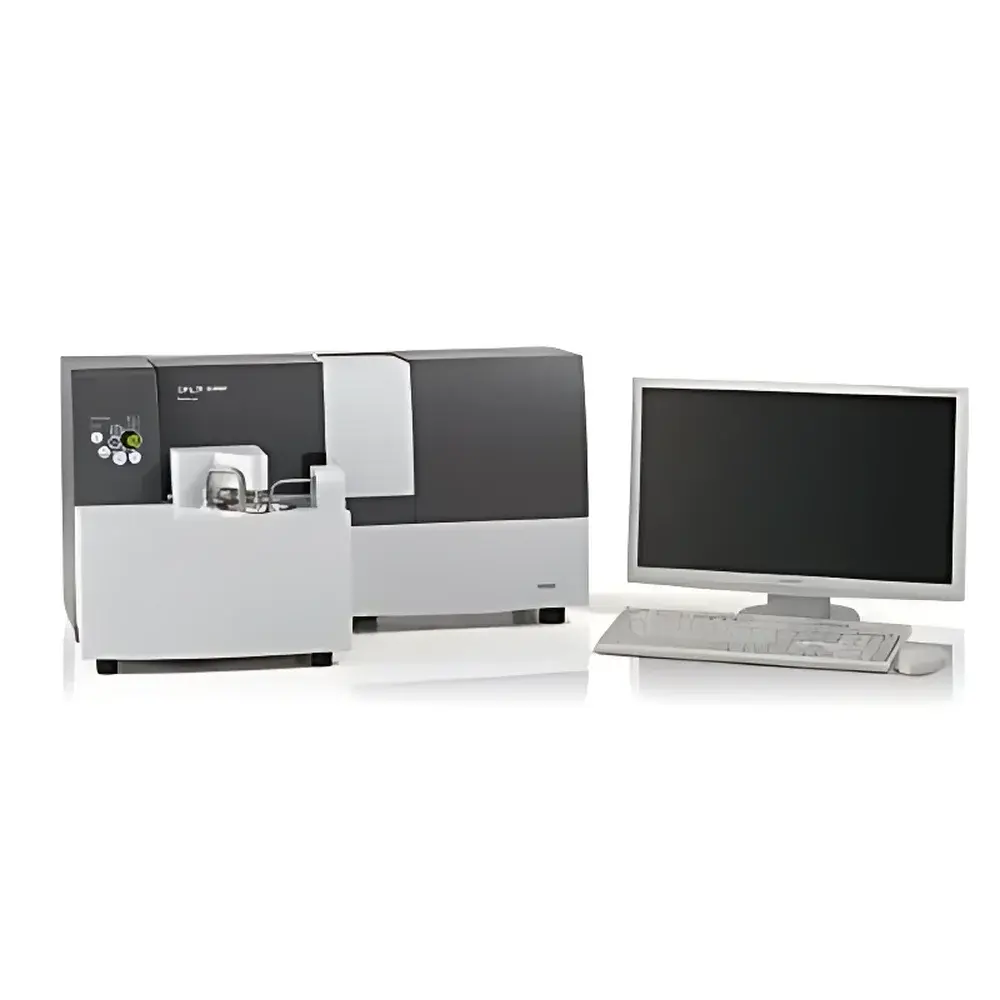
Shimadzu SALD-2300 Laser Diffraction Particle Size Analyzer
| Origin | Japan |
|---|---|
| Manufacturer Type | Authorized Distributor |
| Origin Category | Imported |
| Model | SALD-2300 |
| Price Range | USD 27,000–41,000 (approx.) |
| Dispersion Method | Dry & Wet |
| Measurement Range | 0.017–2500 µm |
| Repeatability | <1% RSD |
| Measurement Time | 10–15 s per analysis |
Overview
The Shimadzu SALD-2300 is a high-performance laser diffraction particle size analyzer engineered for precision, reproducibility, and regulatory compliance across pharmaceutical, cosmetic, food, battery materials, and environmental laboratories. It operates on the fundamental principle of Mie scattering theory—fully aligned with ISO 13320:2020 and JIS Z 8825-1—enabling quantitative determination of particle size distribution (PSD) from 17 nm to 2500 µm in a single, continuous optical path. Unlike hybrid systems requiring multiple lasers or segmented detection zones, the SALD-2300 employs a unified optical architecture: one high-stability 680 nm red semiconductor laser, one diffraction optics train, and one integrated 84-element photodetector array (79 forward, 1 side, 4 backward sensors). This monolithic design eliminates data stitching artifacts, ensures traceable linearity across the full dynamic range, and supports robust quantification of both nano- and macro-particulates within the same measurement cycle.
Key Features
- Single-source, single-optics wide-range coverage: Achieves uninterrupted measurement from 0.017 µm to 2500 µm without source switching or optical recalibration.
- High-sensitivity detection: 84-element photodetector array delivers 10× improved signal-to-noise ratio versus prior-generation instruments, enabling reliable analysis of dilute suspensions (0.1–200,000 ppm).
- Sub-second temporal resolution: Capable of consecutive measurements at 1-second intervals—ideal for real-time monitoring of aggregation, dispersion kinetics, or antigen–antibody binding dynamics.
- Optical stability architecture: Omnidirectional Shock Absorption Frame (OSAF) isolates all optical components from mechanical vibration; laser thermal stabilization time <60 s.
- Integrated safety & ergonomics: Interlocked measurement chamber automatically deactivates laser emission upon door opening; slide-in sample cell enables rapid cleaning and exchange.
- Dual-mode dispersion compatibility: Supports both dry powder dispersion (via integrated air jet) and wet dispersion (via SALD-MS23 recirculating module with ultrasonic probe, magnetic stirrer, and level-sensing CPU control).
Sample Compatibility & Compliance
The SALD-2300 accommodates diverse particulate systems—including opaque, highly absorbing (e.g., carbon black, metal oxides), and low-refractive-index materials—without compromise in resolution or accuracy. Its wet dispersion module features fluoropolymer- and SUS316L-lined flow paths, ensuring chemical resistance to organic solvents (e.g., THF, acetone, chloroform, IPA) and aggressive aqueous media. All hardware and firmware comply with IEC 61000-4 electromagnetic compatibility standards and Class 1 laser safety requirements (IEC 60825-1). Data integrity protocols support GLP/GMP environments: operation logs record timestamped events (power-on, blank acquisition, alignment status), and full audit trails are embedded in every exported dataset. While not pre-certified for FDA 21 CFR Part 11, the system’s deterministic measurement chain, unambiguous calibration traceability (NIST-traceable PSL standards), and software-controlled validation workflows facilitate qualification under internal SOPs.
Software & Data Management
WingSALD II v3.x is a Windows-based application delivering comprehensive data acquisition, processing, and reporting capabilities. Core functionalities include AI-driven auto-ranging—where raw intensity distributions are analyzed in real time to select optimal inversion parameters—and the proprietary Kinoshita Method (LDR: Light Distribution Recalculation), the world’s first algorithm for automated refractive index selection. Instead of relying on literature values, LDR evaluates five candidate refractive indices against measured scattering patterns and reports confidence-weighted recommendations. Additional tools include time-series PSD overlay, 3D contour mapping of evolving distributions, scatter-angle spectral evaluation, simulated mixing of multi-component systems, and seamless merging of SALD data with sieve or sedimentation results (e.g., >2 mm fractions). All processed data export to CSV, PDF, or XML formats; raw intensity files retain full detector-element resolution for retrospective reanalysis.
Applications
The SALD-2300 serves critical roles in formulation development and QC release testing. In pharmaceutical manufacturing, it verifies micronization efficiency of active pharmaceutical ingredients (APIs), monitors granule growth during fluid-bed drying, and assesses excipient homogeneity in dry-powder inhalers. Battery material labs use it to characterize cathode/anode particle morphology (e.g., NMC, LFP, graphite) and detect agglomerates that impair electrode slurry rheology. Cosmetics R&D leverages its sensitivity to quantify titanium dioxide and zinc oxide nanoparticle dispersion in sunscreens. Environmental researchers apply it to soil texture analysis (clay–silt–sand partitioning) and airborne particulate matter profiling. Its ability to resolve sub-100 nm aggregates in protein therapeutics also supports biopharmaceutical stability studies under accelerated stress conditions.
FAQ
Does the SALD-2300 require multiple lasers or optical modules to cover its full 0.017–2500 µm range?
No. It uses a single 680 nm semiconductor laser and one fixed optical path—eliminating discontinuities inherent in multi-laser or multi-detector systems.
How does the Kinoshita Method improve refractive index selection accuracy?
It computes theoretical scattering patterns for five candidate refractive indices, compares each against the measured intensity distribution, and ranks them by residual error—providing objective, sample-specific guidance instead of generic literature values.
Can the system validate dispersion stability during measurement?
Yes. Real-time display of both raw intensity profiles and calculated PSD updates every second, allowing immediate visual confirmation of dispersion equilibrium or onset of reagglomeration.
Is the wet dispersion module compatible with flammable solvents?
Yes. SALD-MS23 uses chemically inert fluoropolymer tubing and explosion-proof ultrasonic transducers rated for Class I, Division 1 hazardous locations when properly installed.
What maintenance routines are recommended for long-term optical stability?
Daily blank measurements, quarterly alignment verification using built-in reference targets, and annual photodetector gain calibration using NIST-traceable standards—fully guided by the onboard self-diagnostic suite.



