
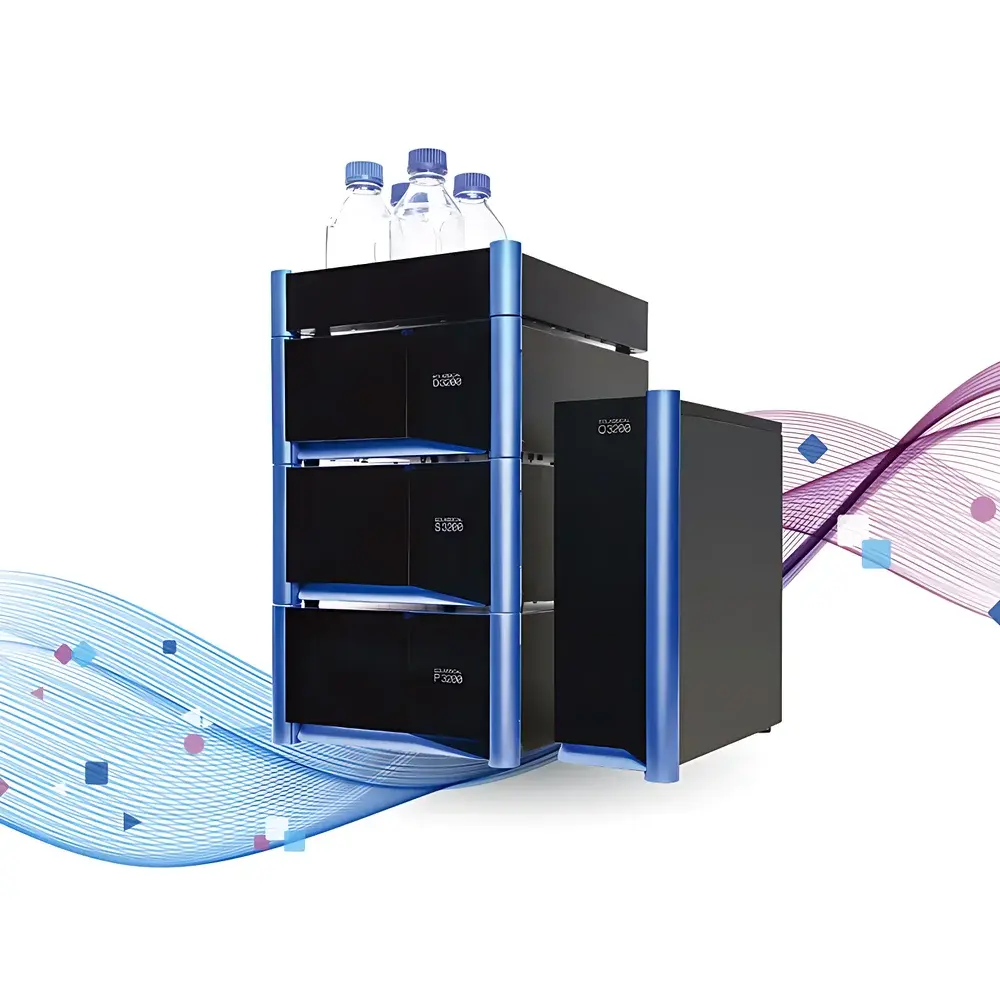
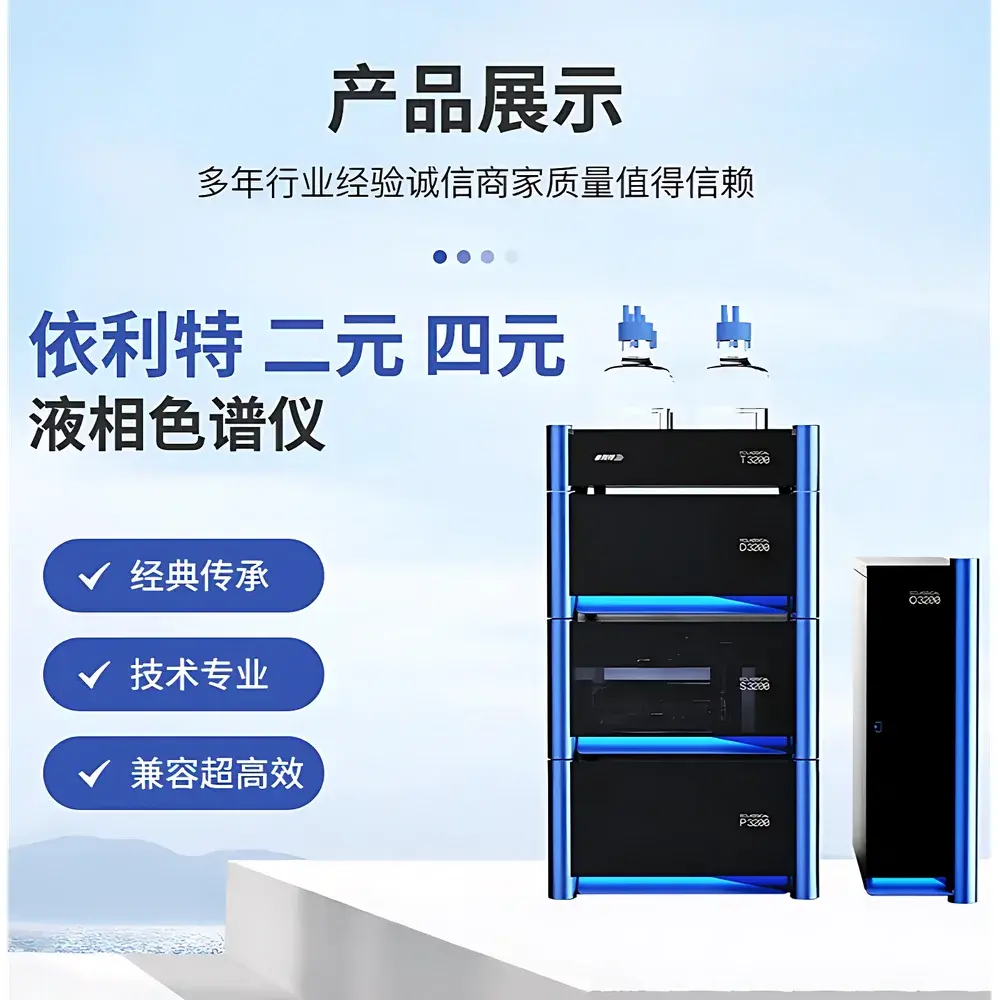
Elite 3200 Binary/Quaternary High-Performance Liquid Chromatograph
| Brand | Elite |
|---|---|
| Origin | Jiangsu, China |
| Manufacturer Type | Direct Manufacturer |
| Instrument Type | Fast Liquid Chromatograph |
| Model | 3200 HPLC System |
| Flow Rate Range | 0.001–10.000 mL/min |
| Maximum Operating Pressure | 90 MPa |
| Column Oven Temperature Range | 4–85 °C |
| UV-Vis Detector Wavelength Range | 190–800 nm |
| Gradient Architecture | Binary (post-column mixing) or Quaternary (proportional valve mixing) |
| Solvent Selection Valve | Standard |
| Online Solvent Filtration | Integrated at pump outlet |
| System Expandability | Modular detector, autosampler, and column oven compatibility |
Overview
The Elite 3200 Binary/Quaternary High-Performance Liquid Chromatograph is an engineered platform for robust, reproducible separation of small molecules, peptides, pharmaceuticals, and natural products under isocratic or gradient elution conditions. Based on proven high-pressure liquid chromatography (HPLC) principles—specifically utilizing either dual-pump post-mixing (binary mode) or proportional solenoid-valve mixing (quaternary mode)—the system delivers precise mobile phase composition control with minimal dwell volume (< 500 µL in binary configuration). Its 90 MPa pressure capability supports sub-2 µm particle-packed columns, enabling fast separations without compromising resolution or peak capacity. Designed for routine QC laboratories, method development environments, and academic research facilities, the 3200 integrates mechanical stability, thermal management, and fluidic integrity to meet the demands of GLP-compliant workflows and long-term unattended operation.
Key Features
- High-precision dual-servo piston pumps with active pulse dampening, delivering flow accuracy ≤ ±0.1% RSD and pulsation < 0.1% at 1 mL/min
- Binary configuration: Two independent high-pressure pumps with post-column solvent blending; quaternary configuration: Four-solvent proportional mixing via digitally controlled solenoid valves
- Integrated solvent selection valve enabling automatic switching between up to four reservoirs per channel—supports dual-binary expansion for complex multi-gradient methods
- On-line solvent filtration (0.45 µm PTFE membrane) installed upstream of the pump head to prevent particulate ingress and extend seal/piston lifetime
- Low-dwell-volume fluidic path design minimizes gradient delay and improves method transfer fidelity across instruments
- Modular architecture: Fully compatible with Elite UV-Vis detectors (190–800 nm), refrigerated autosamplers (0.1–100 µL injection range), and column ovens with PID-controlled temperature stability (±0.1 °C)
Sample Compatibility & Compliance
The Elite 3200 accommodates standard 4.6 mm × 150 mm analytical columns as well as narrow-bore (2.1 mm i.d.) and microbore configurations. It supports reversed-phase, normal-phase, HILIC, and ion-exchange chemistries. All wetted surfaces are constructed from stainless steel 316L, sapphire, and PEEK—ensuring chemical compatibility with aqueous, organic, and acidic/basic mobile phases (pH 1.5–12.0). The system conforms to ISO 9001 manufacturing standards and supports audit-trail-enabled operation when paired with compliant chromatography data systems (CDS). While not pre-certified for 21 CFR Part 11 out-of-the-box, its hardware architecture—including non-volatile event logging, user access levels, and electronic signature readiness—is fully compatible with validated CDS platforms meeting FDA, EMA, and PMDA regulatory expectations.
Software & Data Management
The system operates under EliteChrom™ Control & Analysis Software (v3.5+), a Windows-based application supporting method building, real-time monitoring, peak integration, and report generation. Raw data files adhere to ANDI/NetCDF format for cross-platform interoperability. Software features include sequence scheduling with conditional logic (e.g., auto-reinjection on failed integration), gradient optimization tools, and system suitability testing templates aligned with USP and EP 2.2.46. Audit trails record all method changes, calibration events, and user actions with timestamps and operator IDs. Data export supports CSV, PDF, and XML formats for LIMS integration. Remote diagnostics and firmware updates are supported via secure HTTPS connection.
Applications
- Pharmaceutical quality control: Assay, related substances, and dissolution testing per ICH Q2(R2) guidelines
- Food safety analysis: Pesticide residue screening, mycotoxin quantification, and vitamin profiling
- Environmental monitoring: PAHs, PCBs, and endocrine disruptors in water and soil extracts
- Academic research: Natural product isolation, metabolite profiling, and polymer characterization
- Bioanalytical support: Peptide mapping, oligonucleotide purity assessment, and excipient compatibility studies
FAQ
What is the difference between binary and quaternary gradient modes on the Elite 3200?
Binary mode uses two high-pressure pumps to deliver precise solvent ratios with minimal dwell volume and superior gradient reproducibility; quaternary mode employs one pump with a proportional valve to mix up to four solvents—ideal for method scouting and flexible solvent programming.
Can the system be upgraded from binary to quaternary configuration?
No—the binary and quaternary versions are distinct hardware configurations; however, both share identical detector, autosampler, and oven modules for seamless peripheral integration.
Is the column oven compatible with UHPLC columns requiring >60 °C operation?
Yes—the oven supports stable temperature control from 4 °C to 85 °C with ±0.1 °C uniformity across the chamber, suitable for elevated-temperature separations using heat-stable stationary phases.
Does the UV-Vis detector support wavelength scanning and spectral library matching?
Yes—the diode array detector (optional add-on) acquires full spectra (190–800 nm) at 1 nm resolution and enables peak purity assessment, spectral deconvolution, and library search against NIST or custom spectral databases.
What maintenance intervals are recommended for the pump seals and inlet filters?
Under typical use (acetonitrile/water mobile phases, 1 mL/min, 24/7 operation), pump seals require replacement every 6–12 months; inline solvent filters should be inspected monthly and replaced quarterly or after solvent change cycles.





