
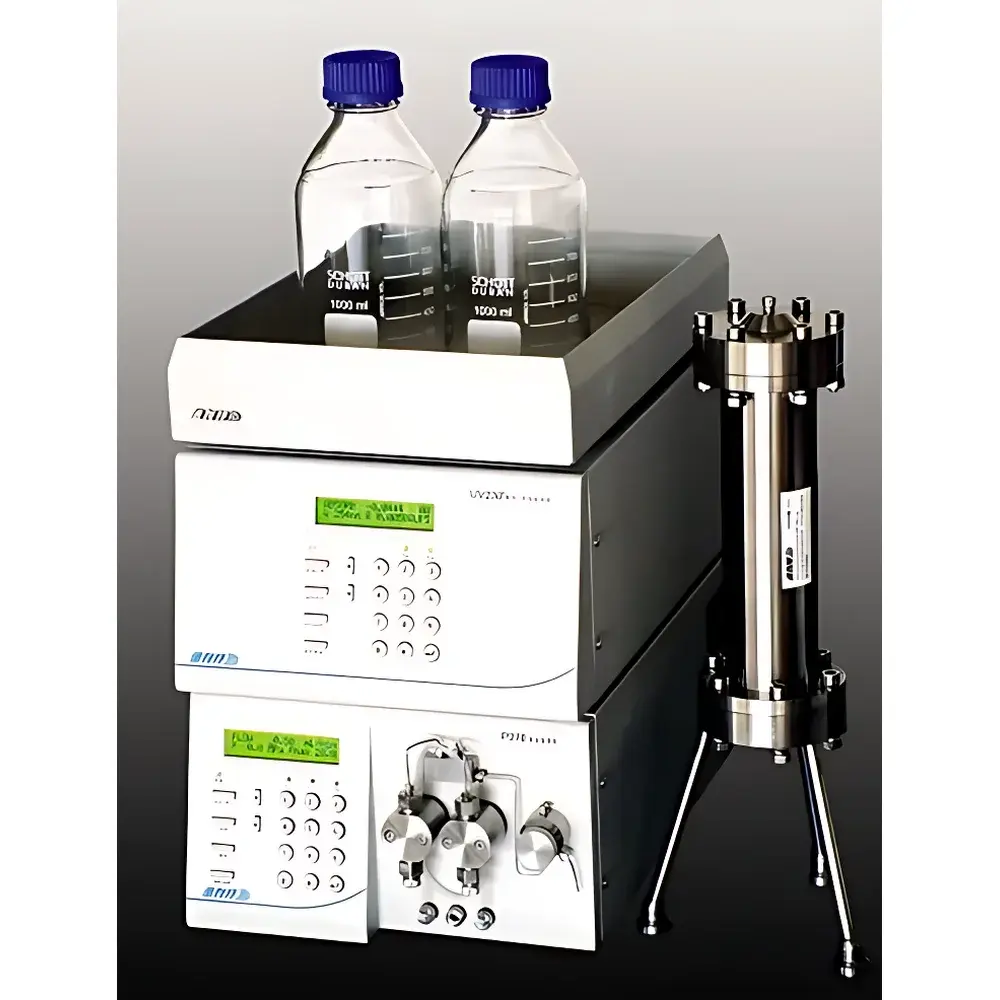
Elite P270 High-Performance Preparative Liquid Chromatography System
| Brand | Elite |
|---|---|
| Origin | Liaoning, China |
| Manufacturer Type | OEM Manufacturer |
| Regional Classification | Domestic (China) |
| Model | P270 |
| Application Level | Laboratory-Grade |
| Instrument Type | High-Pressure Preparative LC System |
| Flow Rate Range | 1.00–99.99 mL/min (0.01 mL/min increment) |
| Flow Accuracy | ≤±1.5% (at 30.00 mL/min, 8.5 MPa, water, 25°C) |
| Flow Precision (RSD) | ≤1.0% (at 30.00 mL/min, 8.5 MPa, water, 25°C) |
| Max Operating Pressure | 30 MPa (1.00–20.00 mL/min) |
| Pressure Display Error | ≤±3% |
| Pressure Pulsation | ≤3.0% |
| UV230+ Detector Wavelength Range | 190–720 nm |
| Wavelength Accuracy | ±0.5 nm |
| Wavelength Repeatability | ±0.1 nm |
| Spectral Bandwidth | 6 nm |
| Response Time | 0.0–9.9 s |
| Linear Dynamic Range | ≥1.5 AU (5% deviation) |
| Baseline Noise | ≤±1.5×10⁻⁵ AU |
| Baseline Drift | ≤3×10⁻⁴ AU/h |
| LOD (Naphthalene in Methanol) | 1.0×10⁻⁸ g/mL |
| Flow Cell Pathlength | 3 mm |
| Flow Cell Volume | 5 µL |
| EC2000 Data Station | RS232 interface |
| Input Range | −100 mV to +2 V |
| Signal Resolution | 2 µV |
| Area Resolution | 0.1 µV·s |
| Channel Options | Single or Dual |
| Integration Reproducibility | ≤0.01% RSD |
Overview
The Elite P270 High-Performance Preparative Liquid Chromatography System is engineered for scalable, reproducible isolation and purification of organic compounds, natural products, synthetic intermediates, and biopharmaceutical actives at the laboratory-to-pilot scale. Based on high-pressure gradient or isocratic separation principles, the system implements dual-plunger reciprocating pump architecture with microstepping motor control to deliver stable, low-pulsation solvent delivery across a broad flow range (1.00–99.99 mL/min). Its modular design integrates a high-sensitivity UV-Vis detector (UV230+), precision manual or automated injection valves (Rehodyne 3725i-038), static mixer modules, preparative-scale columns (10–50 mm i.d.), and optional fraction collection—enabling robust method transfer from analytical to semi-preparative workflows. The P270 operates within ISO/IEC 17025-aligned laboratory environments and supports method development compliant with ICH Q2(R2), USP , and FDA 21 CFR Part 11 when paired with validated software configurations.
Key Features
- Dual-plunger high-pressure pump with step-motor-driven precision control, delivering flow stability (RSD ≤1.0%) and accuracy (≤±1.5%) under load up to 30 MPa at low-flow conditions
- UV230+ detector featuring deuterium/tungsten dual-lamp source, 190–720 nm wavelength coverage, and 0.1 nm repeatability—optimized for preparative flow cells (5 µL volume, 3 mm pathlength)
- Modular valve configuration supporting manual (3725i-038) or automated sample introduction with 10 mL standard loop (expandable to 20 mL), plus integrated switching capability for multi-column or multi-solvent routing
- EC2000 chromatographic data station with GLP-compliant audit trail functionality, dual-channel acquisition, and peak integration reproducibility better than 0.01% RSD
- Scalable column compatibility: accommodates semi-preparative columns from 10 mm to 50 mm internal diameter, enabling linear scale-up from analytical methods without re-optimization
- Low-noise optical detection (baseline noise ≤±1.5×10⁻⁵ AU) and wide linear dynamic range (≥1.5 AU) ensure reliable quantitation of major and minor components in complex crude mixtures
Sample Compatibility & Compliance
The P270 system is routinely deployed for purification of small-molecule APIs, chiral intermediates, plant extracts, peptide fragments, and polymer additives. It handles mobile phases including aqueous buffers (pH 2–8), acetonitrile, methanol, THF, and chlorinated solvents—compatible with stainless steel and PEEK-wetted fluidic paths rated to 30 MPa. All hardware components meet CE marking requirements for electromagnetic compatibility (EMC Directive 2014/30/EU) and low-voltage safety (LVD Directive 2014/35/EU). When operated with EC2000 software under documented SOPs, the system supports compliance with GLP (OECD Principles), GMP Annex 11 (EU), and 21 CFR Part 11 electronic record integrity standards—including user authentication, electronic signatures, and immutable audit logs for all acquisition and processing events.
Software & Data Management
The EC2000 workstation provides native RS232 serial communication with full command set support for pump gradient programming, detector wavelength scanning, valve sequencing, and external fraction collector triggering. Its Windows-based interface features intuitive method building tools, real-time chromatogram overlay, baseline correction algorithms, and customizable report templates exportable to PDF, CSV, or XML. Raw data files are stored in vendor-neutral binary format with embedded metadata (date/time stamp, operator ID, instrument ID, method parameters), ensuring traceability during regulatory inspections. Optional software validation packages—including IQ/OQ documentation, test protocols, and summary reports—are available to support installation in regulated pharmaceutical QC/QA laboratories.
Applications
- Purification of synthetic reaction mixtures prior to NMR or MS characterization
- Isolation of reference standards for pharmacopeial monographs (USP, EP, ChP)
- Desalting and buffer exchange of oligonucleotides and synthetic peptides
- Chiral resolution of racemic drug candidates using polysaccharide-based preparative columns
- Extraction and concentration of bioactive natural products from fermentation broths or botanical extracts
- Removal of residual catalysts (e.g., Pd, Ru) from API synthesis streams
FAQ
What column diameters does the P270 support?
The system is configured for semi-preparative columns with internal diameters ranging from 10 mm to 50 mm, including standard sizes of 10, 20, 30, 40, and 50 mm.
Can the P270 operate in gradient mode?
Yes—the P270 is available in both isocratic and high-pressure gradient configurations; the gradient version includes dual high-pressure pumps and a static mixer module.
Is the EC2000 software compliant with 21 CFR Part 11?
EC2000 supports Part 11 compliance when deployed with enabled audit trail, role-based access control, and electronic signature modules—subject to site-specific validation.
What is the minimum detectable concentration for UV-active analytes?
Using naphthalene in methanol as benchmark, the LOD is 1.0×10⁻⁸ g/mL under standard operating conditions (1 cm pathlength equivalent, 5 µL cell, 254 nm).
Does the system include fraction collection capability?
Fraction collection is an optional module; users may select time-based or peak-triggered collection modes compatible with common rack-based or tube-carousel collectors.




