
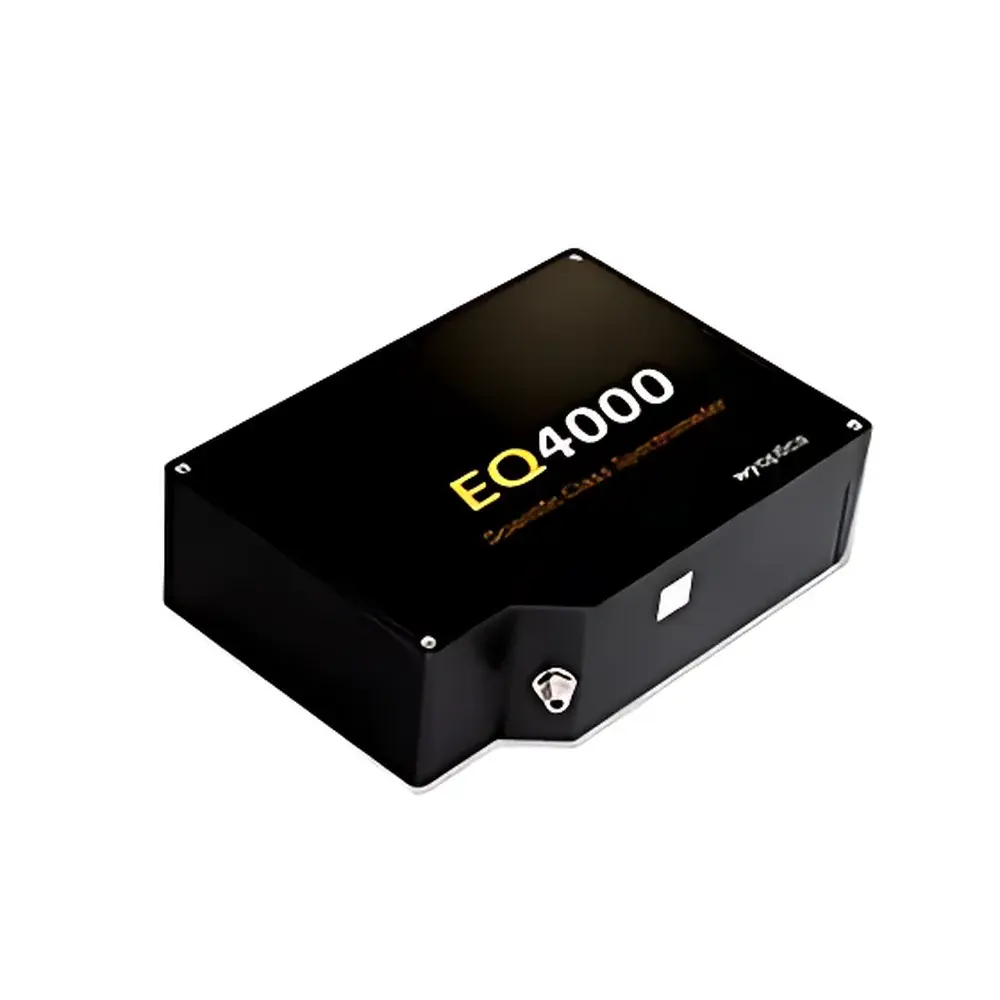
Wyoptics EQ4000 Research-Grade High-Resolution Fiber Optic Spectrometer
| Brand | Wyoptics |
|---|---|
| Origin | Shanghai, China |
| Manufacturer Type | Original Equipment Manufacturer (OEM) |
| Model | EQ4000-1 |
| Spectral Range | 200–1100 nm |
| Detector | Toshiba TCD1304DG linear CCD |
| Optical Resolution | 0.035–4.88 nm FWHM (configurable via grating & slit) |
| System Sensitivity | 2 × 10⁸ |
| Single-Scan Dynamic Range | 1300:1 |
| Signal-to-Noise Ratio (SNR) | 400:1 |
| Full Dynamic Range | 3000:1 |
| Stray Light | < 0.1% @ 600 nm |
| A/D Resolution | 16-bit |
| Integration Time | 1 ms – 2 s |
| Slit Options | 5, 10, 25, 50, 100, 200 µm |
| EX Broadband Technology | 200–1100 nm coverage with variable-order suppression |
Overview
The Wyoptics EQ4000 is a research-grade fiber optic spectrometer engineered for high-fidelity spectral acquisition across the deep ultraviolet (DUV) to near-infrared (NIR) spectrum. Based on a symmetrical crossed Czerny–Turner optical architecture with f/4 throughput and a 100 mm focal length, the EQ4000 leverages precision-machined optics, thermally stabilized mounting, and high-linearity CCD detection to deliver reproducible, calibration-traceable spectra under laboratory and industrial QC conditions. Its core measurement principle relies on wavelength-dispersive diffraction using exchangeable ruled or holographic gratings, enabling quantitative intensity mapping of incident light as a function of photon energy. The system supports both single-shot and averaged acquisitions, with real-time correction for dark current, pixel non-uniformity, and spectral responsivity—critical for applications demanding metrological rigor, such as laser linewidth characterization, atomic emission analysis, and molecular absorption spectroscopy.
Key Features
- Configurable optical resolution from 0.035 nm to 4.88 nm FWHM—achieved through interchangeable gratings (e.g., 2400 l/mm for UV, 300 l/mm for broadband) and user-selectable entrance slits (5–200 µm)
- EX Broadband Technology: proprietary optical design integrating a variable-order suppression filter (OFLV-200–1100) and EX-optimized blazed gratings, enabling seamless 200–1100 nm spectral coverage in a single acquisition without mechanical reconfiguration
- Toshiba TCD1304DG linear CCD detector (3648 pixels, 8 × 200 µm active area, ~100,000 e⁻ full-well capacity) with UV-enhanced coating option for extended DUV response down to 190 nm
- Onboard electronic shutter and programmable integration timing (1 ms–2 s) to prevent detector saturation during high-intensity signal capture
- USB 2.0 interface with bus-powered operation—no external power supply required; compatible with Windows, Linux, and macOS via SDK-supported API (C/C++, Python, LabVIEW)
- High linearity (>99.8% pixel-to-pixel), low dark noise (12 RMS counts), and stray light suppression (<0.1% at 600 nm) ensure compliance with ASTM E275 and ISO/IEC 17025 spectral validation requirements
Sample Compatibility & Compliance
The EQ4000 interfaces seamlessly with standard SMA905 fiber-coupled sources—including deuterium/halogen lamps, LEDs, pulsed lasers, plasma torches, and gas discharge cells—enabling flexible integration into custom optical benches or OEM analytical platforms. Its modular slit and grating configuration allows optimization for transmission, reflection, fluorescence, or Raman scattering geometries. The instrument conforms to electromagnetic compatibility (EMC) standards IEC 61326-1 and safety standard IEC 61010-1. Calibration certificates traceable to NIST SRM 2031 (Holmium Oxide) and SRM 2034 (Didymium) are available upon request. For regulated environments, firmware supports audit trail logging and user-access controls aligned with FDA 21 CFR Part 11 principles when used with validated third-party software.
Software & Data Management
Wyoptics provides SpectraSuite Pro—a cross-platform spectral acquisition and analysis suite supporting real-time preview, multi-curve overlay, peak identification (with library matching), absorbance/transmittance conversion, and derivative spectroscopy. Raw data exports in ASCII, CSV, and HDF5 formats preserve full metadata (wavelength calibration coefficients, integration time, temperature, slit width, grating ID). The SDK enables deterministic control of all hardware parameters and supports integration into automated test systems compliant with GLP/GMP workflows. Optional modules include chemometric preprocessing (baseline correction, Savitzky–Golay smoothing), spectral deconvolution, and time-resolved kinetics analysis for transient emission studies.
Applications
- Laser characterization: precise determination of central wavelength, bandwidth (FWHM), mode structure, and side-mode suppression ratio (SMSR) for diode, DPSS, and ultrafast oscillators
- Gaseous species quantification: high-resolution absorption spectroscopy of O₃, NO₂, SO₂, CH₄, and NH₃ in environmental monitoring and combustion diagnostics
- Plasma diagnostics: line-ratio thermometry, electron density estimation via Stark broadening, and elemental composition mapping in ICP and glow discharge sources
- Material science: thin-film thickness measurement via interference fringe analysis, bandgap determination in semiconductors, and photoluminescence quantum yield assessment
- Pharmaceutical QA/QC: excipient identification, polymorph screening, and dissolution profile monitoring using UV-Vis-NIR reflectance
FAQ
What spectral calibration standards are supported?
NIST-traceable holmium oxide (SRM 2031) and didymium (SRM 2034) filters are recommended for wavelength calibration; factory calibration includes quadratic polynomial coefficients stored in non-volatile memory.
Can the EQ4000 operate in vacuum or controlled atmosphere environments?
The base unit is rated for ambient operation (15–35°C, <80% RH non-condensing); optional hermetic housing and fused-silica windows enable use in dry nitrogen purged or low-pressure enclosures.
Is EX Broadband Technology compatible with all grating options?
EX performance is optimized for designated EX-series gratings (e.g., EX-1200, EX-600); standard gratings retain full functionality but may require manual order-sorting filters outside the 200–1100 nm range.
How is stray light performance verified?
Stray light is measured per ISO 17123-6 using a 600 nm primary source with 5 nm bandwidth and secondary source at ±100 nm offset; reported values reflect worst-case configuration (200 µm slit, broadband grating).
Does the system support trigger synchronization with external devices?
Yes—TTL-compatible input/output ports enable hardware triggering for pump-probe experiments, gated detection, or synchronized multi-channel acquisition with oscilloscopes or data loggers.
Related Products





