
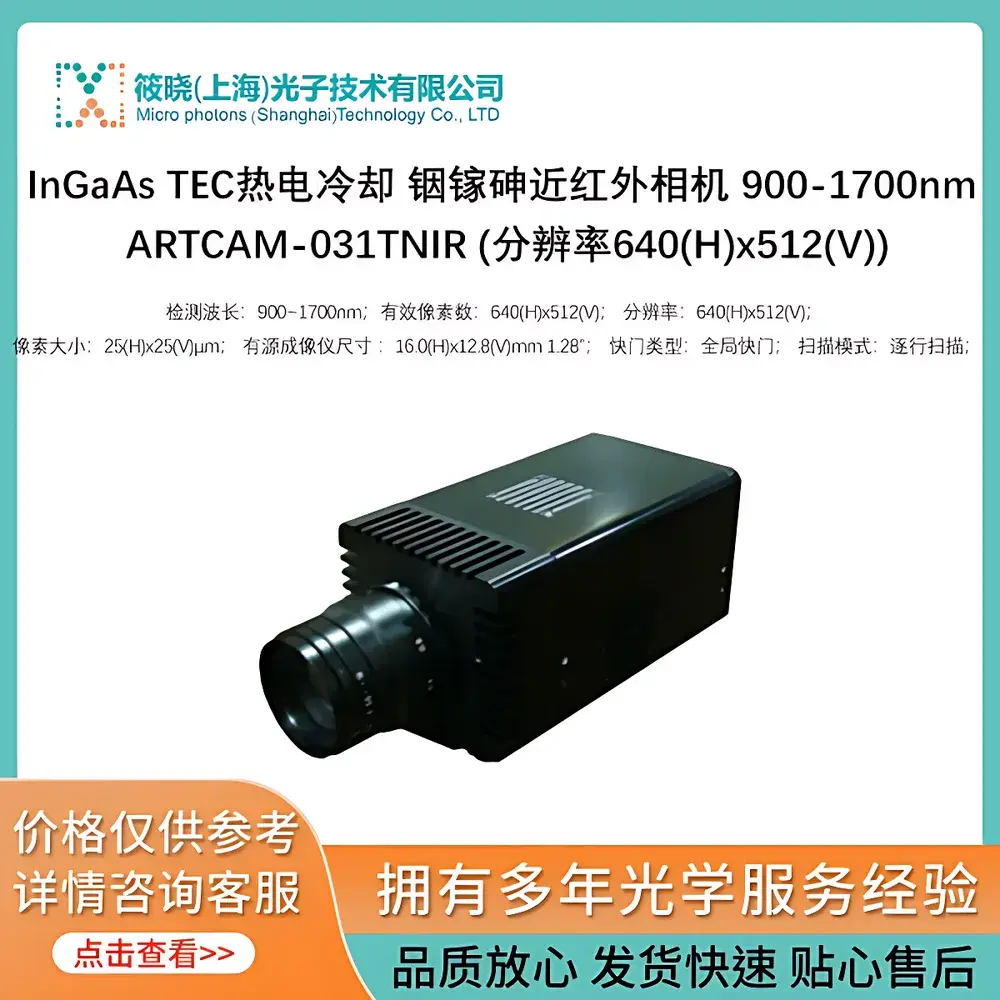
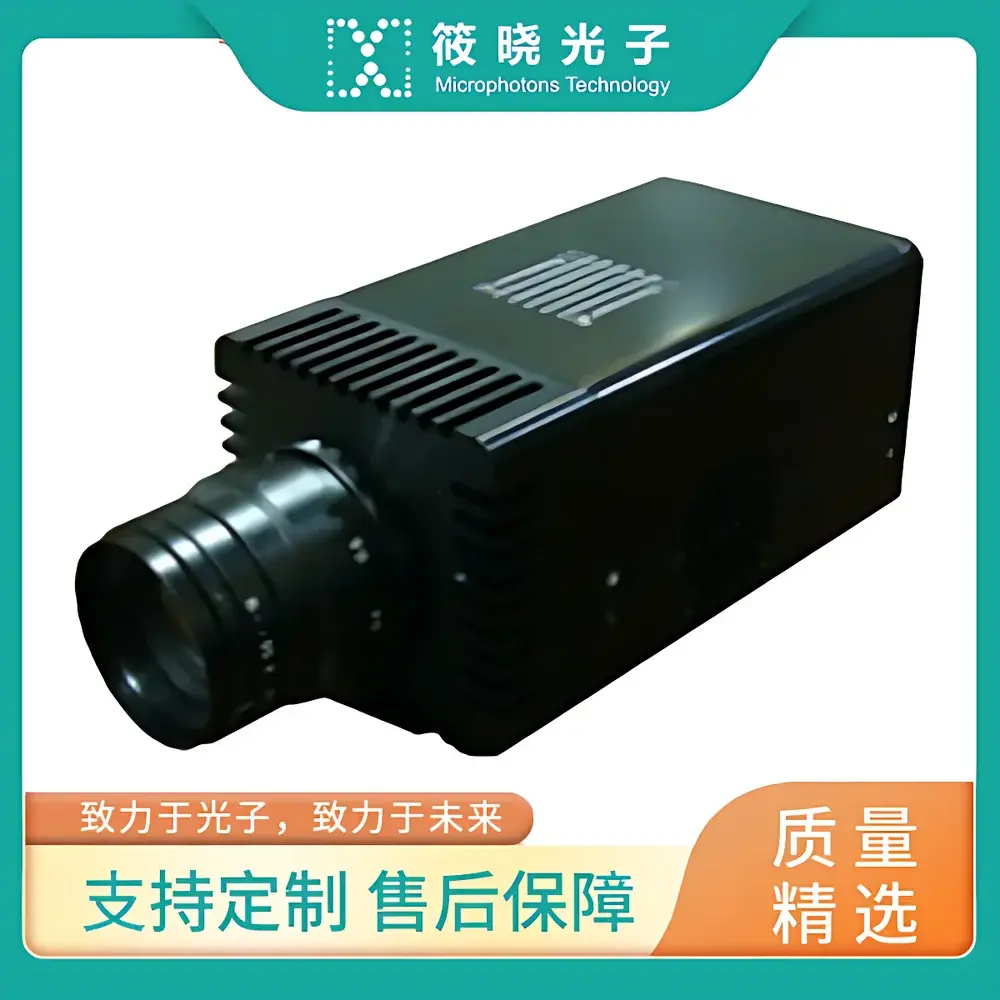
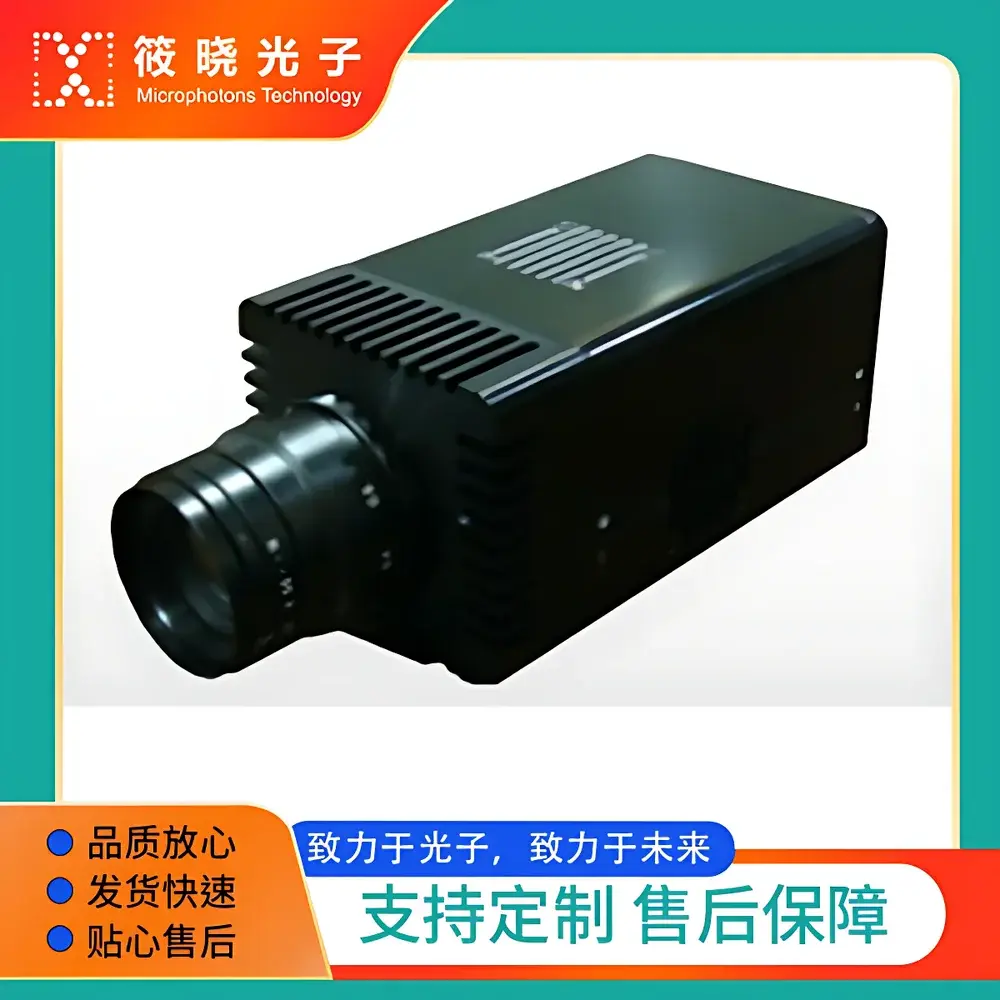
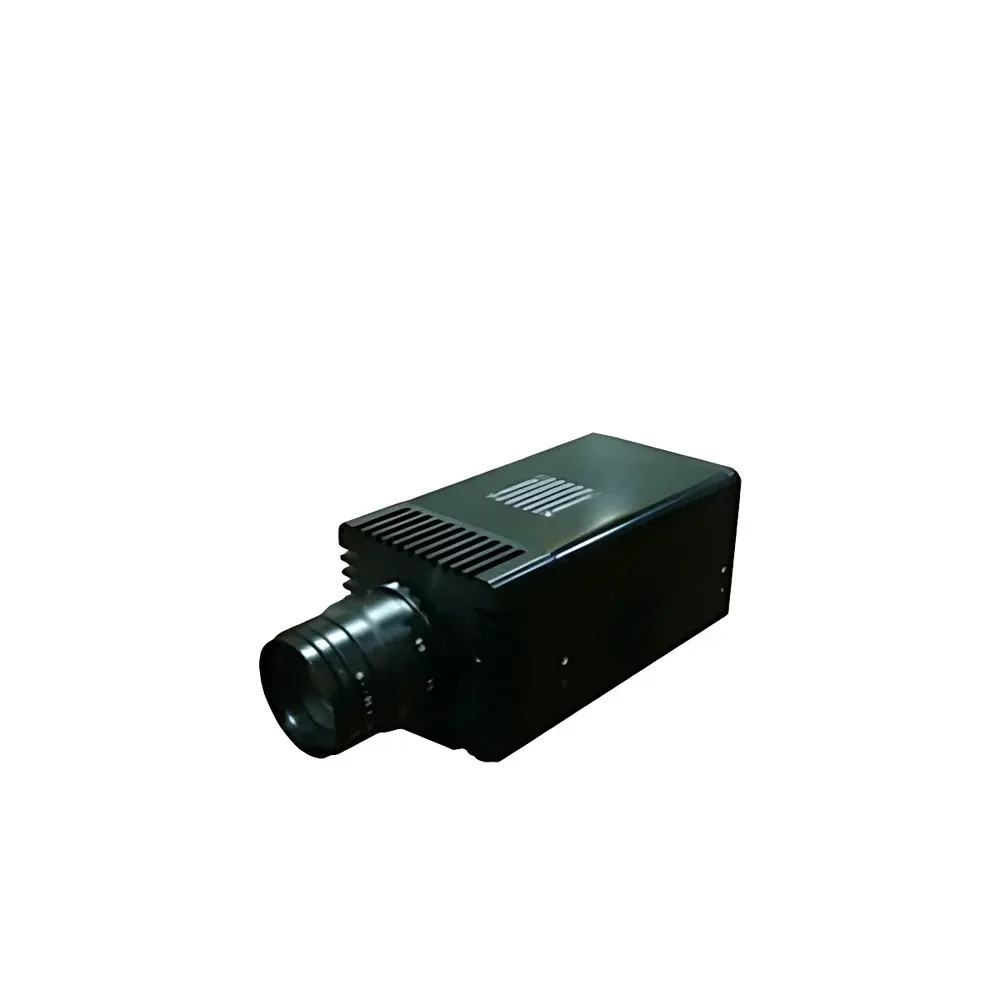
Artray ARTCAM-031TNIR InGaAs TEC-Cooled Near-Infrared Camera (640 × 512 Resolution)
| Brand | Artray |
|---|---|
| Origin | Japan |
| Model | ARTCAM-031TNIR |
| Sensor Type | InGaAs |
| Spectral Range | 900–1700 nm |
| Resolution | 640(H) × 512(V) |
| Pixel Size | 25 µm × 25 µm |
| Active Imaging Area | 16.0 mm × 12.8 mm |
| Shutter Type | Global Shutter |
| Scan Mode | Progressive Scan |
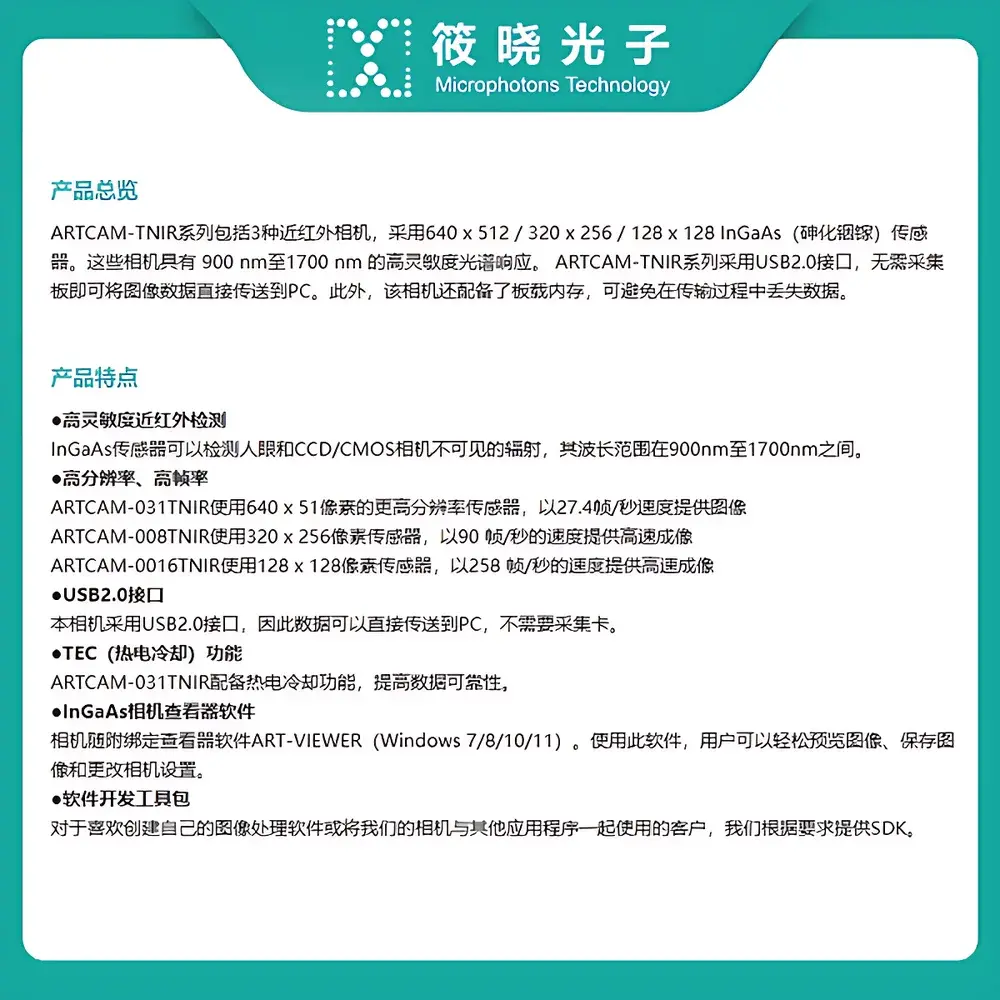
| Interface | USB 2.0 |
| A/D Resolution | 12-bit |
| Frame Rate | 27.4 fps |
| Exposure Time | 5.4 µs – 4.408 s |
| Detectivity | ≥5 × 10¹² Jones |
| Full Well Capacity | High Gain: 118 ke⁻, Low Gain: 1.9 Me⁻ |
| Cooling | Integrated TEC (Thermoelectric Cooler) |
| Lens Mount | C-Mount |
| Power Supply | DC 12 V |
| Power Consumption | <20 W |
| Operating Temperature | 0–35 °C |
| Dimensions | 71.6 × 61.5 × 125 mm |
| Weight | ~400 g |
Overview
The Artray ARTCAM-031TNIR is a high-performance, thermoelectrically cooled (TEC) near-infrared (NIR) imaging camera engineered for precision scientific and industrial applications requiring stable, low-noise detection in the 900–1700 nm spectral band. Built around a monolithic InGaAs (indium gallium arsenide) focal plane array, this camera leverages the intrinsic quantum efficiency of III-V semiconductor photodiodes to deliver quantitative radiometric response where silicon-based sensors are blind. Unlike conventional CCD or CMOS imagers, the ARTCAM-031TNIR operates in the short-wave infrared (SWIR) region—enabling non-destructive inspection of silicon wafers, laser beam profiling, optical component characterization, and thermal contrast analysis through scattering media. Its integrated single-stage TEC actively stabilizes the sensor die at a fixed temperature (typically ~−10 °C), suppressing dark current drift and ensuring shot-noise-limited performance over extended acquisition periods. Designed for plug-and-play integration, the camera employs a standard USB 2.0 interface with on-board frame buffering—eliminating dependency on external frame grabbers while maintaining data integrity during high-throughput streaming.
Key Features
- TEC-Stabilized InGaAs Sensor: Integrated thermoelectric cooler maintains sensor temperature within ±0.5 °C, reducing dark current by up to two orders of magnitude versus uncooled operation and enabling long-exposure (>1 s), low-light NIR imaging with high dynamic range.
- High Spatial Fidelity: 640 × 512 pixel resolution with uniform 25 µm × 25 µm square pixels ensures consistent modulation transfer function (MTF) across the full active area (16.0 mm × 12.8 mm), supporting calibrated line-spread function (LSF) measurements and precise MTF mapping of optical systems.
- Global Shutter Architecture: Synchronous exposure control eliminates motion-induced skew or rolling shutter artifacts—critical for time-resolved laser diagnostics, pulsed illumination synchronization, and high-speed machine vision tasks involving moving targets.
- USB 2.0 Direct Acquisition: Native UVC-compliant driver stack enables seamless compatibility with Windows 7/8/10/11 without proprietary hardware dependencies; onboard 128 MB DDR3 buffer prevents frame loss during host latency spikes or bus contention.
- Flexible Gain & Exposure Control: Dual-gain analog front-end supports high-sensitivity (low-noise) and high-dynamic-range (HDR) modes; programmable exposure from 5.4 µs to 4.408 s permits optimization for both fast transient events and low-flux steady-state imaging.
- C-Mount Standardization: Industry-standard C-mount lens interface allows interchangeability with off-the-shelf SWIR lenses (e.g., f/1.4, f/2.0, telecentric), objective couplers, and custom collimation optics—facilitating rapid system reconfiguration.
Sample Compatibility & Compliance
The ARTCAM-031TNIR is compatible with a broad range of NIR-emitting and NIR-transmissive samples, including but not limited to silicon wafers (defect inspection via carrier lifetime imaging), polymer films (thickness and moisture content analysis), pharmaceutical tablets (coating uniformity assessment), and laser diodes (near-field/far-field profiling at 1064 nm, 1310 nm, or 1550 nm). It meets mechanical and electrical requirements for ISO 17025-accredited laboratories when used with traceable calibration sources (e.g., NIST-traceable tungsten halogen lamps with SWIR-enhanced spectral output). While not inherently FDA 21 CFR Part 11 compliant as a standalone device, its SDK supports integration into validated GxP environments where audit trails, electronic signatures, and user access controls are implemented at the application layer per ICH GCP and GLP guidelines.
Software & Data Management
The camera ships with ART-VIEWER—a native Windows application providing real-time preview, histogram-based auto-exposure, ROI-based statistics (mean, std dev, min/max), multi-frame averaging, and TIFF/RAW16 export with embedded metadata (timestamp, exposure, gain, sensor temperature). For automated workflows, Artray provides a comprehensive C/C++ and Python-compatible Software Development Kit (SDK) supporting asynchronous image capture, hardware-triggered acquisition, and memory-mapped buffer access. The SDK includes sample code for integration with OpenCV, MATLAB Image Acquisition Toolbox, and LabVIEW Vision Development Module. All firmware updates and configuration files are digitally signed to ensure integrity, and logging functions record all parameter changes with UTC timestamps—supporting traceability in regulated QA/QC processes.
Applications
- Semiconductor Metrology: Backside inspection of silicon ICs through substrate transparency at 1310 nm; identification of micro-cracks, voids, and bond wire misalignment.
- Laser Characterization: M² measurement, beam centroid tracking, and hot-spot detection for fiber-coupled and free-space NIR lasers used in telecommunications and material processing.
- Non-Destructive Testing (NDT): Subsurface defect detection in composites, ceramics, and painted metal surfaces using NIR reflectance and transmission contrast.
- Biomedical Research: Small-animal fluorescence imaging using NIR-II fluorophores (e.g., IR-1061, CH1055); vascular perfusion mapping under controlled ambient light conditions.
- Industrial Sorting & Quality Assurance: Real-time discrimination of plastic resin types (e.g., PET vs. PP) based on spectral absorption fingerprints in the 1100–1600 nm window.
FAQ
Does the ARTCAM-031TNIR support external triggering?
Yes—the camera accepts TTL-level trigger signals via a dedicated SMA input, enabling precise synchronization with pulsed lasers, strobe lights, or motion stages.
Is radiometric calibration available?
Artray offers optional factory-applied NIST-traceable responsivity calibration (per-pixel gain and offset maps) delivered as binary lookup tables compatible with ART-VIEWER and the SDK.
Can the camera operate continuously for >8 hours?
Under ambient temperatures ≤30 °C and adequate airflow, continuous operation is supported; thermal throttling is disabled in firmware, and TEC duty cycle remains stable due to closed-loop temperature regulation.
What is the maximum sustained data throughput over USB 2.0?
At full resolution and 27.4 fps, the sustained bandwidth is ~28 MB/s—well within the theoretical limit of USB 2.0 (480 Mbps ≈ 60 MB/s raw), with headroom for metadata and protocol overhead.
Is Linux or macOS support provided?
Official drivers are Windows-only; however, the SDK’s USB vendor-class interface allows community-developed libusb bindings for Linux (e.g., via Python’s PyUSB) and limited macOS compatibility using IOUSBHostFamily extensions.




