
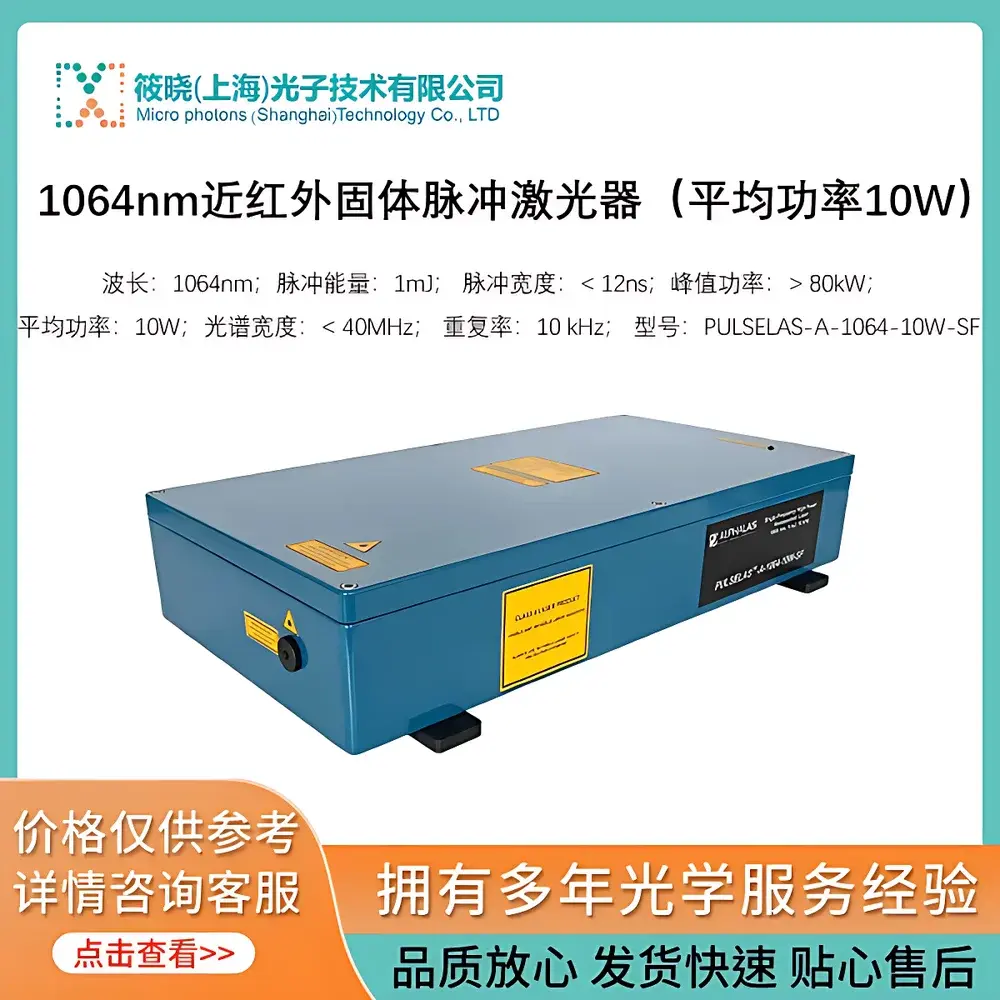

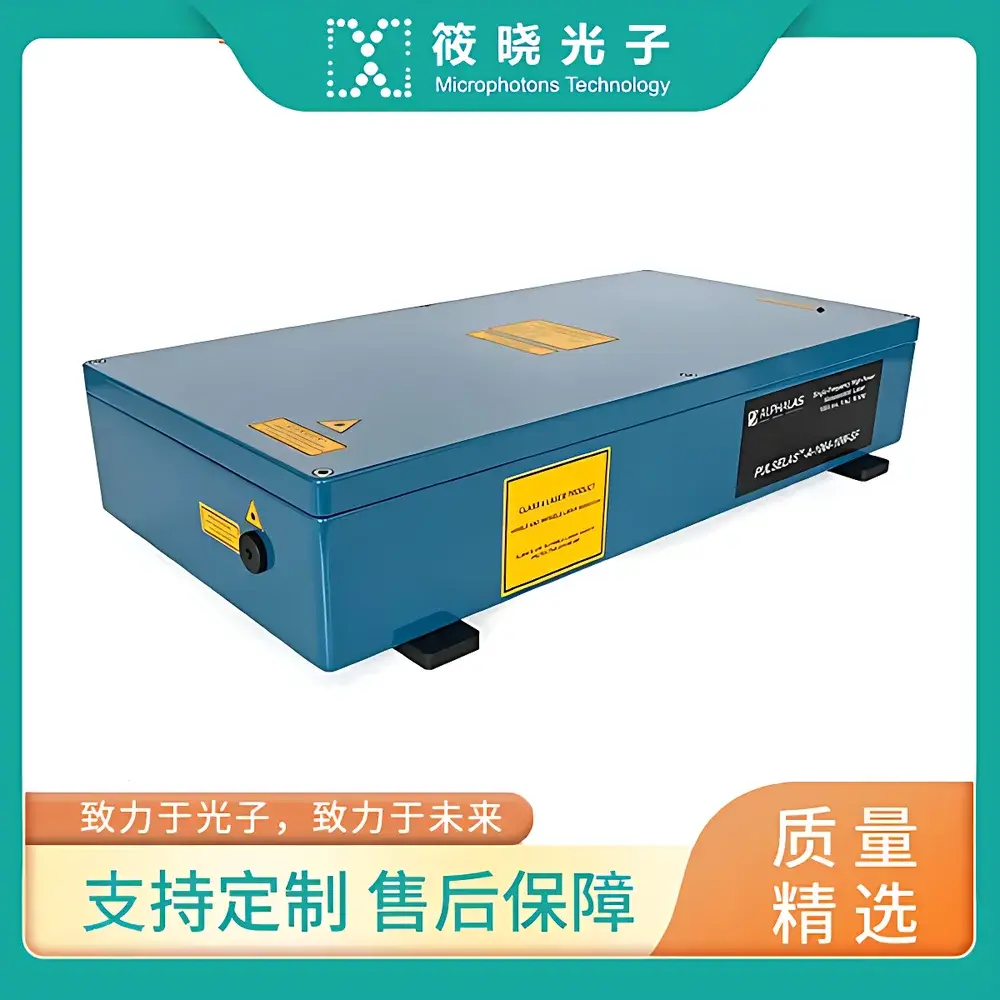
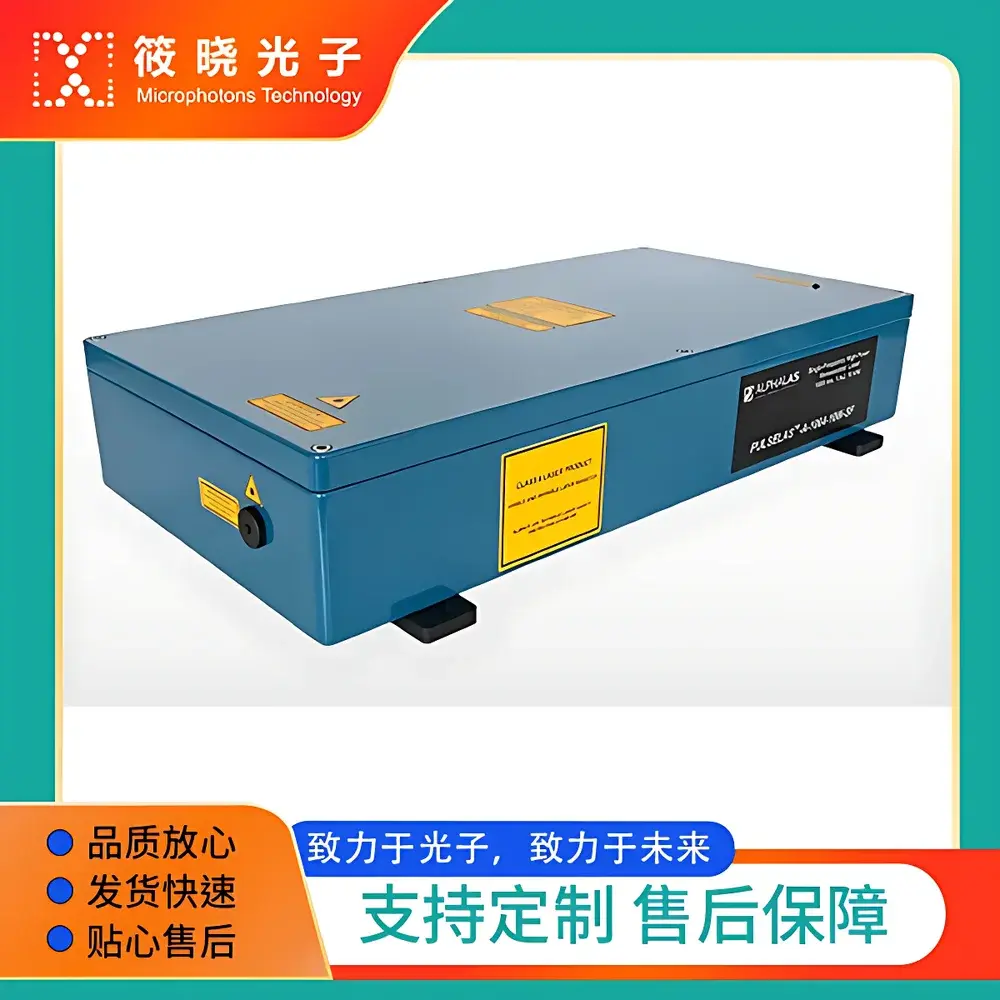
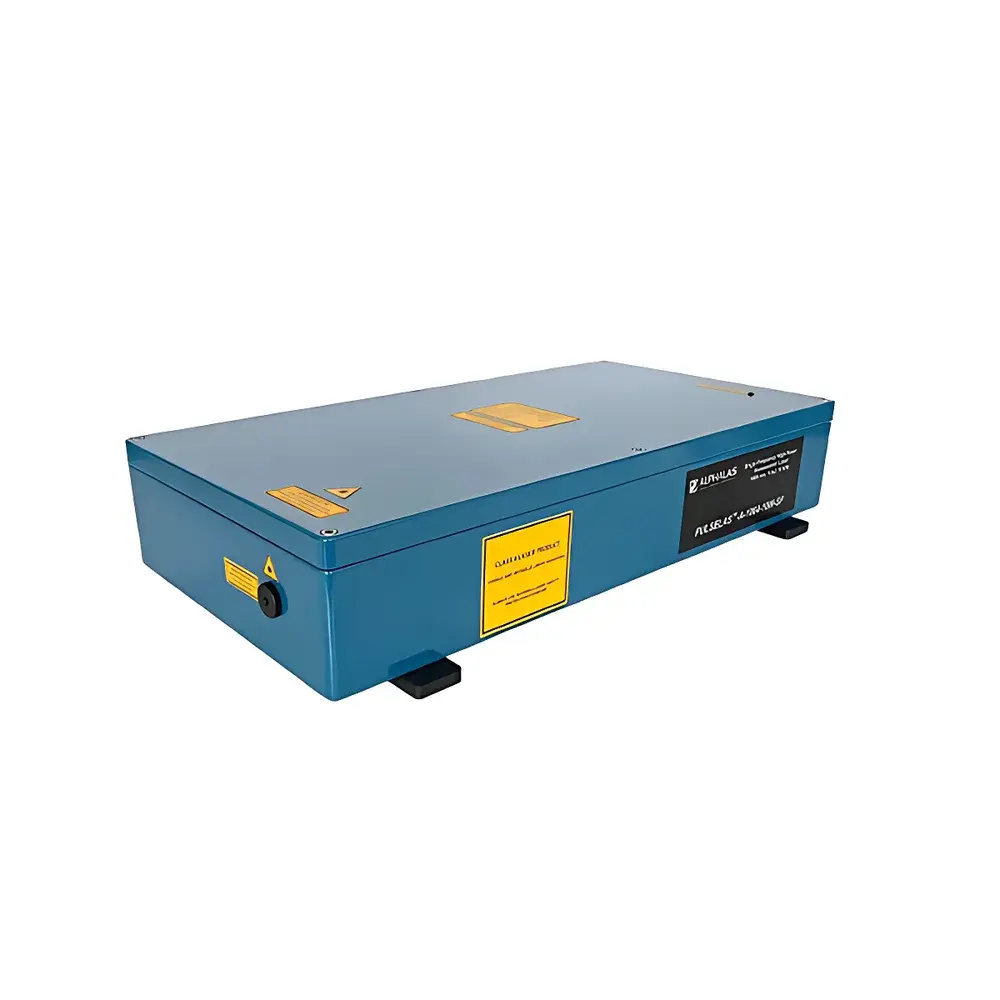
AlphaLas PULSELAS-A-1064-10W-SF 1064 nm Diode-Pumped Solid-State Q-Switched Nanosecond Pulsed Laser
| Brand | AlphaLas |
|---|---|
| Origin | Germany |
| Model | PULSELAS-A-1064-10W-SF |
| Wavelength | 1064 nm |
| Average Output Power | 10 W |
| Pulse Width (FWHM) | <1 ns (typ.) |
| Repetition Rate | Up to 10 kHz (adjustable) |
| Beam Quality (M²) | 1.01 (ISO 11146) |
| Beam Parameter Product (BPP) | 0.338 mm·mrad |
| Divergence (Full Angle, eff.) | 1.08 mrad |
| Side-Mode Suppression Ratio (SMSR) | >25 dB |
| Long-Term Power Stability (8 h) | <±0.5% RMS |
| Beam Pointing Stability (8 h) | <5 µrad RMS |
| Polarization | Linear, >100:1 |
| Cooling | Water-cooled |
| Compliance | CE, RoHS, IEC 60825-1:2014 Class 4 Laser Product |
Overview
The AlphaLas PULSELAS-A-1064-10W-SF is a high-reliability, diode-pumped solid-state (DPSS) Q-switched nanosecond pulsed laser engineered for precision industrial, scientific, and metrological applications requiring stable 1064 nm output at high average power. Based on Nd:YAG gain medium with intra-cavity frequency stabilization and active thermal management, it delivers near-transform-limited pulses with sub-nanosecond duration and exceptional temporal contrast. Its design adheres to fundamental principles of resonant cavity dynamics and electro-optic Q-switching, enabling deterministic pulse timing and minimal amplitude jitter (<1% RMS). The system operates in TEM00 mode with diffraction-limited beam propagation characteristics—validated per ISO 11146—making it suitable for applications demanding tight focusability, low M², and reproducible spatial intensity distribution over extended operational cycles.
Key Features
- Stable 10 W average output power at 1064 nm with <±0.5% RMS long-term power stability over 8-hour continuous operation
- Sub-nanosecond pulse width (FWHM <1 ns, typical) with adjustable repetition rate from single-shot up to 10 kHz
- Exceptional beam quality: M² = 1.01, BPP = 0.338 mm·mrad, and effective divergence of 1.08 mrad (full angle)
- High spectral purity: side-mode suppression ratio exceeding 25 dB, confirmed via calibrated optical spectrum analysis
- Beam pointing stability <5 µrad RMS over 8 hours—critical for alignment-sensitive interferometric and nonlinear optical setups
- Integrated water cooling architecture ensuring thermal equilibrium across ambient temperatures from 15–30 °C
- Compliance with IEC 60825-1:2014 as a Class 4 laser product, including interlock-ready safety interface and emission indicator
Sample Compatibility & Compliance
The PULSELAS-A-1064-10W-SF is compatible with standard optical mounts (e.g., kinematic mirror mounts, Ø25.4 mm lens tubes) and integrates seamlessly into vacuum-compatible or cleanroom environments when equipped with optional sealed housing. Its 1064 nm output is optimized for interaction with silicon-based detectors, nonlinear crystals (e.g., KTP, LBO), and photoconductive switches. The laser meets EU CE marking requirements and conforms to RoHS Directive 2011/65/EU for hazardous substance restrictions. For regulated laboratory environments—including those operating under GLP or ISO/IEC 17025—its built-in analog monitor outputs (photodiode signal, sync TTL) support traceable power logging and external trigger synchronization. Full documentation includes factory calibration certificates referencing NIST-traceable radiometric standards.
Software & Data Management
While the PULSELAS-A-1064-10W-SF operates in stand-alone mode via front-panel controls and analog/digital I/O, optional AlphaLas Control Suite (v3.2+) provides USB 2.0–based remote configuration of repetition rate, burst mode parameters, and internal pulse counter reset. All operational logs—including real-time photodiode feedback, temperature telemetry, and interlock status—are timestamped and exportable in CSV format. Audit trails comply with FDA 21 CFR Part 11 requirements when deployed with validated user access control and electronic signature modules. No proprietary drivers are required; communication uses standard HID-compliant protocols compatible with LabVIEW™, MATLAB®, and Python (PySerial/PicoSDK).
Applications
- Laser-induced breakdown spectroscopy (LIBS) requiring high peak power and shot-to-shot consistency
- Pump source for optical parametric oscillators (OPOs) and tunable ultrafast amplifier systems
- Time-resolved fluorescence lifetime imaging (FLIM) and time-correlated single-photon counting (TCSPC)
- High-resolution laser ablation for mass spectrometry sample introduction (e.g., LA-ICP-MS)
- Calibration of photodetectors, streak cameras, and fast oscilloscopes (≥20 GHz bandwidth)
- Nonlinear frequency conversion experiments (SHG, THG, SFG) where beam quality and pointing stability directly affect conversion efficiency
- Industrial micromachining of transparent dielectrics and thin-film patterning with minimized heat-affected zones
FAQ
What is the maximum pulse energy achievable at 10 kHz repetition rate?
At 10 kHz, the average power remains 10 W; therefore, pulse energy is approximately 1 mJ per pulse (10 W ÷ 10⁴ Hz), assuming uniform pulse distribution.
Is the laser qualified for use in cleanroom Class 100 environments?
Yes—the base unit features sealed optics and low-outgassing materials; optional ISO Class 5–compatible enclosure kits are available upon request.
Does the system include a built-in energy meter or require external calibration?
No integrated energy meter is included; however, calibrated photodiode monitoring output (0–10 V proportional to pulse energy) enables traceable external measurement using NIST-certified pyroelectric or thermopile sensors.
Can the pulse repetition rate be externally triggered in burst mode?
Yes—TTL-compatible external trigger input supports gated operation with programmable burst patterns (e.g., 1–100 pulses per trigger) and delay resolution ≤10 ns.
What maintenance intervals are recommended for sustained M² performance?
AlphaLas recommends annual inspection of cavity alignment and coolant loop integrity; no routine realignment is required under normal operating conditions due to monolithic mechanical design and passive thermal compensation.



