
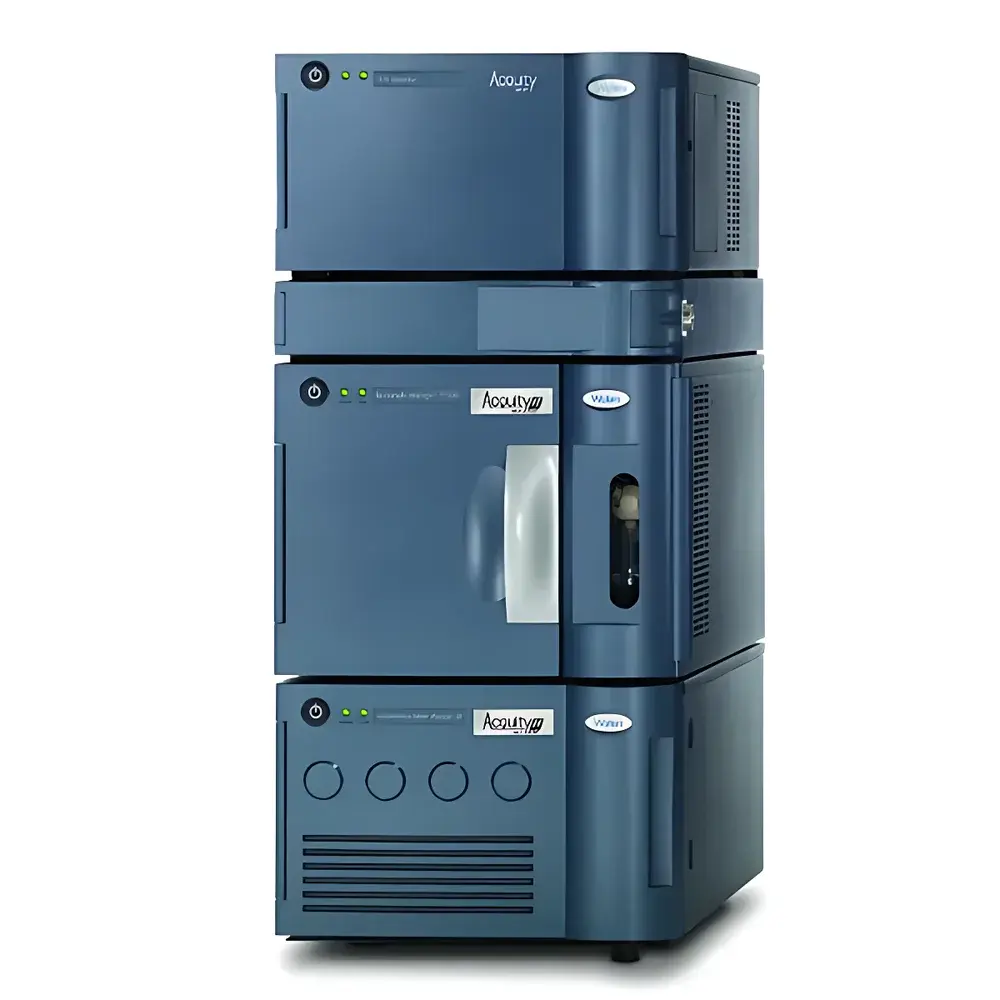
Waters ACQUITY UPLC H-Class Bio System
| Brand | Waters |
|---|---|
| Origin | USA |
| Manufacturer Type | Authorized Distributor |
| Origin Category | Imported |
| Model | ACQUITY UPLC H-Class Bio |
| Instrument Type | Ultra-Performance Liquid Chromatograph (UPLC) |
| Solvent Delivery | Quaternary Gradient System |
| Sample Introduction | Flow-Through Needle Autosampler |
| Temperature Control | Column Heater with Multi-Column Switching Capability |
| Detection Compatibility | UPLC-Optimized UV/Vis, PDA, Fluorescence, and Mass Spectrometry Detectors |
| Regulatory Support | 21 CFR Part 11–compliant software, GLP/GMP audit trail, method validation support per ICH Q2(R2) and USP <1058> |
Overview
The Waters ACQUITY UPLC® H-Class Bio System is an ultra-high-pressure liquid chromatography platform engineered specifically for the robust, reproducible, and biocompatible analysis of large biomolecules—including monoclonal antibodies (mAbs), antibody-drug conjugates (ADCs), recombinant proteins, peptides, oligonucleotides, and polysaccharides. Unlike conventional HPLC or generic UPLC systems, the H-Class Bio integrates a fully inert, low-metal, low-surface-area fluidic path constructed from titanium, PEEK, and ceramic components to minimize adsorption, aggregation, and on-column degradation. Its core architecture leverages Couette flow-based solvent blending, low-dispersion gradient formation, and minimized dwell volume (<100 µL) to ensure precise retention time control and peak fidelity across diverse separation modes—reversed-phase (RP), ion-exchange (IEX), size-exclusion (SEC), and hydrophilic interaction liquid chromatography (HILIC). Designed for method transferability and regulatory compliance, it serves as a foundational platform for biopharmaceutical characterization, stability-indicating assays, and quality control in GMP environments.
Key Features
- Biocompatible Fluidic Pathway: Titanium pump heads, inert PEEK tubing, and ceramic check valves eliminate metal-catalyzed oxidation and surface-induced denaturation—critical for intact mAb analysis and subunit mapping.
- Quaternary Solvent Manager with AutoBlend Plus™ Technology: Enables real-time, on-the-fly pH and organic modifier adjustment during gradient runs; supports up to four solvents with programmable mixing ratios for method development flexibility in IEX and HILIC.
- Flow-Through Needle Autosampler: Delivers high recovery (>95%) and negligible carryover (<0.005%) across viscous, sticky, or low-concentration biotherapeutic samples—validated per USP and ICH Q5E.
- Modular Column Oven with Multi-Column Selection: Maintains temperature stability within ±0.1 °C across 0–90 °C; integrated column switcher supports automated method sequencing across orthogonal columns without manual intervention.
- Low-Dispersion Detector Interface: Optimized for sub-2-µm particle columns and flow rates up to 1.0 mL/min; compatible with Waters ACQUITY UPLC PDA eXtended Range, FLR, and Xevo® TQ-S micro mass spectrometers via direct LC-MS coupling.
Sample Compatibility & Compliance
The H-Class Bio system accommodates complex biological matrices—including cell culture supernatants, purified protein fractions, enzymatic digests, and formulated drug products—without compromising integrity or resolution. Its hardware and Empower™ 3 Software (with BioSuite option) are validated for use in regulated environments: full 21 CFR Part 11 compliance (electronic signatures, audit trails, role-based access control), alignment with ICH Q5A–Q5E guidelines for biotechnological product characterization, and support for USP analytical instrument qualification (AIQ). System suitability testing (SST) templates, forced degradation study workflows, and peptide mapping report generators are embedded in the software suite to accelerate regulatory submissions.
Software & Data Management
Empower 3 Software with BioSuite Extension provides end-to-end workflow automation—from sequence setup and peak integration (using advanced baseline correction algorithms for overloaded SEC chromatograms) to comparative analysis across batches and stability timepoints. Raw data is stored in secure, tamper-evident .emp format with SHA-256 hashing. All processing parameters—including integration events, threshold settings, and calibration curves—are version-controlled and traceable. The system supports LIMS integration via ASTM E1578-compliant interfaces and exports reports in PDF/A-1b and CSV formats compliant with FDA eCTD requirements.
Applications
- Intact mass analysis and subunit characterization of mAbs under native and denaturing conditions
- Peptide mapping for primary structure verification and post-translational modification (PTM) profiling
- SEC-UPLC for aggregation assessment (monomer/dimer/fragment quantification) with <1.5% RSD in retention time
- HILIC-UPLC for glycan release and profiling using 2-AB labeling
- IEX-UPLC for charge variant analysis (acidic/basic species) with <0.02 min retention time variability across 100+ injections
- Stability-indicating assays for thermal, oxidative, and photolytic stress studies per ICH Q1A–Q1E
FAQ
Is the H-Class Bio compatible with mass spectrometry detection?
Yes—it supports direct coupling to Waters Xevo series and other industry-standard LC-MS platforms via low-dead-volume interfaces optimized for nanoflow to standard-flow UPLC conditions.
Can methods developed on the H-Class Bio be transferred to other UPLC or HPLC systems?
Method transfer is facilitated by its standardized dwell volume, consistent gradient delay compensation, and Empower’s Method Transfer Assistant tool—enabling seamless migration to ACQUITY Arc or Alliance HPLC systems with minimal revalidation.
Does the system support unattended overnight operation for stability studies?
Yes—the autosampler includes temperature-controlled sample storage (4–40 °C), robotic arm collision avoidance, and run-failure recovery protocols compliant with ALCOA+ data integrity principles.
What validation documentation is provided with the system?
Waters supplies IQ/OQ/PQ protocols aligned with ASTM E2500, USP , and Annex 11; installation and operational qualification reports are pre-executed and user-signature-ready.
How is carryover managed for highly adsorptive samples like ADCs?
The flow-through needle design, combined with programmable needle wash cycles using dual-solvent (aqueous/organic) protocols and pressure-pulsed rinsing, achieves <0.005% carryover even after injection of 10 mg/mL naked antibody solutions.






