
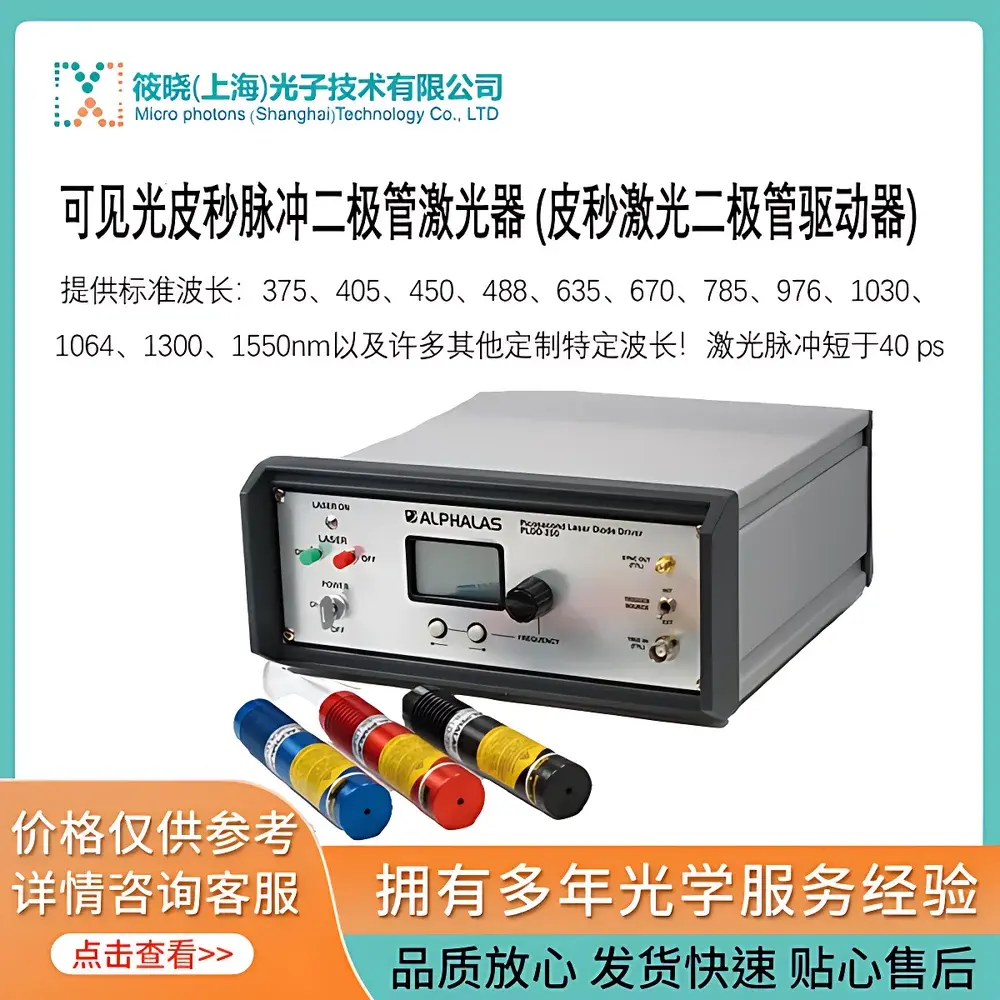

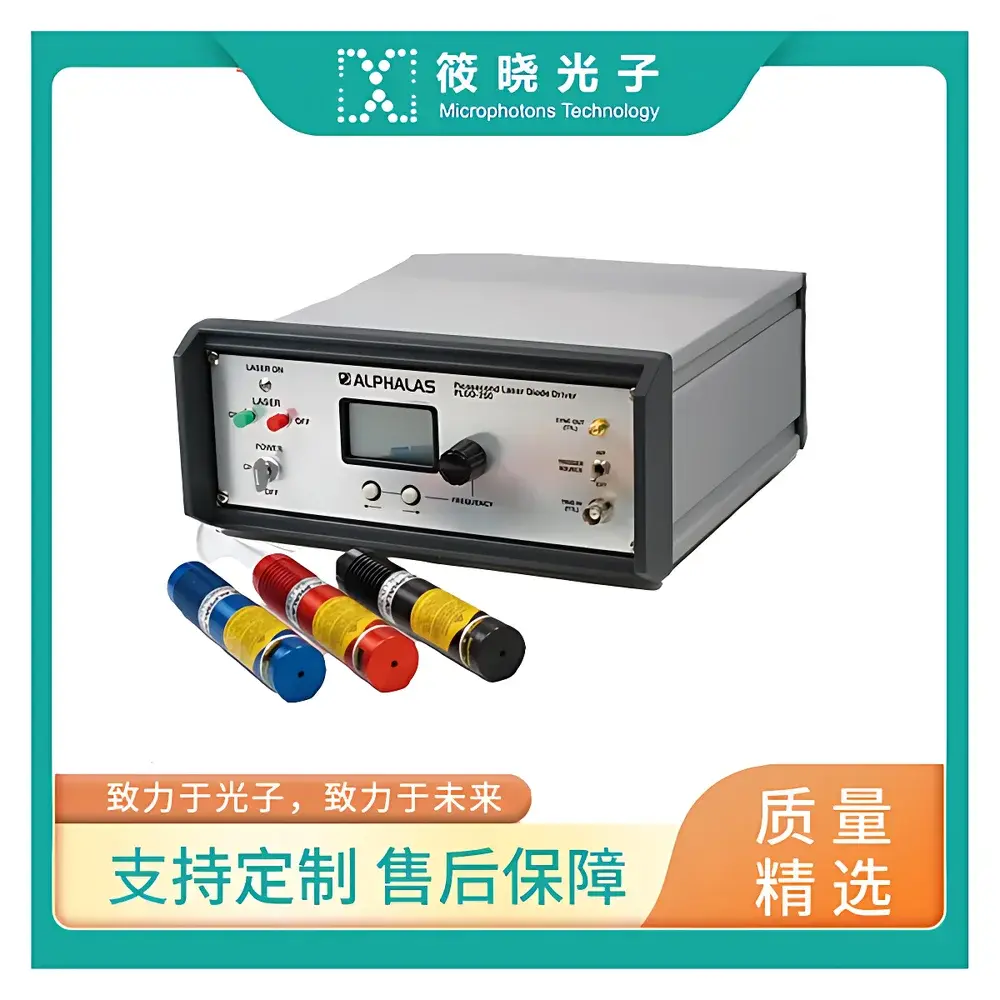
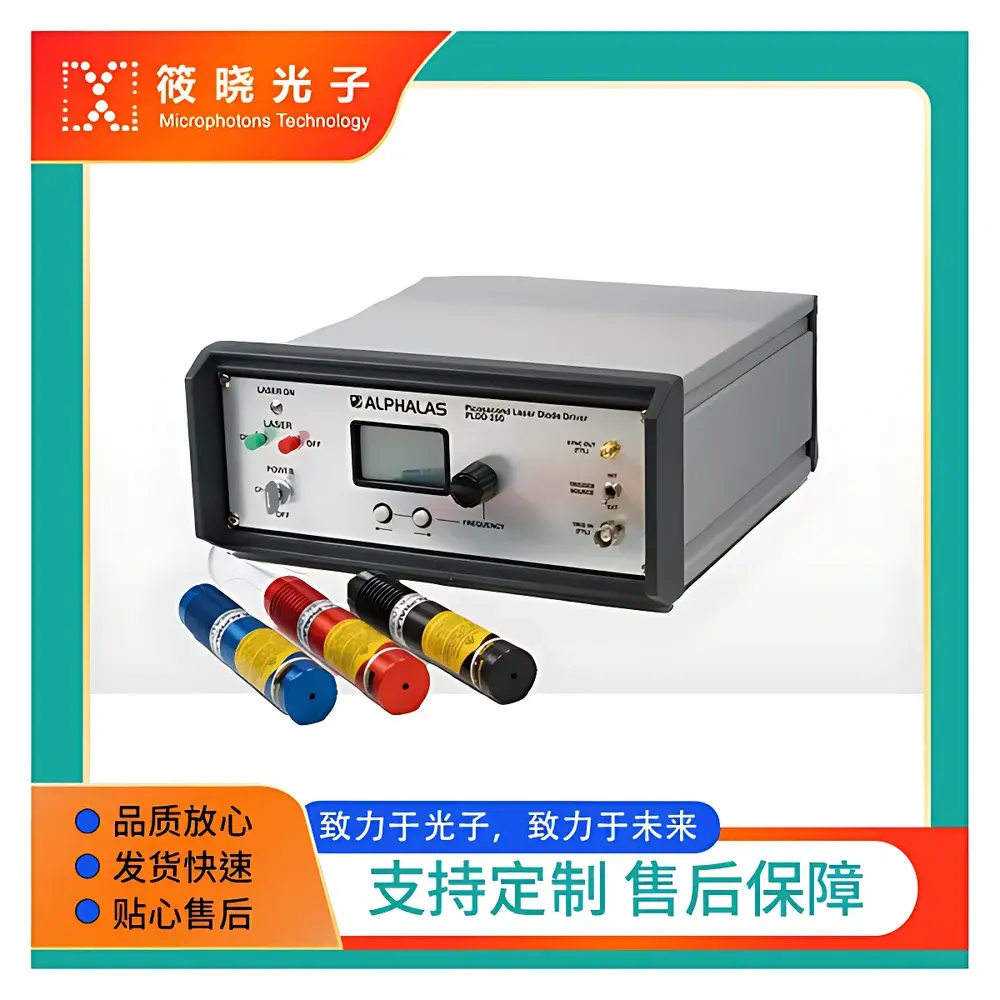
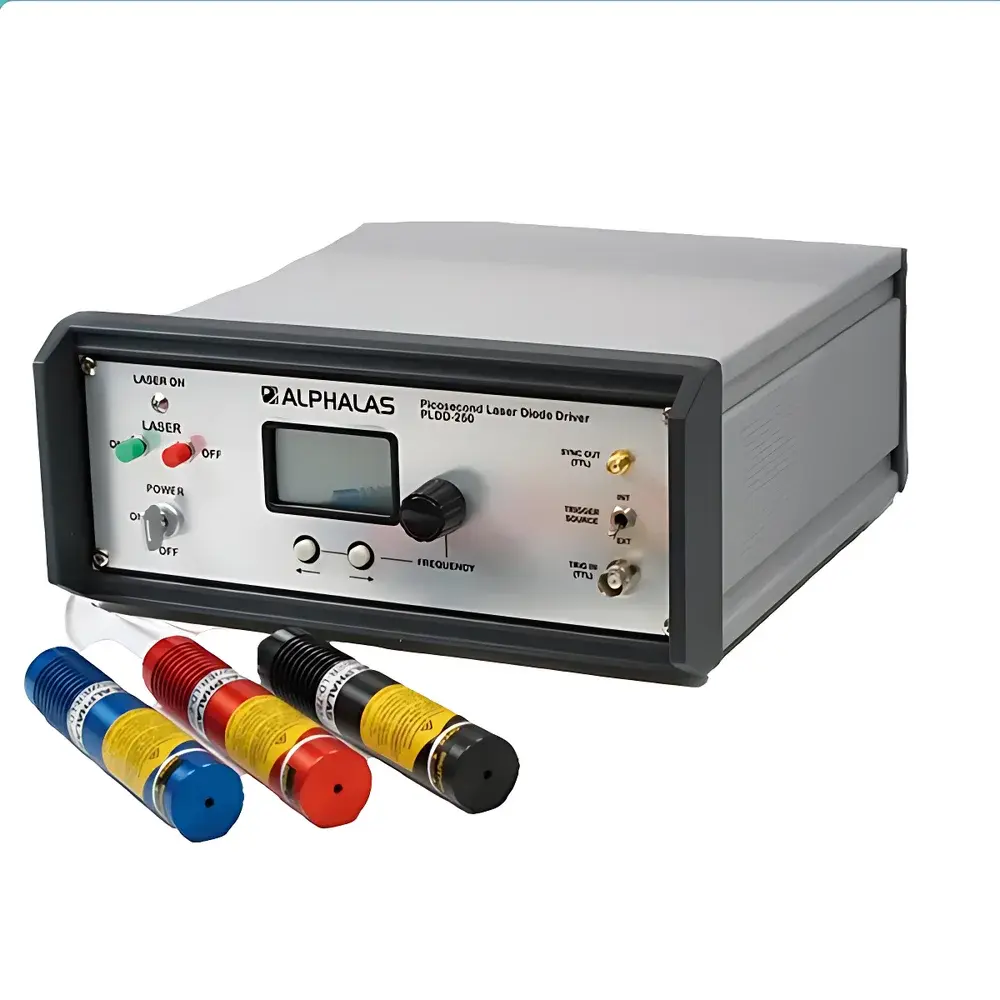
Alphalas PLDD-100-40 Picosecond Pulsed Diode Laser System with Integrated Driver
| Brand | Alphalas |
|---|---|
| Origin | Germany |
| Model | PLDD-100-40 |
| Pulse Width | <15 ps (FWHM) |
| Repetition Rate | Up to 100 MHz (adjustable) |
| Wavelength Options | 405 nm, 450 nm, 635 nm, 670 nm, 785 nm, 850 nm |
| Average Output Power | Up to 50 mW (wavelength-dependent) |
| Trigger Input | TTL-compatible, <10 ns jitter |
| Operating Temperature | 15–35 °C |
| Cooling | Thermoelectric (TEC) stabilized |
| Compliance | CE, RoHS, IEC 60825-1:2014 (Class 4 Laser Product) |
Overview
The Alphalas PLDD-100-40 is a fully integrated picosecond pulsed diode laser system engineered for precision time-resolved optical measurements in research and industrial laboratory environments. Unlike conventional continuous-wave or nanosecond-pulsed sources, this instrument employs gain-switched laser diode technology to generate sub-15 ps optical pulses with high temporal fidelity and low timing jitter (<10 ns). Its monolithic architecture integrates the laser diode, thermoelectric cooler (TEC), driver electronics, and optical collimation into a single compact, air-cooled module—eliminating alignment sensitivity and enabling turnkey deployment. Designed for applications demanding precise photon arrival timing and minimal pulse broadening, the PLDD-100-40 serves as a stable excitation source for time-correlated single-photon counting (TCSPC), fluorescence lifetime imaging (FLIM), pump-probe spectroscopy, and optical time-domain reflectometry (OTDR). The system operates under strict adherence to IEC 60825-1:2014 safety standards and is classified as a Class 4 laser product, requiring appropriate interlocks and beam containment per local regulatory protocols.
Key Features
- Sub-15 ps optical pulse width (FWHM) with consistent temporal profile across full repetition rate range
- Adjustable repetition rate from single-shot up to 100 MHz via internal oscillator or external TTL trigger
- Multiple wavelength options (405, 450, 635, 670, 785, and 850 nm) optimized for common fluorophores, semiconductors, and photodetector responsivity
- Integrated TEC stabilization ensures wavelength stability better than ±0.1 nm over 8-hour operation
- Low-jitter (<10 ns RMS) synchronization interface compatible with commercial TCSPC hardware and oscilloscopes
- Internal power regulation maintains pulse-to-pulse energy stability within ±2% (RMS) over ambient temperature fluctuations (15–35 °C)
- Front-panel status indicators and RS-232/USB interface support remote monitoring of diode current, TEC voltage, and temperature feedback
Sample Compatibility & Compliance
The PLDD-100-40 is designed for use with standard optical breadboards, fiber-coupled setups (FC/PC or SMA905 connectors optional), and free-space confocal or widefield microscope configurations. It interfaces seamlessly with streak cameras, MCP-PMTs, SPAD arrays, and silicon photomultipliers (SiPMs). All units are CE-marked and conform to RoHS 2015/863/EU directives. Laser safety documentation—including nominal ocular hazard distance (NOHD) calculations, beam divergence data, and interlock circuit schematics—is supplied with each shipment. The system supports integration into GLP-compliant workflows through configurable logging of operational parameters and timestamped event records. While not FDA 21 CFR Part 11–certified out-of-the-box, audit trails can be enabled via third-party data acquisition software meeting ALCOA+ principles.
Software & Data Management
Alphalas provides the PLDD Control Suite—a cross-platform (Windows/macOS/Linux) application supporting real-time parameter adjustment, automated pulse train characterization, and export of metadata-rich ASCII logs (.csv/.txt). The suite enables scripting via Python API (pyPLDD) for integration into custom automation pipelines (e.g., LabVIEW, MATLAB, or Python-based measurement frameworks). All configuration changes—including repetition rate, bias current, and TEC setpoint—are timestamped and stored locally with SHA-256 checksum integrity verification. Firmware updates preserve user calibration offsets and retain factory-traceable serial-number-linked calibration certificates. No cloud connectivity or telemetry is enabled by default; all data remains on-premise unless explicitly exported by the user.
Applications
- Time-resolved photoluminescence (TRPL) of perovskites, quantum dots, and 2D materials
- Fluorescence lifetime imaging microscopy (FLIM) in biological tissue sections and live-cell assays
- Pump-probe transient absorption studies of carrier dynamics in semiconductor heterostructures
- Calibration of ultrafast photodetectors and streak camera response functions
- Development and validation of single-photon avalanche diode (SPAD) timing resolution benchmarks
- Optical clock distribution and jitter analysis in photonic integrated circuit testbenches
FAQ
Is the PLDD-100-40 suitable for integration into an existing TCSPC system?
Yes—the laser’s TTL sync output and <10 ns jitter specification ensure direct compatibility with Becker & Hickl, PicoQuant, and ID Quantique TCSPC modules without additional timing electronics.
Can the repetition rate be externally modulated at arbitrary waveforms?
No—repetition rate control is limited to square-wave TTL triggering or internal crystal oscillator selection; analog modulation of pulse spacing is not supported.
What is the typical pulse energy at 635 nm with 50 MHz repetition rate?
Approximately 0.8 nJ per pulse (1.6 mW average power), assuming standard collimated free-space output; fiber-coupled variants exhibit ~15% coupling loss.
Does the system include beam delivery optics?
The base configuration includes a fixed-focus collimator; optional adjustable focus lenses, fiber launch adapters, and polarization-maintaining fiber pigtails are available as accessories.
Is factory recalibration required after one year of operation?
Not mandatory—Alphalas specifies 12-month calibration stability under normal operating conditions; however, users performing ISO/IEC 17025-accredited measurements should implement in-house verification using traceable photodiode and fast oscilloscope standards.





