
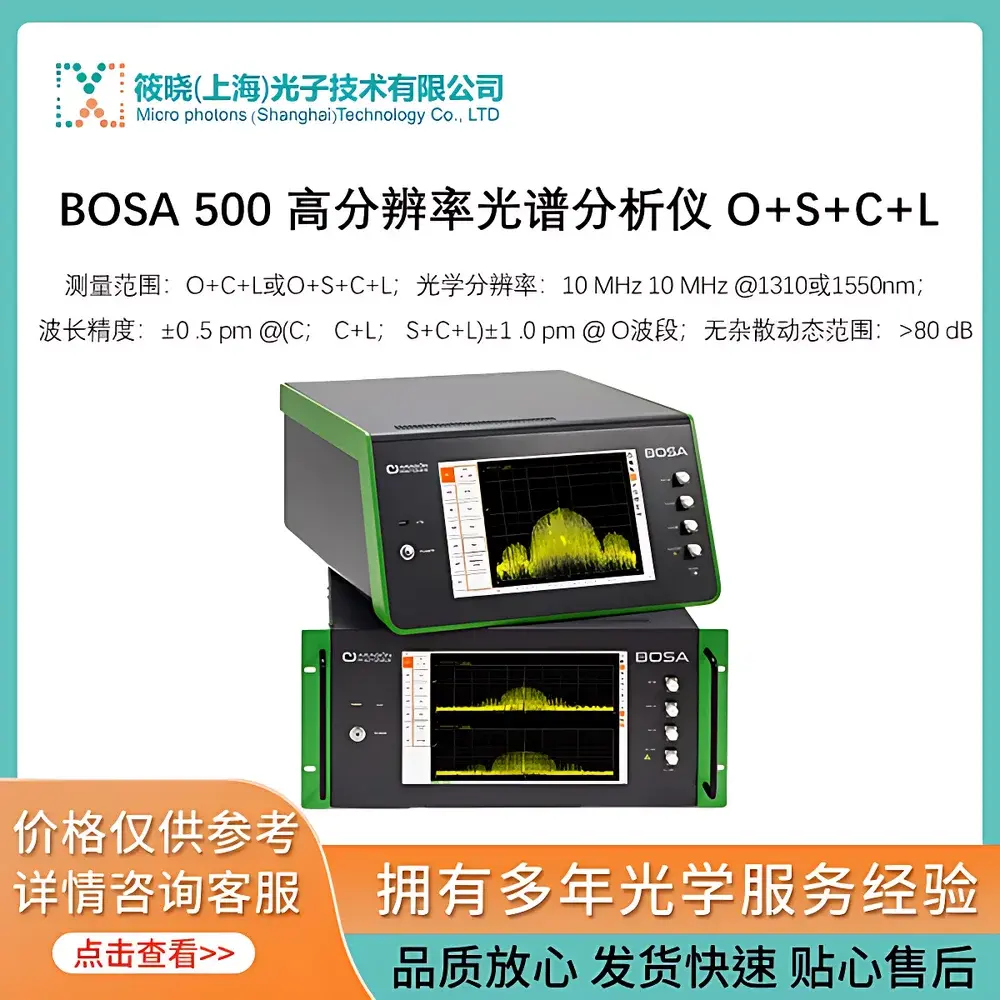

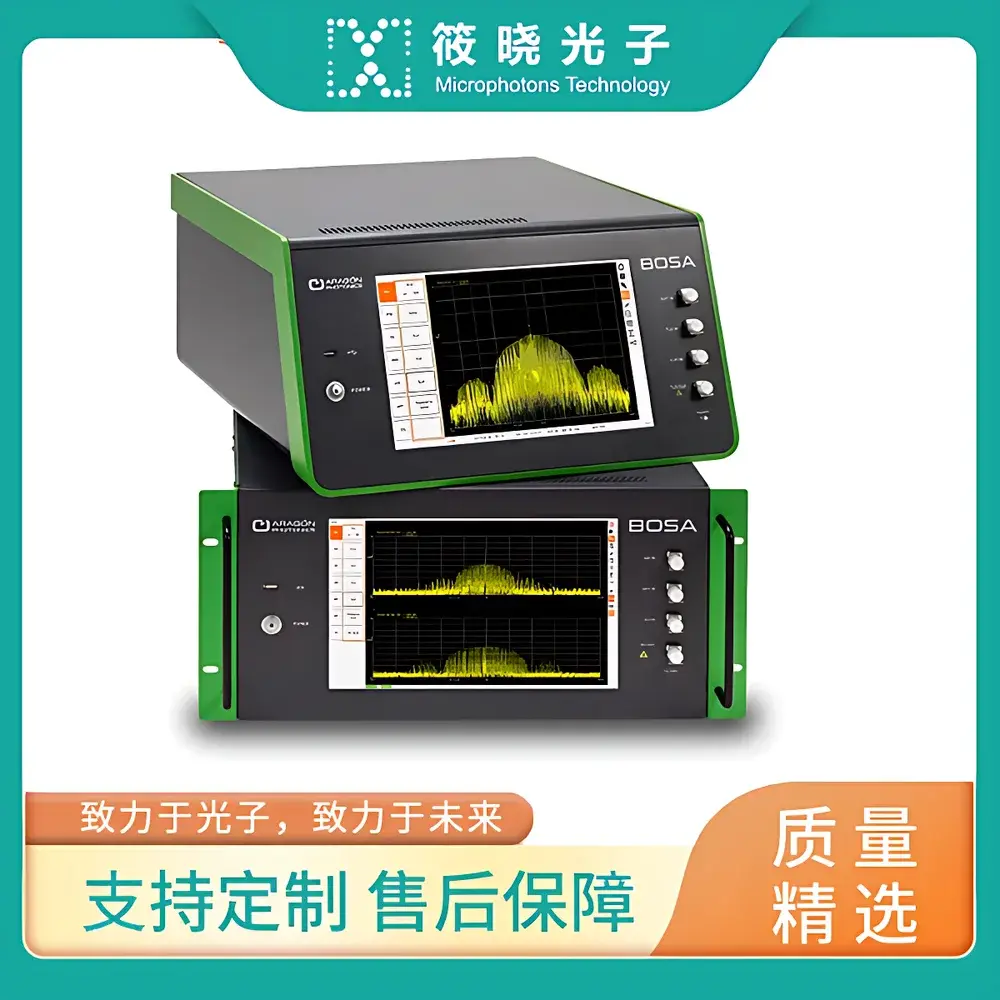
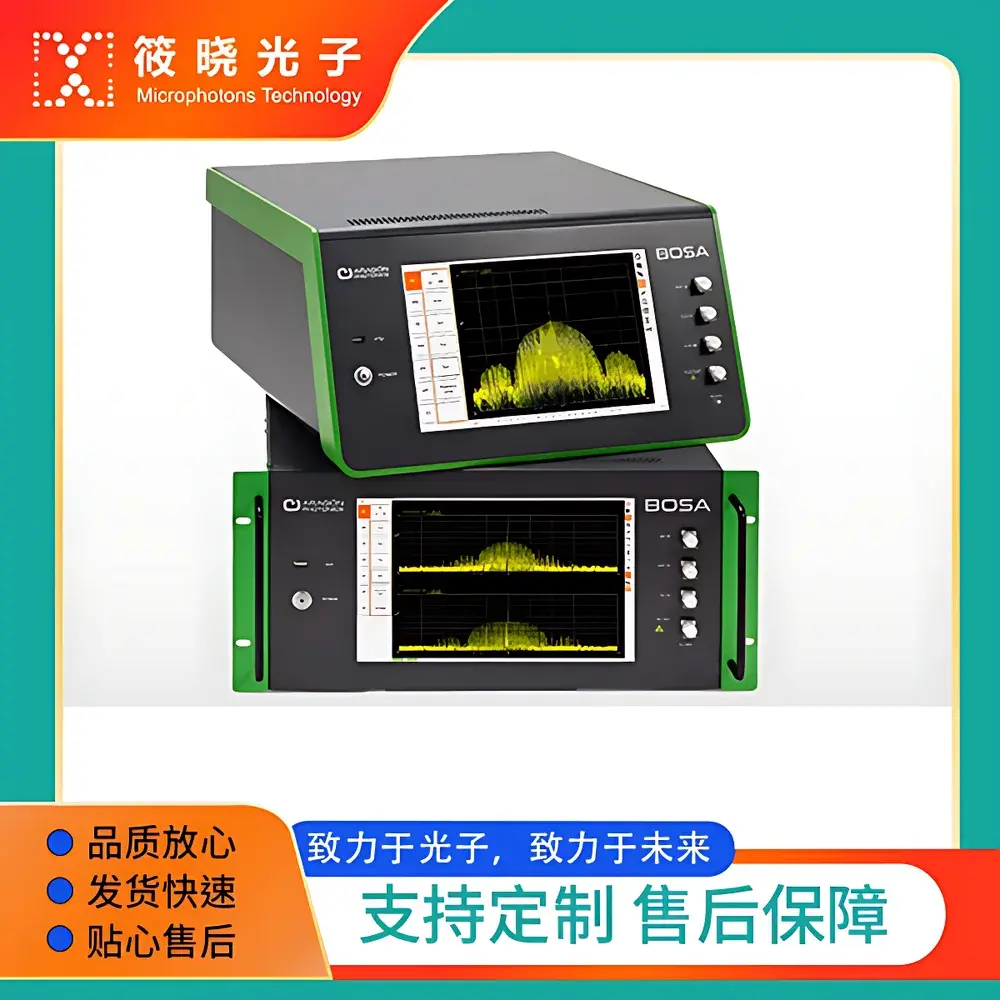
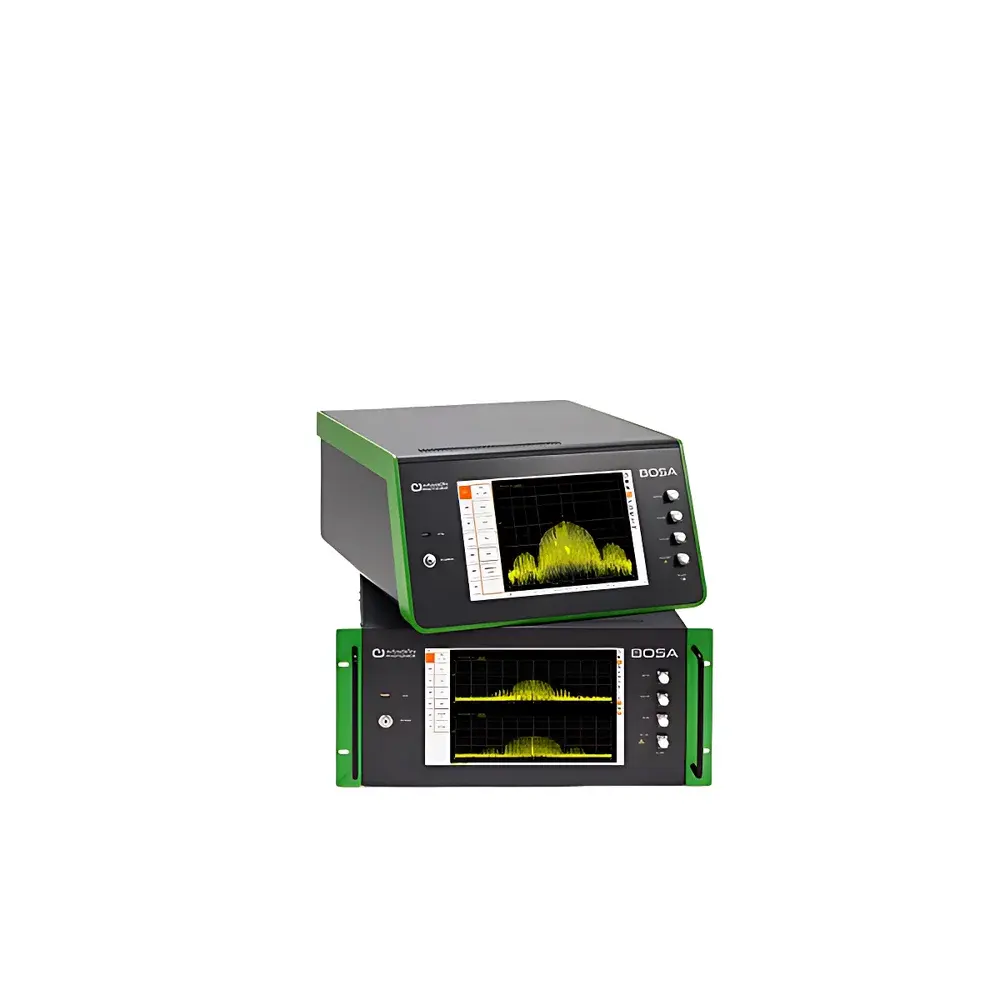
Aragon Photonics BOSA-500 High-Resolution Optical Spectrum Analyzer (O+S+C+L Bands)
| Brand | Aragon Photonics |
|---|---|
| Origin | Spain |
| Manufacturer Type | Original Equipment Manufacturer (OEM) |
| Product Category | Imported Instrument |
| Model | BOSA-500 |
| Optical Band Coverage | O, S, C, and L bands |
| Optical Resolution | 10 MHz @ 1310 nm or 1550 nm (0.08 pm) |
| Wavelength Accuracy | ±0.5 pm @ C/C+L/S+C+L bands |
| Spurious-Free Dynamic Range (SFDR) | >80 dB |
| Core Technology | Stimulated Brillouin Scattering (SBS)-based tunable optical filtering |
| Integrated Tunable Laser Source (TLS) | Yes |
| Polarization-Resolved Spectral Measurement | Supported |
| Phase-Spectral Characterization Capability | Yes (e.g., chirp, eye diagram, constellation analysis) |
Overview
The Aragon Photonics BOSA-500 is a high-resolution optical spectrum analyzer engineered for metrology-grade spectral characterization of advanced photonic devices and systems operating across the O-, S-, C-, and L-bands (1260–1625 nm). Unlike conventional diffraction-grating or interferometric OSAs, the BOSA-500 employs stimulated Brillouin scattering (SBS) as an active, ultra-narrowband optical filtering mechanism. In this architecture, an external-cavity tunable laser source (TLS) pumps a nonlinear optical fiber, generating a dynamic, sub-MHz linewidth gain filter via SBS. As the TLS sweeps across the target wavelength range, the SBS-mediated transmission profile provides true optical resolution down to 10 MHz (0.08 pm at 1550 nm), with intrinsic immunity to local oscillator side-mode artifacts common in heterodyne-based analyzers. This physical filtering principle eliminates spurious responses arising from etalon effects, polarization-dependent loss, or detector nonlinearity—enabling a verified spurious-free dynamic range exceeding 80 dB. The instrument is designed for traceable, repeatable measurements under laboratory and production test environments compliant with IEC 61280-2-9 and Telcordia GR-1073-CORE requirements.
Key Features
- Optical resolution of 10 MHz (0.08 pm at 1550 nm), achieved via SBS-based active filtering—not digital interpolation or curve fitting
- Wavelength accuracy of ±0.5 pm over C, C+L, and S+C+L bands; ±1.0 pm over O-band—calibrated against NIST-traceable reference lasers
- Spurious-free dynamic range >80 dB, validated per IEC 61280-2-9 Annex D methodology
- Integrated dual-wavelength TLS enabling simultaneous sweep and reference channel acquisition for real-time drift compensation
- Polarization-resolved spectral analysis capability—supports Stokes parameter extraction and differential group delay (DGD) mapping
- Phase-spectral reconstruction functionality: enables linear chirp quantification, eye diagram synthesis, and QAM constellation projection directly from spectral phase data
- Rugged monolithic optomechanical design with temperature-stabilized SBS fiber coil and active vibration isolation
Sample Compatibility & Compliance
The BOSA-500 accepts standard single-mode fiber inputs (SMF-28 or equivalent) with FC/APC or SC/APC connectors. It supports continuous-wave (CW), pulsed (≥10 ns pulse width), and modulated signals—including OFDM, Nyquist-WDM, DP-QPSK, and 64-QAM formats—without aliasing or coherence-induced distortion. All internal optical paths are hermetically sealed and humidity-controlled to maintain long-term calibration stability. The system complies with IEC 61326-1 (EMC for laboratory equipment), IEC 61000-4-3 (radiated immunity), and meets CE marking requirements for electromagnetic compatibility and safety. Firmware and measurement routines support audit trails aligned with GLP/GMP documentation workflows, including user-access logging and calibration certificate embedding in exported .csv and .sdf files.
Software & Data Management
BOSA-500 ships with BOSA Control Suite v4.x—a Windows-based application supporting SCPI command set (IEEE 488.2 compliant) over TCP/IP and USB-TMC interfaces. The software includes built-in peak detection with customizable SNR thresholds, automatic comb-line identification for frequency comb characterization, and batch export to CSV, HDF5, or MATLAB .mat formats. Advanced scripting modules enable integration with Python (via PyVISA), LabVIEW, or MATLAB for automated test sequences—fully compatible with IEEE 1647 ETSI-compliant test executive frameworks. All spectral acquisitions include embedded metadata: timestamp (UTC), TLS wavelength lock status, polarization state vector, and SBS gain saturation flag. Raw interferometric data and calibrated intensity/phase spectra are stored separately to support post-acquisition reprocessing and uncertainty propagation analysis per GUM (JCGM 100:2018).
Applications
- Characterization of narrow-linewidth lasers (DFB, DBR, external cavity diodes) including linewidth, SMSR, and mode-hop detection
- Testing of coherent transceivers (100G/400G ZR, OpenZR+, 800G FR4) for OSNR, spectral regrowth, and modulation fidelity
- Chirp and dispersion analysis of semiconductor optical amplifiers (SOAs), electro-absorption modulators (EAMs), and MZMs
- DWDM channel spacing verification, FlexGrid grid alignment, and superchannel spectral integrity assessment
- Fundamental research on microresonator combs, Brillouin lasers, and photonic integrated circuit (PIC) spectral response
- Calibration of optical frequency references and traceability transfer in national metrology institutes
FAQ
What distinguishes BOSA’s resolution from that of grating-based or FT-based OSAs?
BOSA achieves true optical resolution via stimulated Brillouin scattering—a physical narrowband gain process—not digitized interpolation or Fourier transform deconvolution. Its 10 MHz resolution is bandwidth-limited by the intrinsic phonon lifetime in silica fiber, not by detector sampling rate or grating groove density.
Can BOSA-500 measure phase-modulated signals like QPSK or 16-QAM?
Yes—when combined with optional polarization-diverse homodyne detection hardware (sold separately), the BOSA-500 reconstructs full complex-valued spectra, enabling direct extraction of modulation-induced phase trajectories and constellation diagrams.
Is firmware update and calibration traceability supported?
Yes—each unit ships with a factory calibration certificate traceable to CEM (Spain) and NIST (USA). Firmware updates preserve calibration coefficients and support delta-calibration mode for in-field verification using internal reference lines.
Does the system meet FDA 21 CFR Part 11 requirements for electronic records?
The BOSA Control Suite supports optional 21 CFR Part 11 compliance package—including electronic signatures, audit trail encryption, and role-based access control—upon request and validation documentation.
What is the typical measurement repeatability for wavelength accuracy?
Under controlled lab conditions (23 ± 0.5 °C, <40% RH), 24-hour repeatability is ±0.15 pm (1σ) for C-band measurements, verified using stabilized HeNe and iodine-stabilized diode laser references.





