
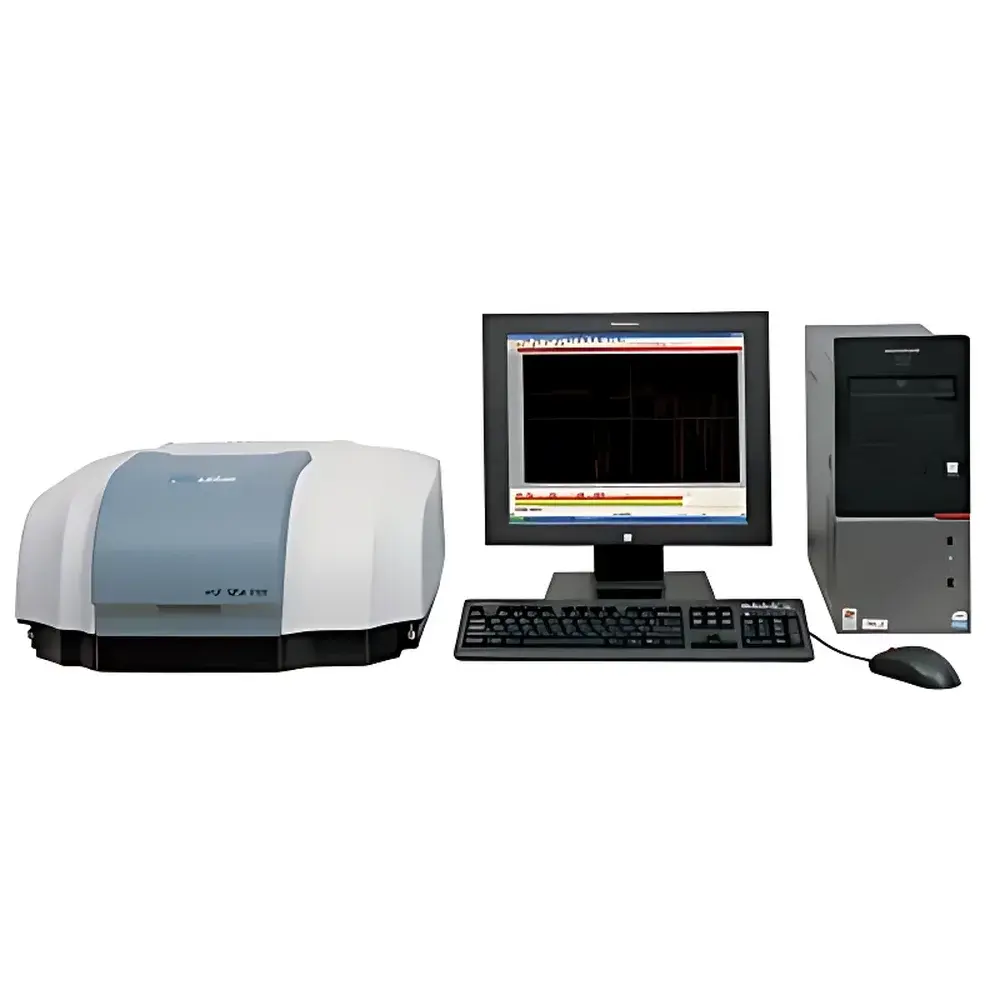
Beifen Ruili WQF-520A Fourier Transform Infrared (FTIR) Spectrometer
| Brand | Beifen Ruili |
|---|---|
| Origin | Beijing, China |
| Model | WQF-520A |
| Instrument Type | Laboratory FTIR Spectrometer |
| Wavenumber Range | 7800–350 cm⁻¹ |
| Spectral Resolution | Better than 0.5 cm⁻¹ |
| Scan Velocity | 2 mm/s (optical path difference rate) |
| Signal-to-Noise Ratio | >15,000:1 (at 4 cm⁻¹, 1 min scan, peak-to-peak) |
| Dimensions | 540 × 515 × 260 mm |
| Weight | 28 kg |
| Interface | USB 2.0 |
| Light Source | High-intensity air-cooled infrared source with spherical reflector |
| Detector | Standard DTGS or optional MCT (configurable) |
| Environmental Protection | Hermetically sealed Michelson interferometer with desiccant-view window |
| Software Platform | Windows-based native Chinese GUI with spectral library management, quantitative analysis, and GLP-compliant reporting modules |
Overview
The Beifen Ruili WQF-520A Fourier Transform Infrared (FTIR) Spectrometer is a laboratory-grade analytical instrument engineered for high-fidelity molecular identification and structural characterization across organic, inorganic, polymeric, and pharmaceutical materials. Based on the Michelson interferometer principle, it acquires full-spectrum interferograms via rapid optical path difference scanning, followed by fast Fourier transformation to yield high-resolution absorbance/transmittance spectra. Its core optical architecture employs a compact, corner-cube retroreflector-based interferometer—designed for intrinsic alignment stability, reduced sensitivity to mechanical vibration, and long-term baseline reproducibility. The system operates across a broad mid-infrared range (7800–350 cm⁻¹), enabling detection of fundamental vibrational modes—including C=O stretching (1700 cm⁻¹), O–H bending (1400 cm⁻¹), N–H deformation (1550 cm⁻¹), and Si–O–Si asymmetric stretch (1080 cm⁻¹)—with resolution better than 0.5 cm⁻¹. Thermal stability is enhanced through an externally mounted, isolated air-cooled infrared source coupled with a large-volume heat-dissipation chamber, eliminating the need for real-time interferogram phase correction during routine operation.
Key Features
- Corner-cube Michelson interferometer with multi-layer hermetic sealing and visible silica gel indicator window for humidity monitoring and field serviceability
- Air-cooled high-intensity infrared source with integrated spherical reflector ensuring uniform beam profile and stable radiant output over extended duty cycles
- Elastomer-suspended cooling fan design minimizing mechanical coupling and acoustic noise transmission to the optical bench
- Extra-large sample compartment (≥150 mm vertical clearance) accommodating bulky accessories including microscopes, gas cells, and custom ATR stages
- External beam port architecture supporting seamless integration with attenuated total reflectance (ATR), diffuse reflectance (DRIFTS), specular reflectance, transmission liquid/gas cells, and fiber-optic probes
- Digital signal chain featuring programmable-gain amplification, 24-bit analog-to-digital conversion, and embedded real-time microcontroller for synchronized scan control and metadata tagging
- USB 2.0 interface compliant with Windows OS (7/10/11), enabling true plug-and-play instrument recognition without proprietary drivers
Sample Compatibility & Compliance
The WQF-520A supports universal sampling modalities via standardized optical interfaces per ASTM E1421 and ISO 18388. It is routinely deployed for solid (KBr pellet, ATR, DRIFTS), liquid (sealed transmission cell, thin-film), and gaseous (multi-pass absorption cell) analyses. All hardware and firmware comply with IEC 61010-1 safety requirements for laboratory electrical equipment. The software architecture supports audit trail logging, user access levels, and electronic signature capability—facilitating alignment with FDA 21 CFR Part 11 and GLP/GMP documentation workflows when configured with optional secure mode activation. Routine performance verification follows manufacturer-recommended protocols traceable to NIST SRM 1921b (polystyrene film) for wavenumber accuracy and SRM 2036 (KBr powder) for resolution validation.
Software & Data Management
The native Windows application suite provides a complete spectral workflow: acquisition, preprocessing (zero-filling, apodization, phase correction), quantitative analysis (classical least-squares, PLS regression), spectral library search (with Hit Quality Index scoring), and report generation. Eleven pre-installed domain-specific libraries—including polymers, pharmaceuticals, minerals, forensic toxics, and environmental contaminants—are fully editable; users may import third-party JCAMP-DX files, define custom search filters, and assign compound classes for hierarchical retrieval. All spectral data are stored in vendor-neutral HDF5 format with embedded acquisition parameters (apodization type, zero-filling factor, coaddition count, detector gain), ensuring long-term interoperability with MATLAB, Python (SciPy/NumPy), and open-source chemometrics platforms. Batch processing, macro scripting (VBScript-compatible), and PDF/XPS export with embedded spectral metadata satisfy regulatory submission requirements.
Applications
The WQF-520A serves as a primary identification tool in QC laboratories for raw material verification (e.g., API identity testing per USP ), polymer resin grade confirmation, lubricant oxidation state assessment, counterfeit pharmaceutical screening, and catalyst surface functional group mapping. In research settings, it supports time-resolved reaction monitoring (via rapid-scan mode), in situ catalysis studies using high-temperature ATR cells, and micro-domain analysis when coupled with an infrared microscope (optional). Its robust thermal design and sealed optics make it suitable for installation in non-climate-controlled environments typical of industrial quality control labs or field-deployable analytical units.
FAQ
What is the maximum recommended scan speed for high-SNR measurements?
For optimal signal-to-noise ratio (>15,000:1), a 1-minute coaddition at 4 cm⁻¹ resolution is standard; faster scans (e.g., 32 scans/sec) are achievable but require trade-offs in SNR and dynamic range.
Is the instrument compatible with external detectors such as liquid-nitrogen-cooled MCT?
Yes—detector bay supports field-upgradable MCT configurations with appropriate preamplifier and dewar interface kits (sold separately).
Does the software support automated peak integration and calibration curve generation?
Yes—quantitative module includes interactive peak picking, baseline correction algorithms (Rubberband, Concave Hull), and linear/nonlinear calibration curve fitting with residual diagnostics.
Can spectral libraries be exported in JCAMP-DX format for cross-platform use?
Yes—all libraries and individual spectra can be exported as JCAMP-DX v5.01 or ASCII text, preserving wavenumber intensity pairs and metadata headers.
What maintenance intervals are recommended for the desiccant system?
Visual inspection every 3 months; replacement of silica gel cartridge upon color transition (blue → pink), typically every 6–12 months depending on ambient humidity.





