
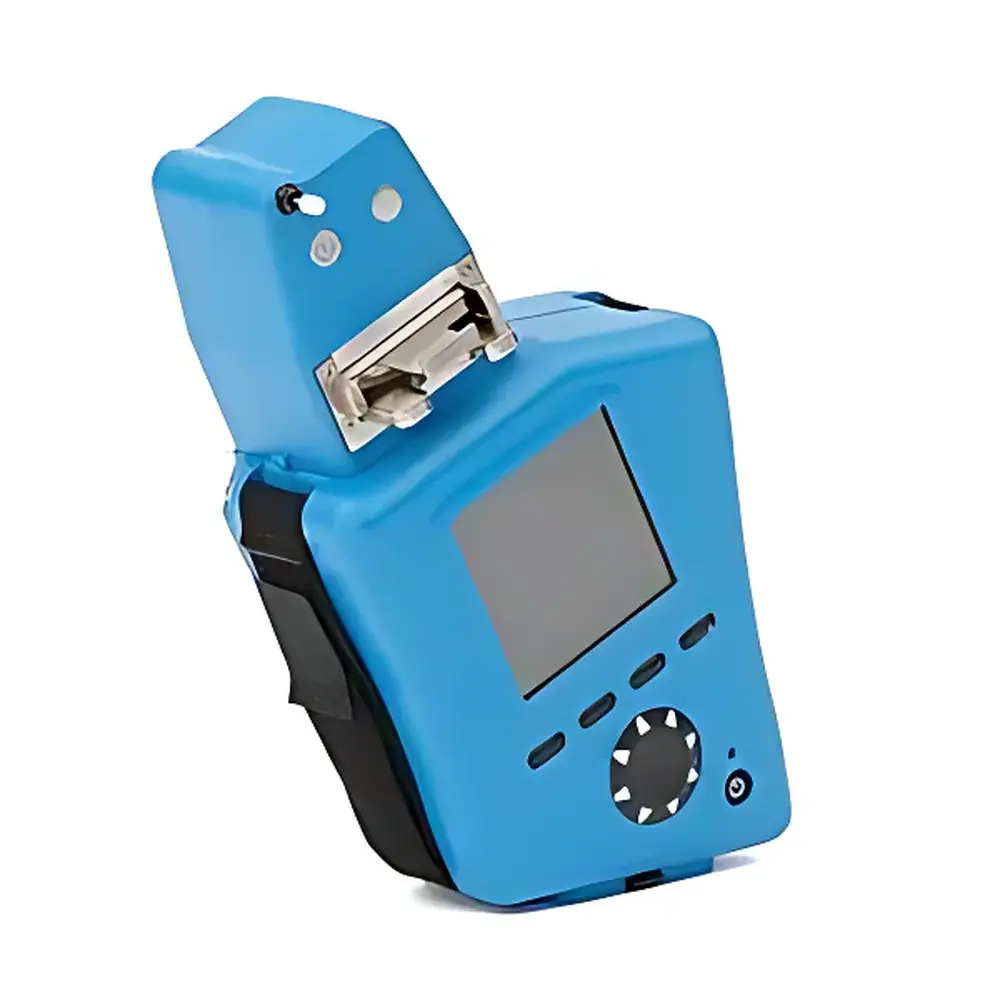
Spectro Scientific FluidScan 1000 Series Portable Oil Condition Analyzer
| Brand | Spectro Scientific |
|---|---|
| Origin | USA |
| Manufacturer Type | Authorized Distributor |
| Product Origin | Imported |
| Model | FluidScan 1000 Series |
| Instrument Type | Portable Analyzer |
| Measurement Parameters | Water Content, TAN (Total Acid Number), TBN (Total Base Number), Oxidation, Nitration, Sulfation, Glycol, Soot, Additive Depletion, Overall Oil Health Index |
| Compliance | ASTM D7889, ASTM E2412, ASTM E1655 |
| Sample Volume | 1 drop (~50 µL) |
| Analysis Time | < 60 seconds per sample |
| Calibration Database | > 850 reference spectra (mineral & synthetic oils, greases, biodiesel, fuels) |
| Cleaning Method | Solvent-free |
| Detection Principle | Fourier Transform Infrared (FTIR) Spectroscopy |
| Portability | Handheld, battery-operated, field-deployable |
Overview
The Spectro Scientific FluidScan 1000 Series is a handheld, Fourier Transform Infrared (FTIR) spectrometer engineered for on-site quantitative oil condition analysis. Unlike conventional laboratory-based FTIR systems requiring solvent extraction and extensive sample preparation, the FluidScan 1000 employs patented direct-absorption infrared measurement technology—enabling rapid, solvent-free quantification of critical oil degradation and contamination markers directly in the field. Its optical architecture is optimized for robustness under industrial conditions, with temperature-stabilized interferometry and a sealed, alignment-free optical path ensuring long-term spectral fidelity. Designed explicitly for predictive maintenance programs, it delivers lab-equivalent data for key parameters including water content, Total Acid Number (TAN), Total Base Number (TBN), oxidation, nitration, sulfation, glycol contamination, soot loading, additive depletion, and an algorithm-derived Overall Oil Health Index. The instrument operates independently of external PCs or network infrastructure, making it suitable for use in remote facilities, mobile maintenance units, offshore platforms, and production floors where immediate decision support is required.
Key Features
- Patented total water detection method compliant with ASTM D7889—eliminates need for Karl Fischer titration in field applications
- Solvent-free operation: no reagents, no consumables, no hazardous waste generation
- Single-drop sample requirement (≈50 µL) with automated fluid film thickness compensation
- Battery-powered (up to 8 hours continuous operation) with integrated rechargeable Li-ion pack
- Color-coded pass/fail indicators with user-configurable alarm thresholds per parameter and application
- Embedded calibration database comprising >850 reference spectra across mineral oils, synthetics, greases, biodiesel blends, and aviation/turbine fuels
- On-device spectral acquisition, processing, and reporting—no external software dependency for core functionality
- IP54-rated enclosure for resistance to dust and incidental water exposure during field use
Sample Compatibility & Compliance
The FluidScan 1000 supports analysis of used and new lubricants across multiple equipment classes: engine oils (diesel, gasoline, natural gas), turbine oils, hydraulic fluids, gear oils, compressor oils, transmission fluids, and greases. It is validated for water-in-grease quantification—a capability not supported by most portable IR analyzers. All quantitative algorithms are traceable to ASTM standards: measurement repeatability and reproducibility meet ASTM E2412 requirements; spectral processing workflows conform to ASTM E1655 guidelines; and field performance is certified per ASTM D7889 for in-situ determination of TAN, TBN, and water. The system supports GLP-compliant data integrity through embedded audit trails, user access control, and timestamped result export (CSV/Excel). While not FDA 21 CFR Part 11–certified out-of-the-box, its data export structure enables integration into validated LIMS environments supporting regulated industries.
Software & Data Management
Data acquisition, calibration management, and reporting occur via the onboard touchscreen interface running Spectro’s proprietary firmware. Results are stored locally with metadata (date/time, operator ID, equipment tag, sample ID, ambient temperature/humidity). USB-C and Bluetooth 5.0 enable secure transfer to enterprise CMMS or cloud-based reliability platforms. Optional SpectroView Desktop Software provides advanced trending, fleet-level benchmarking, statistical process control (SPC) charting, and custom report generation—including ISO 4406 particle count correlation when paired with complementary hardware. All spectral libraries are updatable via encrypted firmware packages, ensuring ongoing alignment with evolving OEM specifications and industry best practices.
Applications
The FluidScan 1000 serves as a primary tool in reliability-centered maintenance (RCM) and ISO 55000-aligned asset management frameworks. Typical use cases include: real-time assessment of diesel engine oil depletion in marine propulsion systems; verification of hydraulic fluid integrity prior to turbine startup; monitoring oxidation progression in wind turbine gearboxes; detecting glycol ingress in heavy-duty truck engines; validating new oil quality upon receipt; and screening biofuel blends for oxidative stability. Its portability enables routine sampling at point-of-use—reducing turnaround time from days to seconds—and supports root-cause analysis when coupled with historical spectral libraries and failure mode databases.
FAQ
Does the FluidScan 1000 require annual recalibration?
No—its solid-state interferometer and reference laser stabilization eliminate drift-related recalibration needs. Spectro recommends annual verification using certified reference oils per ASTM D7889 Annex A3.
Can it differentiate between free water and emulsified water?
Yes—the instrument reports total water content but does not speciate water forms. Interpretation of free vs. emulsified water requires correlation with physical inspection (e.g., crackle test) or complementary particle counting.
Is grease analysis performed in the same way as liquid oils?
Grease samples are heated to ~60°C and homogenized before deposition; the analyzer applies a dedicated spectral model trained on >120 grease formulations to quantify water and oxidation without solvent extraction.
How is compliance with ISO 17025 addressed?
While the instrument itself is not accredited, its measurement outputs—when used within a documented SOP, with traceable reference materials and controlled environmental conditions—support ISO/IEC 17025 method validation by end-user laboratories.
What happens if the database does not include my specific OEM oil?
Users may create custom calibrations using SpectroView Desktop Software and reference data from accredited labs, then deploy them to the device via secure firmware update.





