
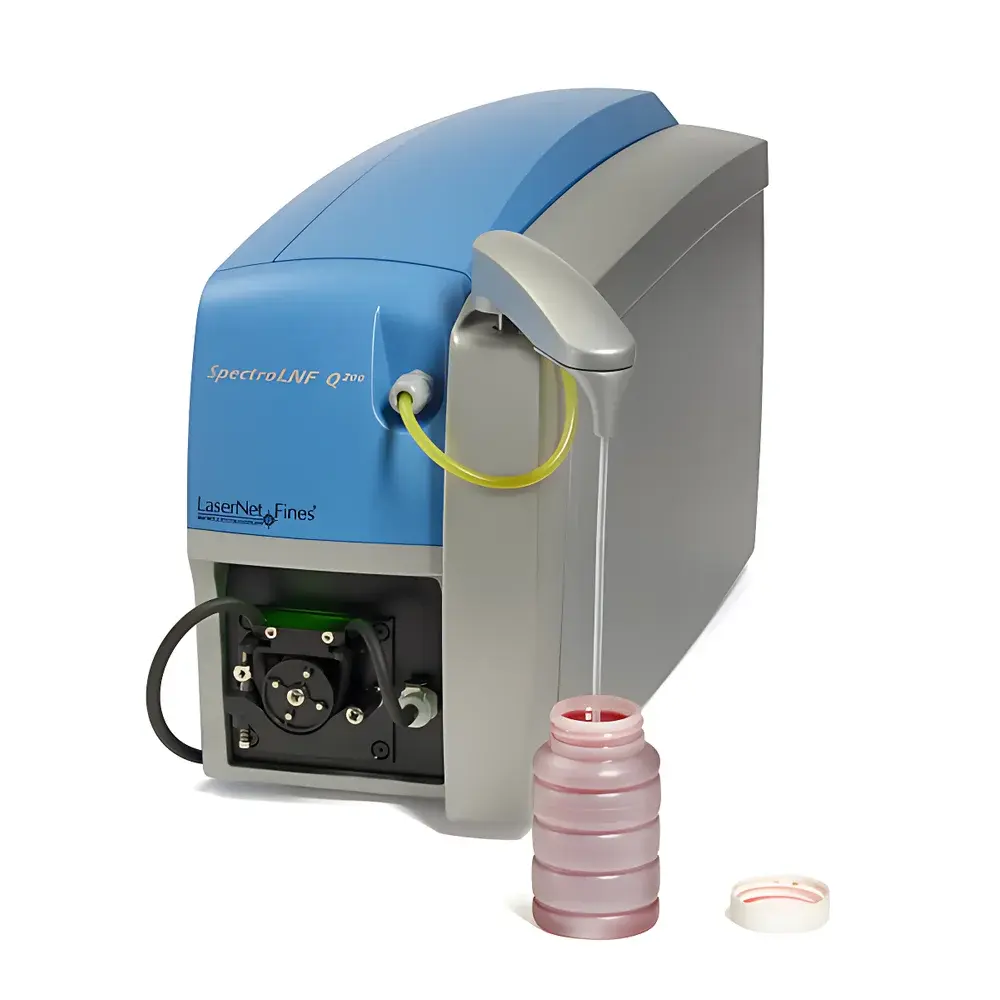
Spectro Scientific LaserNet 230 Multi-Parameter Wear Particle Analyzer
| Brand | Spectro Scientific |
|---|---|
| Origin | USA |
| Model | LaserNet 230 |
| Detection Capabilities | Simultaneous particle counting, ferrous particle quantification (ppm & size distribution), and morphology-based wear debris classification |
| Particle Size Range (counting) | 4–100 µm |
| Max. Particle Concentration | 5,000,000 particles/mL |
| Viscosity Range | 15–320 cSt (no dilution required) |
| Soot Tolerance | up to 2% (w/w) |
| Counting Uncertainty | <2% (statistical repeatability) |
| Standards Compliance | ISO 4406, NAS 1638, SAE AS4059, ASTM D6786, NAVAIR 01-1A-17, GOST, HAL |
| Imaging Resolution | ≥20 µm for automated morphology classification |
| Ferrous Sensor Sensitivity | Sub-ppm detection limit for ferrous concentration |
| Analysis Time per Sample | ~4 minutes |
| Data Integration | Native export to SpectroTrack LIMS and AMS Asset Management System |
Overview
The Spectro Scientific LaserNet 230 Multi-Parameter Wear Particle Analyzer is an integrated optical-magnetic laboratory instrument engineered for comprehensive condition monitoring of in-service lubricants in critical rotating and reciprocating machinery. It employs dual-path laser obscuration combined with high-resolution digital microscopy and embedded ferromagnetic sensing to perform three core analytical functions—particle counting, ferrous mass quantification, and morphology-driven wear debris classification—in a single, unattended 4-minute analysis cycle. Unlike conventional offline particle counters or standalone ferrography systems, the LaserNet 230 operates on undiluted oil samples across a broad viscosity range (15–320 cSt), eliminating pre-analytical dilution errors and preserving native particle dispersion integrity. Its adaptive gain control (AGC) illumination system dynamically adjusts laser intensity to maintain signal fidelity in heavily sooted oils (up to 2% soot by weight), ensuring robust performance in diesel engine oil, turbine oil, and hydraulic fluid applications where traditional light-blockage methods fail.
Key Features
- Simultaneous triple-parameter analysis: particle count (per ISO 4406/NAS 1638), ferrous concentration (ppm), and morphology-based debris classification—all executed in one sample aspiration cycle.
- Wide dynamic particle sizing: calibrated detection from 4 µm to 100 µm with statistical uncertainty <2% at high concentrations (up to 5×10⁶ particles/mL), enabling reliable trending of early-stage contamination and wear onset.
- No-dilution operation across 15–320 cSt viscosity range, reducing analyst variability and eliminating solvent-related safety and disposal concerns.
- Embedded high-sensitivity magneto-resistive sensor for real-time ferrous mass measurement and discrete sizing of ferrous particles ≥25 µm—including total ferrous count, size bins, and ferrous density distribution.
- Automated digital imaging platform capturing >20 µm wear particles at sufficient resolution for neural network–driven classification into six mechanistic categories: cutting wear, contact fatigue, sliding wear, non-metallic debris, fibers, water droplets, and air bubbles.
- Adaptive Gain Control (AGC) optics compensates for optical attenuation in dark or sooted oils, maintaining consistent sizing accuracy without manual intervention or sample pretreatment.
Sample Compatibility & Compliance
The LaserNet 230 is validated for use with mineral-, synthetic-, and bio-based lubricants including engine oils (SAE 0W–60), turbine oils (ISO VG 32–100), hydraulic fluids (ISO VG 22–68), gear oils, and greases after appropriate solvent extraction. It meets the physical measurement requirements of multiple international standards: particle counting conforms to ISO 4406:2017 (code assignment), NAS 1638 Class Code, SAE AS4059F (Table 1–3), ASTM D6786-21 (Standard Test Method for Determination of Particulate Contamination in Hydraulic Fluids by Automatic Particle Counter), and NAVAIR 01-1A-17. Ferrous quantification adheres to ASTM D5183-18 (Standard Test Method for Determination of Ferrous Wear Debris in Lubricating Oils by Direct-Reading Rotating Disk Spectrometry) principles, while image-based classification supports root-cause diagnostics aligned with ISO 17359:2014 (Condition monitoring and diagnostics of machines — General guidelines). The system architecture supports audit-ready data handling under GLP and GMP environments, with timestamped metadata, user authentication, and electronic signature capability.
Software & Data Management
Instrument control, image acquisition, and analytical reporting are managed through Spectro’s proprietary LaserNet Software v5.x, which implements role-based access control, configurable report templates, and automated pass/fail logic against user-defined alert thresholds. All raw images, particle histograms, ferrous concentration curves, and classification matrices are stored with full metadata (sample ID, operator, date/time, instrument calibration status, environmental conditions). Native integration with SpectroTrack LIMS enables bidirectional data exchange—including sample registration, test method assignment, and result archival—while AMS (Asset Management System) connectivity supports automated flagging of equipment-level alerts based on trended particle population shifts. Audit trails comply with FDA 21 CFR Part 11 requirements for electronic records and signatures, including immutable logging of all data modifications, user logins, and method changes.
Applications
The LaserNet 230 serves as a primary diagnostic tool in predictive maintenance programs for power generation turbines, marine propulsion systems, wind turbine gearboxes, aviation auxiliary power units (APUs), and heavy-duty off-highway equipment. Its ability to distinguish fatigue spalls from cutting wear enables differentiation between bearing degradation modes and gear tooth pitting versus abrasive contamination. In military and aerospace contexts, it supports compliance with NAVAIR and SAE specifications for oil analysis program (OAP) reporting. In refinery and petrochemical facilities, it monitors compressor and pump lubricants for abnormal wear initiation and cross-contamination events. Laboratories accredited to ISO/IEC 17025 utilize its traceable calibration and standardized output formats to support third-party certification of lubricant health.
FAQ
Does the LaserNet 230 require oil dilution prior to analysis?
No. It is specifically designed for direct analysis of undiluted oils within the 15–320 cSt viscosity range.
Can it differentiate water droplets from air bubbles in oil?
Yes. High-contrast imaging combined with refractive index–informed segmentation algorithms enables reliable discrimination between spherical water droplets and transient air bubbles.
What is the minimum detectable ferrous concentration?
The embedded magneto-resistive sensor achieves sub-ppm sensitivity for total ferrous mass, with discrete sizing resolution for ferrous particles ≥25 µm.
Is neural network classification validated against expert ferrography interpretation?
Yes. Classification models were trained and verified using reference datasets annotated by certified wear analysts per ASTM E768-19 (Standard Practice for Describing and Classifying Wear Debris), achieving >92% concordance in blind validation studies.
How does the system handle highly sooted diesel engine oils?
The AGC illumination subsystem automatically modulates laser power to compensate for optical density, maintaining sizing accuracy even at 2% soot content without manual gain adjustment or sample filtration.




