
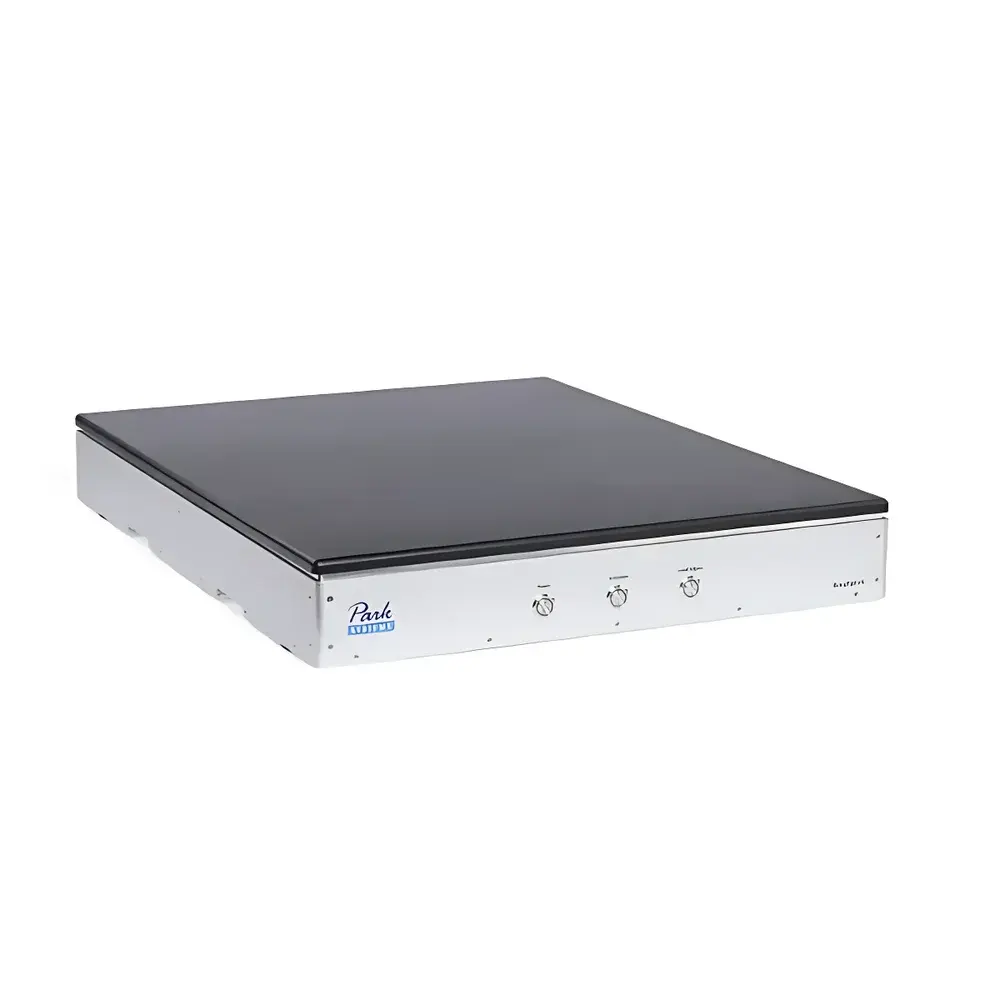
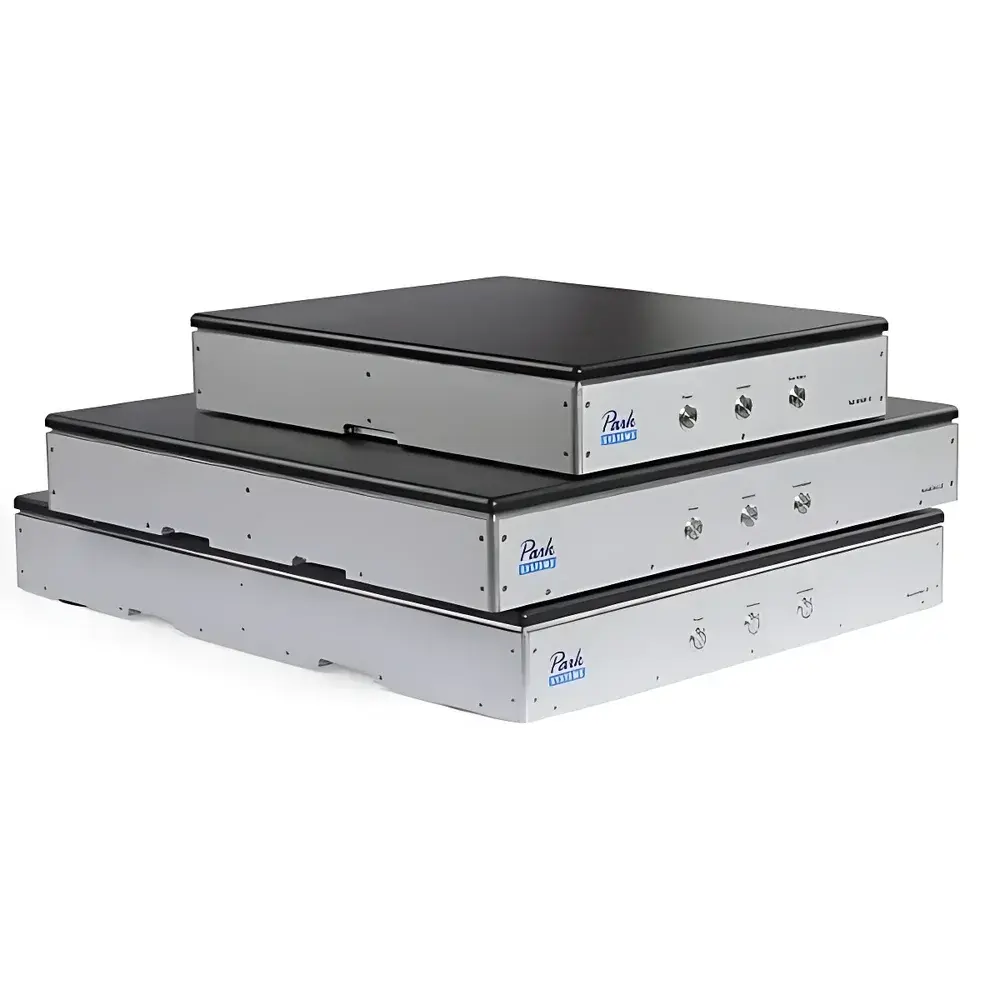
Park Accurion Accurin i4 Active Vibration Isolation Table
| Brand | Park Accurion |
|---|---|
| Origin | Germany |
| Model | Accurin i4 |
| Isolation Start Frequency | 0.6 Hz |
| Peak Isolation Performance | −40 dB at 10 Hz (99% vibration attenuation) |
| Settling Time | 0.3 s |
| Degrees of Freedom | 6-DOF active compensation |
| Power Supply | Standard AC outlet (no compressed air required) |
| Load Auto-Adaptation | Yes |
| Transport Lock | Integrated and automatic |
| Structural Stiffness | High intrinsic rigidity for positional stability |
| Compliance | Designed for ISO 14644-1 Class 5–8 cleanroom environments and compatible with GLP/GMP-aligned lab infrastructure |
Overview
The Park Accurion Accurin i4 Active Vibration Isolation Table is an engineered solution for laboratories requiring sub-micron measurement stability in high-sensitivity instrumentation environments. Based on real-time inertial feedback and electromagnetic actuation, the Accurin i4 implements closed-loop, six-degree-of-freedom (6-DOF) active vibration control—distinct from passive elastomeric or pneumatic isolation systems. Its core principle relies on continuous sensing of ground-borne and structural vibrations via high-bandwidth accelerometers, followed by instantaneous generation of counteracting forces through precision voice-coil actuators. This architecture enables effective suppression starting at 0.6 Hz—well below the resonance thresholds of conventional passive tables—and delivers up to −40 dB attenuation at 10 Hz, corresponding to >99% energy reduction across critical low-frequency bands (1–20 Hz) where floor-borne traffic, HVAC harmonics, and building sway dominate. Unlike passive systems that exhibit amplification near their natural resonance (typically 2–8 Hz), the Accurin i4 eliminates this vulnerability through zero-resonance design and adaptive stiffness tuning.
Key Features
- Six-degree-of-freedom (6-DOF) real-time active compensation across translational (X, Y, Z) and rotational (pitch, yaw, roll) axes
- No low-frequency resonance: Inherent mechanical rigidity prevents amplification in the 1–10 Hz range—critical for AFM, optical interferometry, nanoindentation, and electron microscopy
- Ultra-fast stabilization: <0.3 s settling time after perturbation or load change, enabling rapid experimental turnover
- Automatic load adaptation: Onboard sensors detect mass distribution and dynamically recalibrate actuator gain without user intervention
- Integrated transport lock: Electromechanically engaged during relocation; disengages automatically upon power-up and self-calibrates
- Zero-compressed-air operation: Powered exclusively by standard 100–240 V AC input—eliminates infrastructure dependencies and maintenance overhead
- Low-profile, carbon-reduced chassis: Constructed with recycled aluminum alloys and optimized topology for minimal environmental footprint without compromising modal stiffness
Sample Compatibility & Compliance
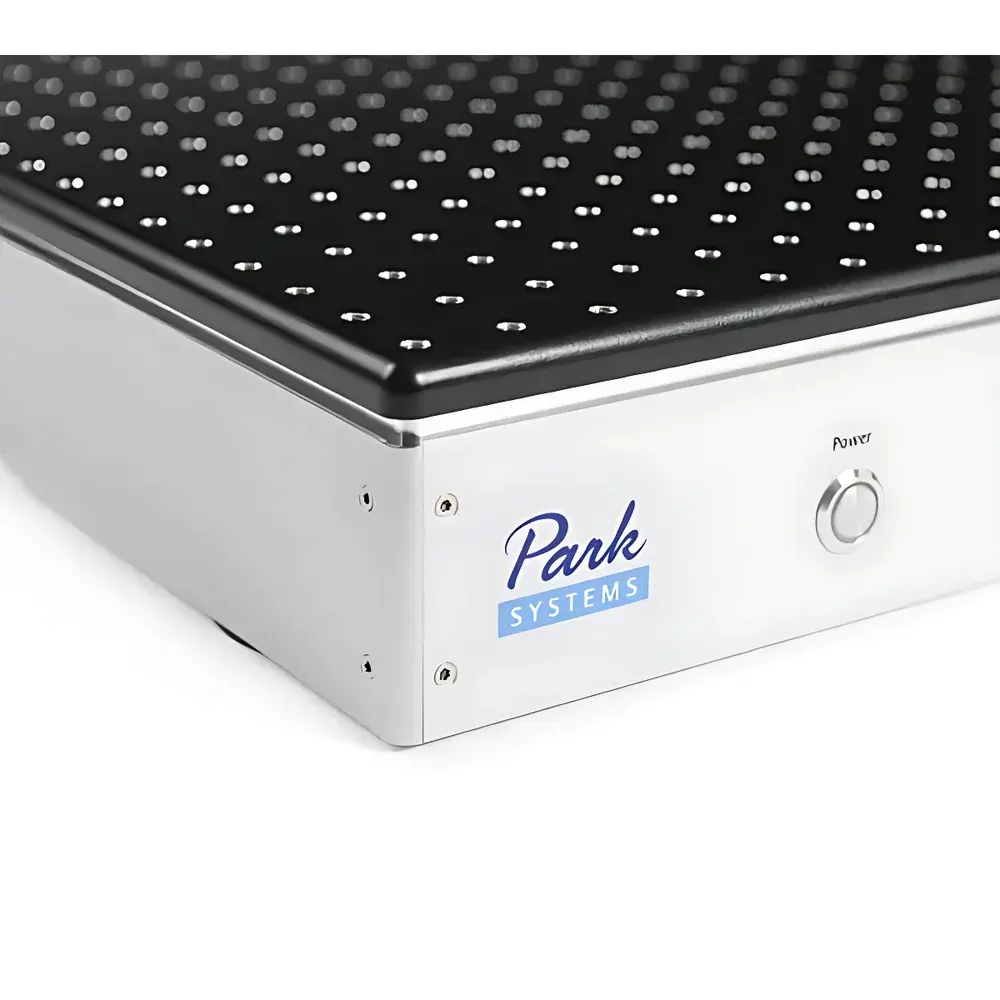
The Accurin i4 supports payloads from 20 kg to 150 kg with uniform center-of-gravity tolerance (±30 mm in X/Y). It is mechanically and thermally compatible with vacuum chambers, cryostats, and optical breadboards (standard M6 threaded mounting grid). The system meets electromagnetic compatibility requirements per EN 61326-1:2013 and operates within ambient temperature ranges of 15–30 °C and humidity ≤70% RH non-condensing. Its control electronics are designed for continuous operation under ISO/IEC 17025-accredited laboratory conditions and support audit-ready logging for GLP and GMP workflows. While not a medical device, its performance envelope satisfies vibration-sensitive requirements referenced in ASTM E1776 (Standard Practice for Vibration Testing of Optical Instruments) and ISO 20816-1 (Mechanical vibration — Evaluation of machine vibration).
Software & Data Management
The Accurin i4 operates autonomously via embedded firmware—no external PC or driver installation required. A front-panel interface with three tactile buttons provides mode selection (Standby/Active/Transport), status verification, and manual reset. Real-time diagnostic data—including RMS acceleration spectra (1–200 Hz), actuator utilization, and thermal margin—are accessible via optional USB-C diagnostics port for integration into centralized lab monitoring platforms. Firmware updates are delivered via signed binary packages compliant with IEC 62443-3-3 security guidelines. All operational logs (including timestamped activation events, load adaptation triggers, and fault codes) are stored locally with non-volatile memory retention exceeding 10,000 cycles—supporting traceability in regulated environments governed by FDA 21 CFR Part 11 when paired with validated third-party LIMS interfaces.
Applications
- Atomic force microscopy (AFM) and scanning probe microscopy (SPM) requiring sub-nanometer Z-axis stability
- Optical coherence tomography (OCT), digital holographic microscopy, and laser Doppler vibrometry
- Nanoindentation and microhardness testing where frame compliance affects load-displacement fidelity
- High-resolution Raman and FTIR spectrometers with long integration times and narrow linewidth resolution
- Quantum optics setups involving trapped ions, cold atoms, or superconducting qubit characterization
- Calibration laboratories performing ISO/IEC 17025-compliant dimensional metrology with coordinate measuring machines (CMMs) or laser trackers
FAQ
Does the Accurin i4 require compressed air or external cooling?
No. It operates solely on standard AC power and uses convection-cooled electromagnetic actuators—no ancillary utilities are needed.
Can it be integrated with existing lab automation software?
Yes. The optional USB-C diagnostics interface supports SCPI-like command sets and CSV-formatted spectral export for integration with LabVIEW, Python-based control frameworks, or enterprise LIMS.
How does it handle sudden load changes during operation?
Its real-time mass-sensing algorithm detects shifts >5 kg within 100 ms and adjusts actuator dynamics accordingly—no manual recalibration is required.
Is remote monitoring or firmware update capability available?
Firmware updates are performed offline via signed binaries; remote telemetry is not enabled by default but can be activated under controlled network segmentation per organizational IT policy.
What safety certifications does it hold?
It carries CE marking per Directive 2014/30/EU (EMC) and 2014/35/EU (LVD), and conforms to UL 61010-1:2012 Third Edition for laboratory electrical equipment safety.



