
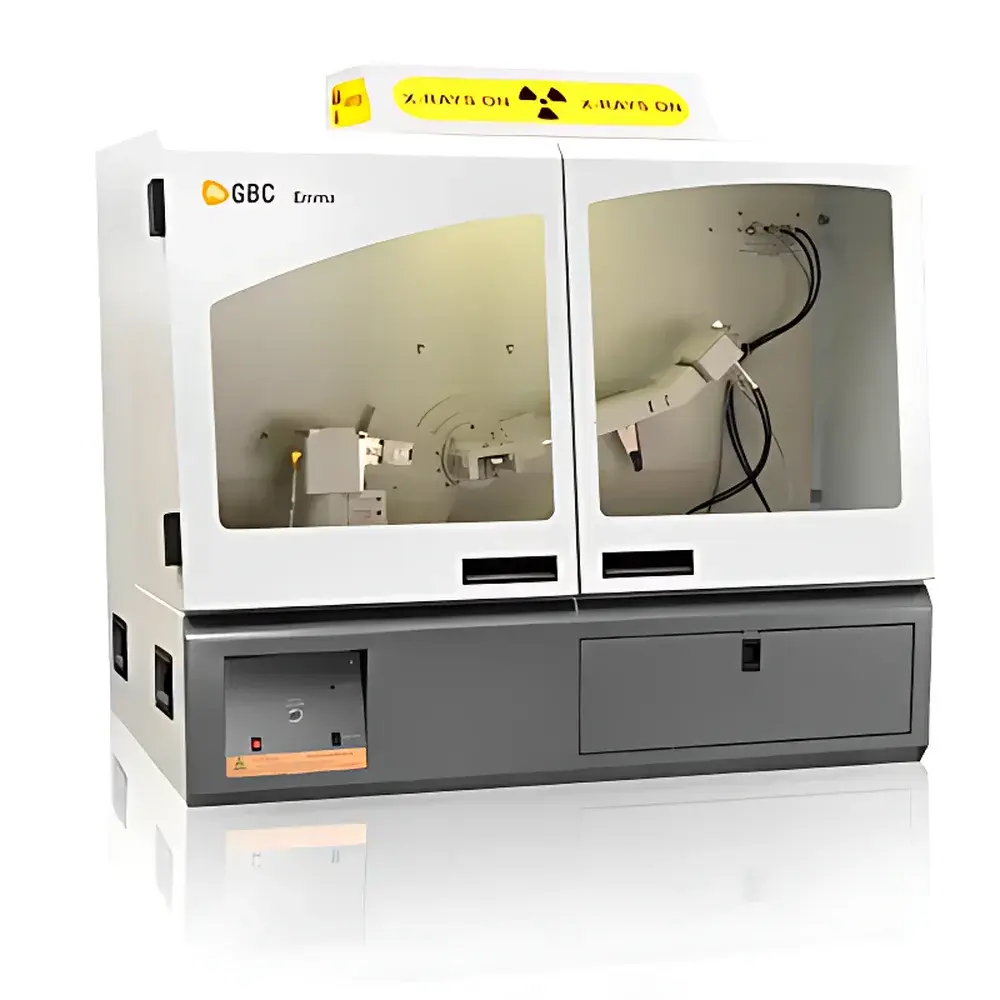
GBC Emma Series X-ray Diffractometer
| Brand | GBC |
|---|---|
| Origin | Australia |
| Manufacturer Type | Authorized Distributor |
| Origin Category | Imported |
| Model | Emma |
| Price Range | USD 135,000 – 205,000 (FOB Australia) |
| Instrument Type | Powder X-ray Diffractometer |
| Power Consumption | <0.1 W (standby), <150 W (operational) |
| Beam Geometry | Variable parallel-beam and Bragg–Brentano focusing geometry |
| Sample Stage | Motorized variable-height powder stage + Eulerian cradle (χ, φ, ω rotation) |
| Detector Configuration | Dual fixed-position detectors — one parallel-beam detector with 0.4° Soller slit collimator, one focusing detector with variable slits and graphite monochromator |
| X-ray Source Optics | XOS polycapillary optic delivering 10 × 10 mm quasi-parallel beam |
| parallel-beam radius | 250 mm |
| focusing radius range | 175–250 mm |
| Optional Integrated Detection | Simultaneous XRD/XRF capability via integrated Si-PIN or SDD X-ray fluorescence detector |
| Portability | Modular chassis with integrated handles |
| Goniometer | Harmonic drive-based θ–2θ goniometer with <0.001° angular reproducibility |
| Radiation Safety | Lead-acrylic interlocked viewing window (large-format, wide-field), software-controlled actuation |
| Electronics | Industrial-grade FPGA-based control architecture with GLP-compliant event logging |
Overview
The GBC Emma Series X-ray Diffractometer is a benchtop, dual-geometry powder X-ray diffractometer engineered for high-fidelity phase identification, quantitative Rietveld analysis, crystallite size/strain evaluation, and residual stress mapping in industrial and academic laboratories. It operates on the fundamental principle of Bragg’s law (nλ = 2d sinθ), utilizing Cu Kα radiation (λ = 1.5418 Å) generated by a sealed-tube microfocus source. The system supports both parallel-beam and Bragg–Brentano focusing geometries—enabling method flexibility across sample types ranging from loose powders and thin films to textured metallurgical specimens and fibrous textiles. Its modular mechanical architecture, harmonic-drive goniometer, and factory-aligned optical train ensure long-term angular stability and eliminate the need for field recalibration after relocation—a critical advantage for mobile QA/QC deployment, on-site metallurgical audits, or multi-site research collaboration.
Key Features
- Variable optical configuration: Switchable between parallel-beam (for low-absorption samples, thin films, and transmission geometry) and focusing (Bragg–Brentano) modes using motorized beam-path selectors.
- Dual-detector architecture: Fixed-position parallel-beam detector equipped with 0.4° Soller slit collimation and graphite monochromator; second focusing detector with adjustable divergence slits and optional energy-dispersive XRF detection.
- Eulerian cradle integration: Precision-engineered 3-axis (χ, φ, ω) sample stage enabling pole-figure acquisition, texture analysis, and non-destructive residual stress measurement per ASTM E915 and ISO 21941 standards.
- XOS polycapillary optic: Delivers a uniform 10 × 10 mm quasi-parallel beam with divergence <0.15°, optimized for signal-to-noise ratio in low-intensity applications such as polymer crystallinity or nanocrystalline phase quantification.
- Radiation safety by design: Large-format lead-acrylic interlocked viewport with software-enforced access control; all interlock states logged with timestamps compliant with IEC 61010-1 and local regulatory requirements.
- Harmonic drive goniometer: Provides sub-arcminute angular repeatability (<0.001°), zero backlash, and immunity to thermal drift over extended scan durations (up to 72 h continuous operation).
- Transport-ready mechanical platform: Fully self-contained unit (≤120 kg) with ergonomic lifting handles; optical alignment retained after transport—verified per GBC Factory Acceptance Test Protocol (FATP-EMMA-03).
Sample Compatibility & Compliance
The Emma Series accommodates standard 25 mm and 50 mm diameter powder holders, custom-cut metal or polymer sample cups, and flat-plate specimens up to 30 mm thick. Textile yarns, rolled sheet metal, weld zones, and ceramic coatings are routinely analyzed using the Eulerian cradle. All hardware and firmware comply with IEC 61010-1 (safety), IEC 61326-1 (EMC), and AS/NZS 3200.1.0 (Australian X-ray equipment standard). Data acquisition and instrument control meet ALCOA+ principles; audit trails, electronic signatures, and user-access tiers are enforced in accordance with FDA 21 CFR Part 11 and EU Annex 11 requirements when operated with optional GBC XRD Suite v4.2.
Software & Data Management
Controlled exclusively via GBC XRD Suite—a Windows-based application built on Qt and HDF5—this platform supports real-time diffraction pattern acquisition, live background subtraction, automatic peak search (based on modified Chebyshev polynomial fitting), and full Rietveld refinement using TOPAS Academic or commercial licenses. Raw data are stored in vendor-neutral .cbf (Crystallographic Binary Format) and .xye formats. The software includes embedded reporting templates aligned with ISO 17025 laboratory accreditation criteria, including uncertainty propagation for lattice parameter determination (per ISO 20957). Remote monitoring, scheduled calibration checks, and firmware update notifications are managed through secure TLS 1.3–encrypted cloud synchronization.
Applications
- Pharmaceutical solid-form screening and polymorph quantification (USP , ICH Q5A)
- Residual stress profiling in aerospace alloys (e.g., Ti-6Al-4V, Inconel 718) per ASTM E915
- Crystallinity assessment in polyolefin films and biodegradable polymers
- Phase purity verification of battery cathode materials (NMC, LFP) and anode composites
- Forensic mineralogical analysis of soil, paint chips, and construction dust
- On-site verification of heat treatment efficacy in forged components
FAQ
Does the Emma Series support in situ heating or humidity-controlled stages?
Yes—GBC offers certified third-party stage integrations: Anton Paar HTK 1200N (up to 1200°C), Linkam TS1500 (−150°C to +150°C), and VTI Corporation RH1500 (10–95% RH), all with synchronized temperature/humidity metadata logging.
Can XRD and XRF data be collected simultaneously without hardware reconfiguration?
Yes—the dual-detector layout enables concurrent collection: the focusing detector acquires XRD patterns while the Si-PIN or SDD detector captures XRF spectra, with time-synchronized event tagging at 10 µs resolution.
Is factory recalibration required after shipping?
No—mechanical and optical alignment is validated prior to shipment using NIST-traceable laser interferometry; post-movement verification requires only a 5-minute alignment check using the onboard Si reference standard.
What spectral resolution is achievable with the integrated XRF detector?
With the optional 25 mm² silicon drift detector (SDD), Mn Kα FWHM resolution is ≤125 eV at 100,000 cps, supporting element identification from Na (1.04 keV) to U (98.4 keV).
How is data integrity ensured during long-duration scans?
All acquisitions include checksummed metadata headers, real-time disk-write verification, and automatic fallback to redundant storage paths—features validated under GLP audit conditions per OECD Principles of Good Laboratory Practice (ENV/MC/CHEM(98)17).




