
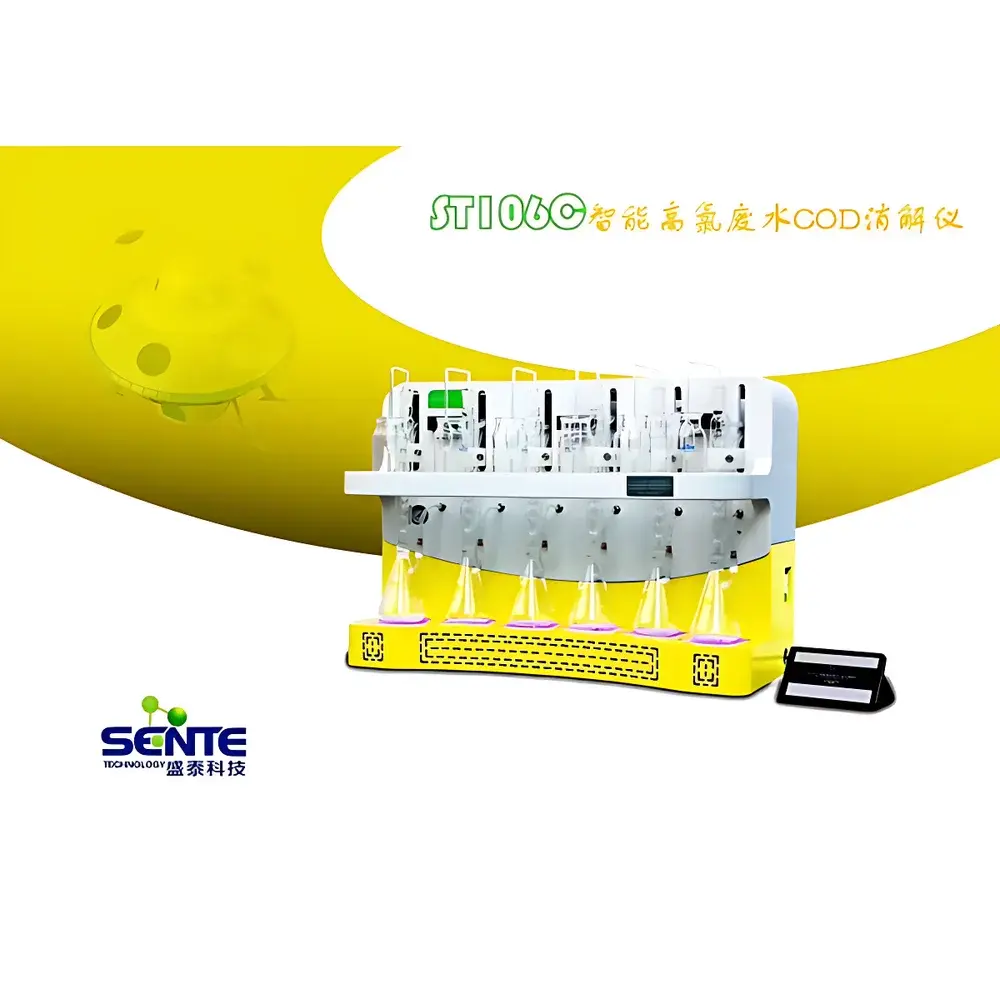
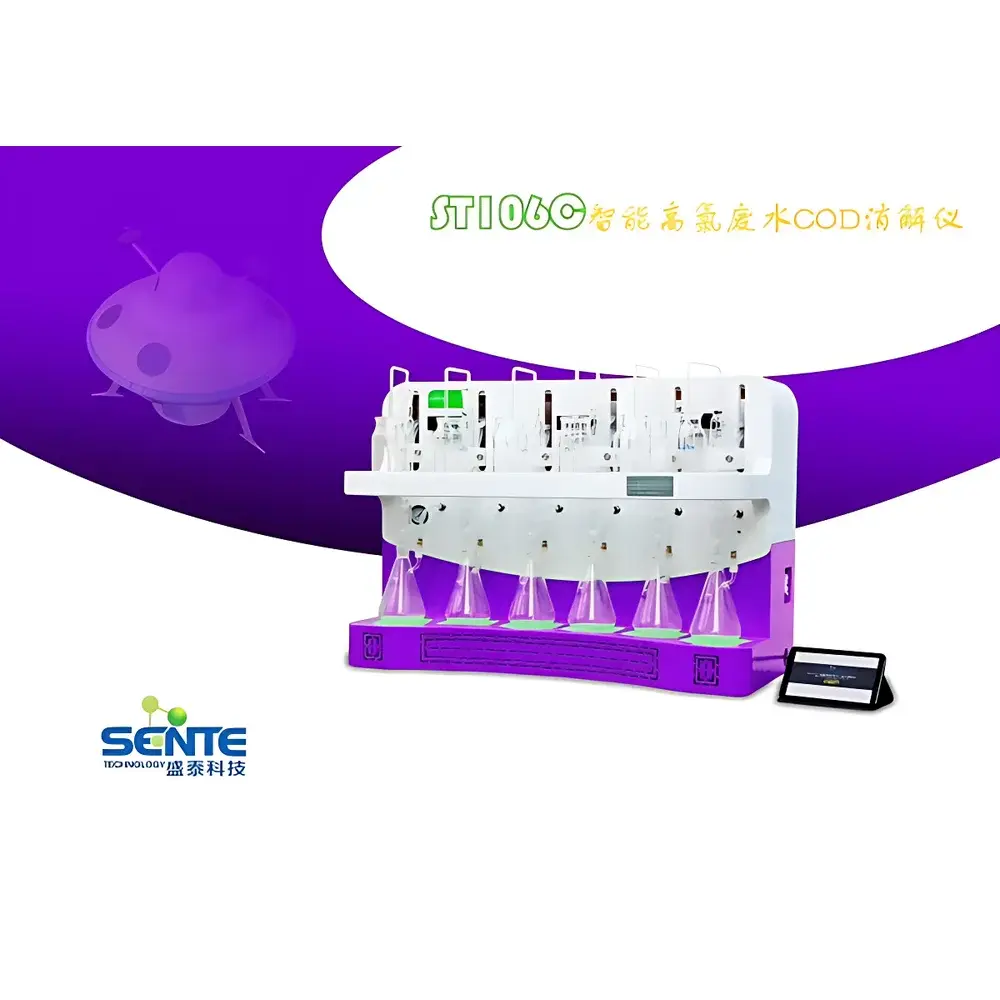
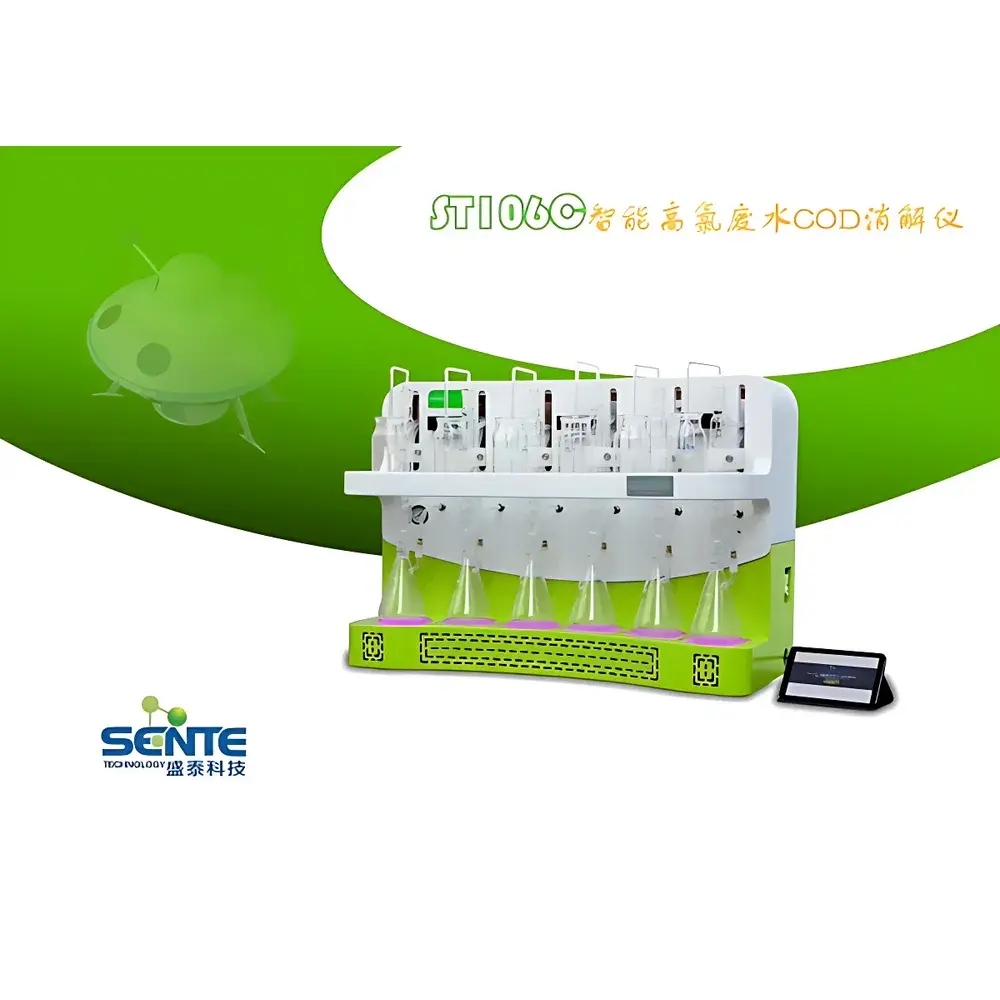
SENTE ST106C High-Chloride Wastewater COD Digestion System
| Brand | SENTE |
|---|---|
| Origin | Shandong, China |
| Manufacturer Type | Direct Manufacturer |
| Model | ST106C |
| Digestion Method | Reflux Digestion |
| Heating Module | Dual Independent Ceramic Heating Blocks |
| Batch Capacity | 1–6 Samples |
| Temperature Range | 0–300 °C |
| Temperature Accuracy | ±2 °C |
| Digestion Vessel Volume | 500 mL |
| Timer Accuracy | ±1 min |
| Chloride Tolerance | 1000–20000 mg/L Cl⁻ |
| Nitrogen Flow Control | Proportional Distribution Valve (0–100 mL/min, per channel) |
| Digestion Time Setting | 0–999 min |
| Cooling System | Integrated Compressor-Based Closed-Loop Cooling |
| Control System | PLC + Touchscreen HMI |
Overview
The SENTE ST106C High-Chloride Wastewater COD Digestion System is a laboratory-grade reflux digestion platform engineered specifically for accurate chemical oxygen demand (COD) determination in chloride-rich aqueous matrices—per the U.S. EPA-aligned methodology equivalent to China’s HJ/T 70–2001 *Determination of Chemical Oxygen Demand in High-Chloride Wastewater—Chlorine Gas Correction Method*. Unlike conventional open-reflux or sealed-vessel COD digesters, the ST106C implements a dual-path analytical workflow: simultaneous thermal digestion under reflux conditions and quantitative capture, absorption, and titrimetric quantification of chlorine gas evolved from chloride oxidation. This architecture eliminates positive bias caused by incomplete chlorination correction—a critical limitation when analyzing industrial effluents containing 1,000–20,000 mg/L chloride (e.g., oilfield produced water, chlor-alkali brines, dye manufacturing runoff, or coastal refinery discharges). The system operates on the principle of controlled boiling reflux in sulfuric acid–silver sulfate–mercury sulfate medium, followed by precise off-gas handling via calibrated nitrogen purge and NaOH scrubbing, enabling stoichiometric back-calculation of chloride-derived oxygen demand. Its design complies with fundamental metrological requirements for traceable, repeatable, and auditable COD analysis in regulated environmental testing environments.
Key Features
- Dual independent far-infrared ceramic heating blocks—each with individual temperature and timing control—ensure uniform thermal distribution across all six digestion positions (1–6 samples), minimizing inter-vessel variance.
- Imported proportional nitrogen flow distributor enables stable, parallel, and independently adjustable gas delivery (0–100 mL/min per channel), critical for consistent chlorine stripping efficiency and method reproducibility.
- Programmable digital timer with ±1 min accuracy supports digestion durations from 0 to 999 minutes—fully compatible with HJ/T 70–2001’s mandated 2-hour reflux protocol and extended validation runs.
- Integrated compressor-driven closed-loop cooling system eliminates dependency on external tap water or chiller units—reducing infrastructure requirements and enhancing lab safety in high-temperature operations.
- Automated anti-suckback module prevents post-digestion backflow of alkaline absorbent into digestion vessels, safeguarding sample integrity and operator safety during chlorine gas handling.
- PLC-based control architecture with 7-inch capacitive touchscreen HMI enables intuitive parameter entry, real-time status monitoring, and remote operation via Ethernet or optional Wi-Fi interface—supporting GLP-compliant data logging.
Sample Compatibility & Compliance
The ST106C accommodates standard 500 mL round-bottom digestion flasks and is validated for aqueous samples with chloride concentrations ranging from 1,000 to 20,000 mg/L. It meets the physical and procedural specifications outlined in HJ/T 70–2001 and is functionally aligned with ASTM D1252–05 (Method C) and ISO 6060:1989 for high-chloride COD correction. The system’s modular gas-handling pathway—including regulated N₂ purge, condenser-cooled vapor transport, and NaOH absorption train—is designed to support full traceability under ISO/IEC 17025:2017 accreditation requirements. All electronic controls retain audit-trail-capable event logs (start/stop time, setpoints, deviations), satisfying documentation expectations for regulatory submissions and internal QA/QC review.
Software & Data Management
The embedded HMI firmware records all operational parameters—including set temperature, actual block temperature (per channel), elapsed digestion time, nitrogen flow rate (per channel), and system fault codes—with timestamped entries stored locally for ≥12 months. Optional SENTE LabLink software (Windows-based) enables USB or Ethernet export of CSV-formatted logs, batch summary reports, and calibration history. Data export conforms to FDA 21 CFR Part 11 readiness—supporting user authentication, electronic signatures, and immutable audit trails when deployed in GMP-adjacent environmental compliance labs.
Applications
- Quantitative COD analysis in high-salinity produced water from offshore oilfields and enhanced oil recovery (EOR) operations.
- Regulatory compliance testing for chlor-alkali plant effluents subject to local discharge limits under GB 8978–1996 or provincial wastewater standards.
- Process water monitoring in textile dyeing facilities where sodium chloride concentrations exceed 15,000 mg/L.
- Pre-discharge verification for deep-sea outfall systems receiving mixed industrial influents.
- Method validation and reference material testing in third-party environmental testing laboratories accredited to CNAS or ILAC-MRA frameworks.
FAQ
Does the ST106C comply with HJ/T 70–2001?
Yes—the instrument’s reflux geometry, temperature control range (up to 300 °C), nitrogen flow regulation, and integrated chlorine gas absorption pathway are fully aligned with the apparatus and procedural requirements specified in HJ/T 70–2001.
Can it be used for samples with chloride >20,000 mg/L?
No—samples exceeding 20,000 mg/L Cl⁻ require dilution prior to analysis to remain within the validated interference correction range; over-range chloride may saturate the NaOH absorbent and compromise stoichiometric accuracy.
Is external cooling water required?
No—the unit features an integrated refrigeration circuit with R134a compressor and heat exchanger, enabling fully self-contained operation without municipal water connections or auxiliary chillers.
What maintenance is required for the nitrogen flow control system?
The proportional distribution valve requires annual verification using certified mass flow meters; SENTE provides traceable calibration certificates and replacement kits upon request.
How is data integrity ensured during power interruption?
The PLC retains volatile settings and active run logs in non-volatile memory; upon reboot, the system resumes operation from last valid state or enters safe-hold mode per preconfigured fail-safe logic.
Related Products







