
Apogee MS100 InSight Handheld Spectroradiometer
| Brand | Apogee |
|---|---|
| Origin | USA |
| Model | MS100 |
| Spectral Range | 380–780 nm |
| Spectral Resolution | 1 nm |
| FWHM | ~12 nm |
| Wavelength Repeatability | ±1 nm |
| PPFD Range | 0.1–3,500 µmol/m²/s |
| Illuminance Range | 5–190,000 lx |
| Illuminance Accuracy | ±5 % (Illuminant A, 2856 K, 20,000 lx) |
| Chromaticity Accuracy | ±0.0025 in CIE 1931 x,y |
| CCT Accuracy | ±2 % |
| CRI Accuracy | ±1.5 % |
| Diffuse Rejection | −25 dB |
| Integration Time | 6–1,000 ms |
| Operating Temperature | 0–35 °C (RH ≤70 %, non-condensing) |
| Storage Temperature | −10–40 °C (RH ≤70 %, non-condensing) |
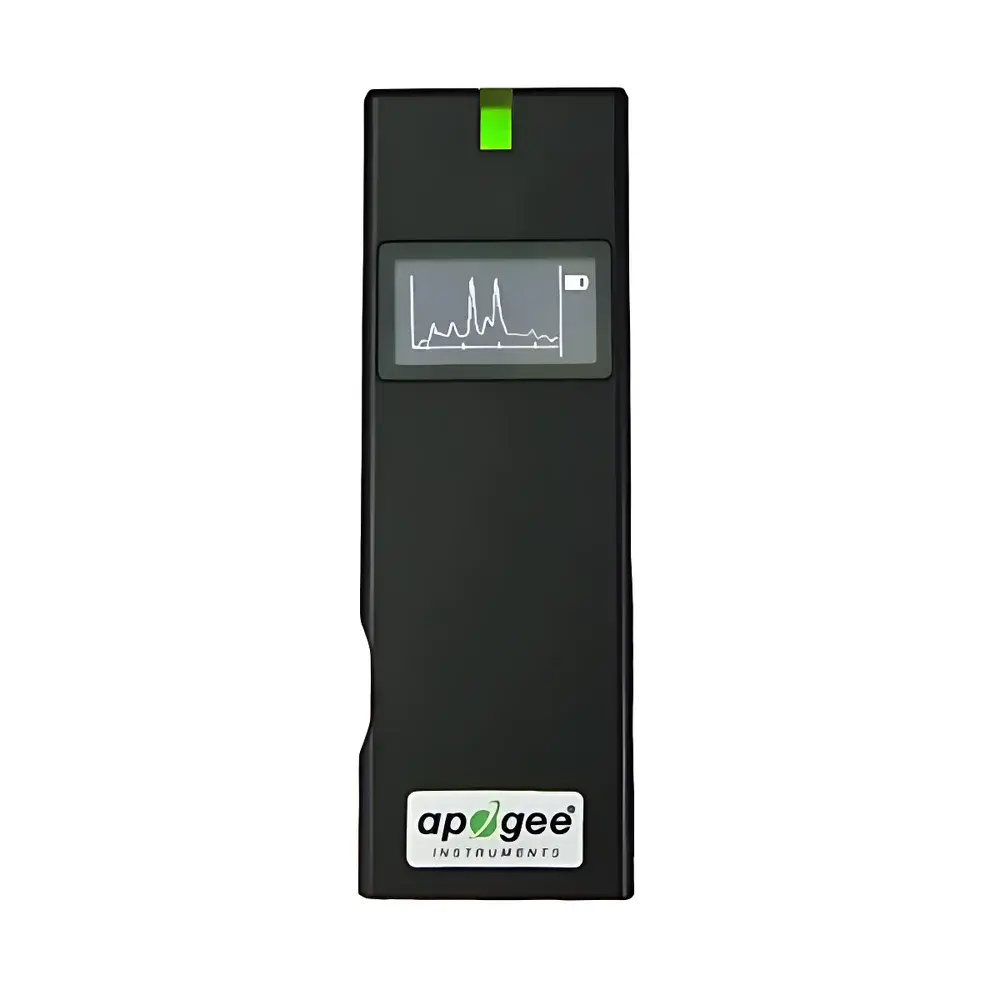
| Display | 0.96″ 128×64 monochrome OLED |
| Battery | 700 mAh / 3.7 V rechargeable Li-ion |
| Weight (with battery) | 70 g ±5 g |
| Dimensions | 90 × 30 × 32.2 mm |
| Data Storage | microSDHC up to 32 GB (supports ≥120,000 Excel files) |
| Connectivity | Mini-USB 2.0, Bluetooth 3.0/4.0 (iOS & Android compatible) |
| Software | Apogee InSight (Windows, macOS, iOS, Android) |
Overview
The Apogee MS100 InSight Handheld Spectroradiometer is a field-deployable, high-fidelity optical measurement instrument engineered for quantitative spectral radiometry across the photosynthetically active and photobiologically relevant range (380–780 nm). Based on a thermally stabilized silicon photodiode array coupled with precision diffraction grating optics and factory-calibrated NIST-traceable reference standards, the MS100 implements absolute spectroradiometric measurement principles compliant with CIE S 025/E:2015 and ISO/CIE 19476:2014. Its core function is the acquisition of calibrated spectral power distribution (SPD) data, from which photometric, radiometric, and phytochromic metrics—including PPFD, ePPFD, YPFD, TPFD, PFD-B/G/R/FR/UV, PPE, CRI, CFI, CCT, and CIE chromaticity coordinates—are derived in real time using embedded firmware algorithms aligned with CIE Publication 224:2017 and ASABE S640.2. Designed for both laboratory-grade validation and rugged outdoor use, the MS100 operates autonomously or integrates into larger environmental monitoring networks via USB or Bluetooth 4.0.
Key Features
- Thermally stabilized optical bench with ±1 nm wavelength repeatability and ~12 nm FWHM spectral bandwidth, minimizing thermal drift during extended field deployments.
- Self-powered architecture: integrated 700 mAh Li-ion battery enables >8 hours of continuous operation; supports USB bus power for lab-based tethered measurements.
- Ruggedized enclosure rated for ambient operation between 0–35 °C and ≤70 % RH (non-condensing); IP54-rated ingress protection against dust and water splashes.
- Real-time calculation of 25+ photobiological and photometric parameters per measurement cycle—no post-processing required.
- On-device 0.96″ monochrome OLED display (128×64 pixels) with intuitive menu navigation and immediate spectral curve visualization.
- Multi-mode connectivity: standalone logging, Bluetooth 3.0/4.0 wireless streaming to iOS/Android devices, and USB 2.0 host interface for PC synchronization and firmware updates.
- microSDHC slot supporting cards up to 32 GB; stores >120,000 timestamped Excel-formatted records with full spectral arrays (380–780 nm at 1 nm intervals).
Sample Compatibility & Compliance
The MS100 is optimized for measuring planar irradiance (W/m²/nm) from artificial lighting sources (LED, HPS, fluorescent, plasma), natural daylight, and reflected light from vegetation canopies or soil surfaces. It meets ANSI/IESNA RP-27.3-19 requirements for LED spectral characterization and conforms to ASTM E308-22 for colorimetric computation. All factory calibrations are traceable to NIST Standard Reference Materials (SRMs) and documented per ISO/IEC 17025:2017. The instrument satisfies GLP-relevant data integrity criteria through embedded audit-trail functionality in Apogee InSight software, including user-defined metadata tagging, time-stamped calibration logs, and immutable file export (CSV/XLSX). It is suitable for regulatory-compliant horticultural lighting validation under USDA-NRCS guidelines and EU Directive 2009/125/EC ecodesign requirements.
Software & Data Management
The Apogee InSight desktop and mobile application provides full control, visualization, and analysis of MS100 datasets across Windows, macOS, iOS, and Android platforms. It supports synchronized multi-instrument deployments, batch spectral averaging, comparative SPD overlays, and export of calibrated spectra in IES, EULUMDAT, and CIE 15:2018-compliant formats. Raw spectral data includes uncertainty estimates per wavelength bin based on SNR modeling and calibration covariance matrices. Exported reports include full metrological traceability statements, compliance flags for CRI ≥90 or CCT deviation thresholds, and optional PDF generation with embedded digital signatures for QA/QC documentation. The software adheres to FDA 21 CFR Part 11 requirements for electronic records and signatures when configured with user authentication and audit-log retention policies.
Applications
- Horticultural lighting R&D and production line verification—quantifying photon efficiency (µmol/J), spectral balance (R:FR ratio), and photoreceptor-weighted irradiance (ePPFD, YPFD).
- Greenhouse and controlled-environment agriculture (CEA) system commissioning—mapping spatial uniformity of PPFD and validating dynamic spectral tuning protocols.
- Plant phenotyping campaigns—measuring reflectance spectra (via bi-directional geometry with external cosine corrector) for NDVI, PRI, and photochemical reflectance index derivation.
- Ecological flux tower instrumentation—long-term spectral monitoring of solar irradiance components (PAR, UV-A/B, NIR) under varying atmospheric conditions.
- Architectural daylighting and museum lighting assessment—evaluating spectral quality (CRI, TM-30 Rf/Rg), circadian stimulus (CS), and melanopic EDI in human-centric lighting design.
- Academic photobiology research—validating action spectra models for cryptochrome, phytochrome, and opsin activation thresholds.
FAQ
What spectral calibration standard is used for the MS100?
The MS100 is calibrated against NIST-traceable tungsten halogen and deuterium lamp standards across its full 380–780 nm range, with certificate-of-calibration provided per ISO/IEC 17025.
Can the MS100 measure reflected light from plant leaves?
Yes—when paired with an optional cosine-corrected fiber optic probe or integrating sphere accessory, it supports bidirectional reflectance distribution function (BRDF) measurements compliant with ASTM E259-21.
Is the device suitable for outdoor solar irradiance measurements?
Yes—the instrument’s −25 dB diffuse rejection ratio and thermal stabilization ensure stable performance under direct sunlight; however, use of a calibrated cosine diffuser is required for hemispherical irradiance quantification.
Does the Apogee InSight software support automated report generation for regulatory submissions?
Yes—customizable templates generate audit-ready PDF reports containing calibration history, measurement metadata, uncertainty budgets, and compliance statements aligned with ISO 17025 and FDA 21 CFR Part 11.
How often does the MS100 require recalibration?
Apogee recommends annual recalibration for critical applications; field verification using a stable reference lamp is advised before each major campaign per ISO/IEC 17025 Clause 7.7.
Related Products





