
Apogee SQ-500 Quantum Sensor
| Brand | Apogee |
|---|---|
| Origin | USA |
| Model | SQ-500 |
| Power Supply | Self-powered (no external power required) |
| Sensitivity | 0.01 mV per μmol·m⁻²·s⁻¹ |
| Calibration Factor | 100 μmol·m⁻²·s⁻¹ per mV |
| Absolute Accuracy | ±5% |
| Repeatability | <1% |
| Long-term Drift | <2% per year |
| Nonlinearity | <1% up to 4000 μmol·m⁻²·s⁻¹ |
| Response Time | <1 ms |
| Field of View | 180° (cosine-corrected hemispherical) |
| Spectral Range | 389–692 nm |
| Directional Response Error at 75° | ±5% |
| Temperature Response | −0.11 ± 0.03 %/°C |
| Operating Environment | −40 to +70 °C, 0–100% RH |
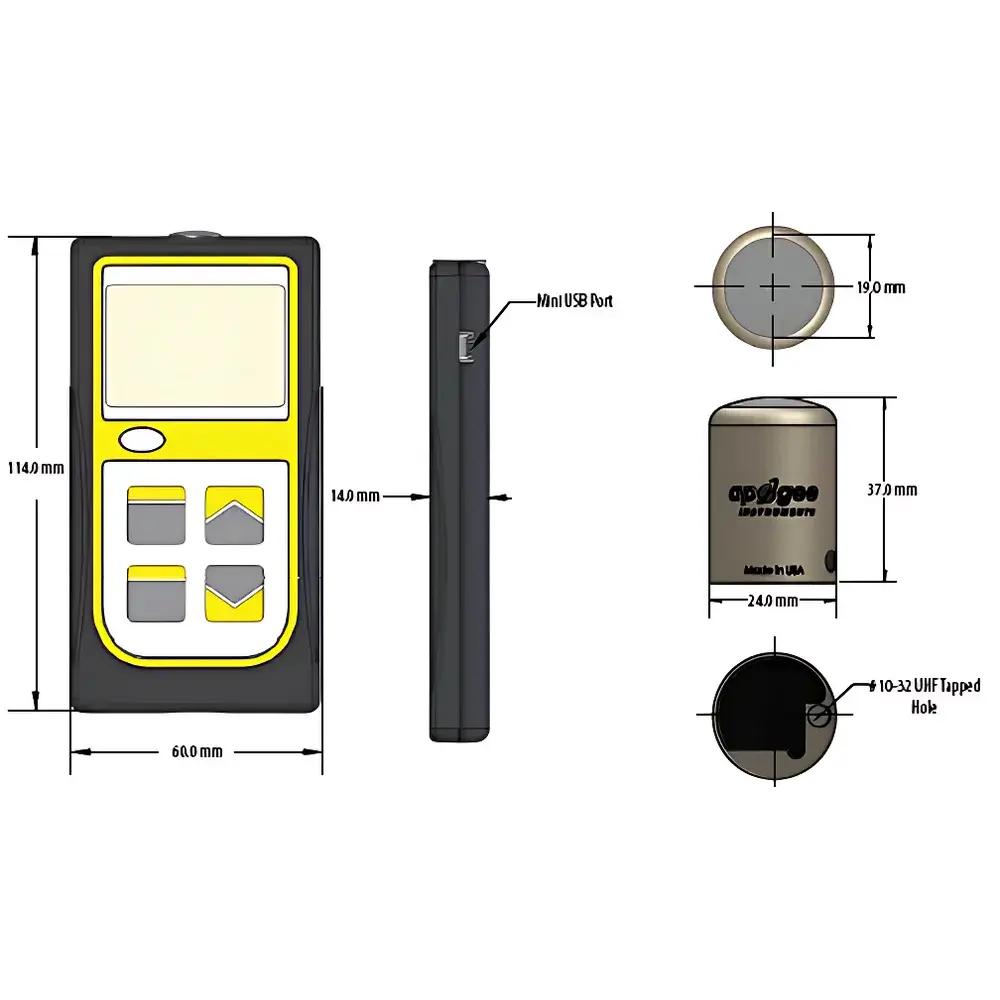
| Dimensions | Ø24 mm × 35 mm (sensor head) |
| Weight | 100 g (sensor with 5 m cable) |
| Waterproof Rating | Submersible to 30 m |
| Warranty | 4 years |
Overview
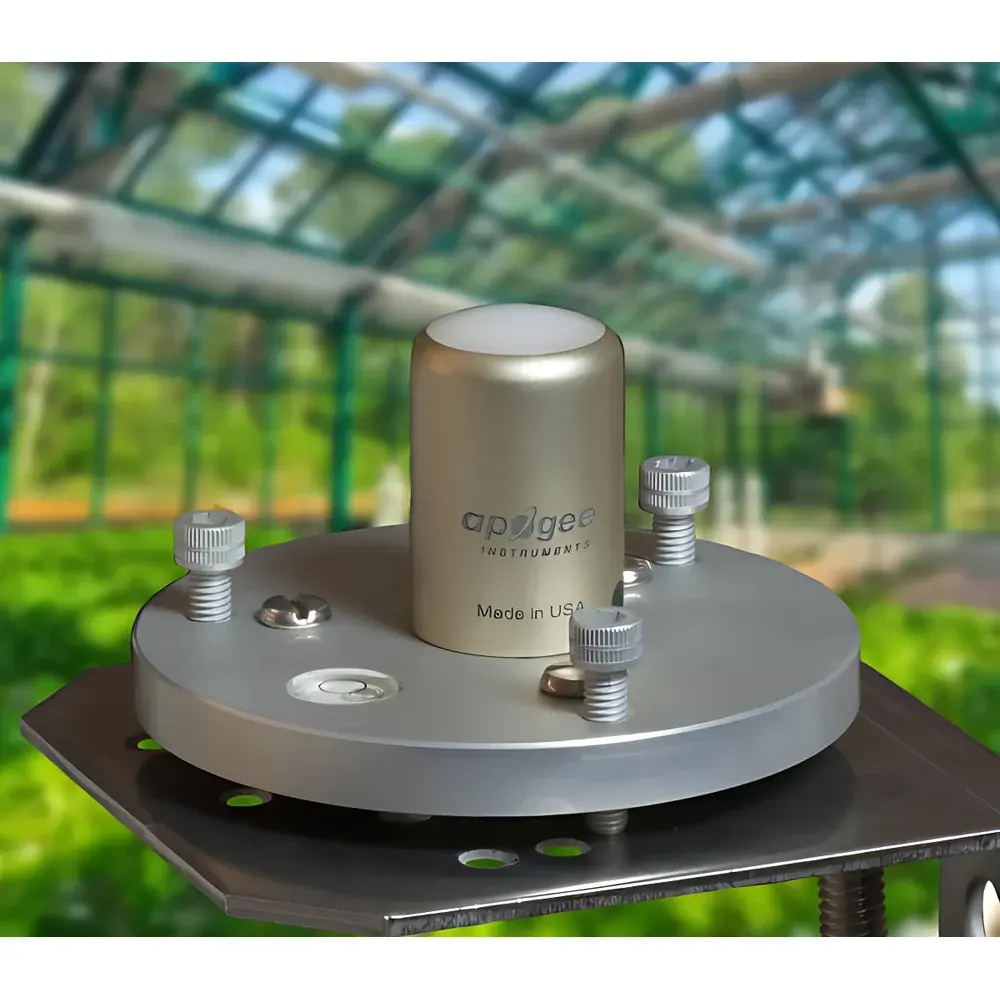
The Apogee SQ-500 Quantum Sensor is a high-precision, self-powered photosynthetic photon flux density (PPFD) sensor engineered for accurate measurement of photosynthetically active radiation (PAR) across the biologically relevant spectral band of 389–692 nm. Designed using a monocrystalline silicon photodiode with precision optical diffuser and cosine-corrected optics, the SQ-500 delivers traceable, spectrally stable response under diverse light sources—including broad-spectrum incandescent, fluorescent, high-intensity discharge (HID), and narrowband LED lighting systems widely deployed in controlled-environment agriculture, greenhouse horticulture, and plant physiology research. Its solid-state architecture eliminates battery dependency, enabling continuous, maintenance-free operation in unattended field deployments or long-term growth chamber monitoring. The sensor conforms to the American Society for Testing and Materials (ASTM) E2912–22 standard for PAR sensors and meets ISO 17025 calibration traceability requirements when used with Apogee’s NIST-traceable calibration certificates.
Key Features
- Self-powered operation: No external power supply or batteries required—ideal for remote or solar-powered monitoring stations.
- Cosine-corrected 180° field of view ensures accurate angular response under diffuse and direct illumination conditions, with directional error ≤±5% at 75° zenith angle.
- Ultrafast response time (<1 ms) enables real-time capture of dynamic light transients, including pulsed LED drivers and rapid cloud cover transitions.
- Robust environmental resilience: Rated for continuous operation from −40 to +70 °C and 0–100% relative humidity; sensor housing is IP68-rated and submersible to 30 meters.
- Low thermal drift (−0.11 ± 0.03 %/°C) minimizes temperature-induced measurement bias across diurnal and seasonal ambient fluctuations.
- High linearity (<1% nonlinearity up to 4000 μmol·m⁻²·s⁻¹) supports reliable quantification across low-light germination studies and high-intensity supplemental lighting applications.
- Four-year limited warranty reflects Apogee’s confidence in long-term stability (<2% annual drift) and mechanical durability.
Sample Compatibility & Compliance
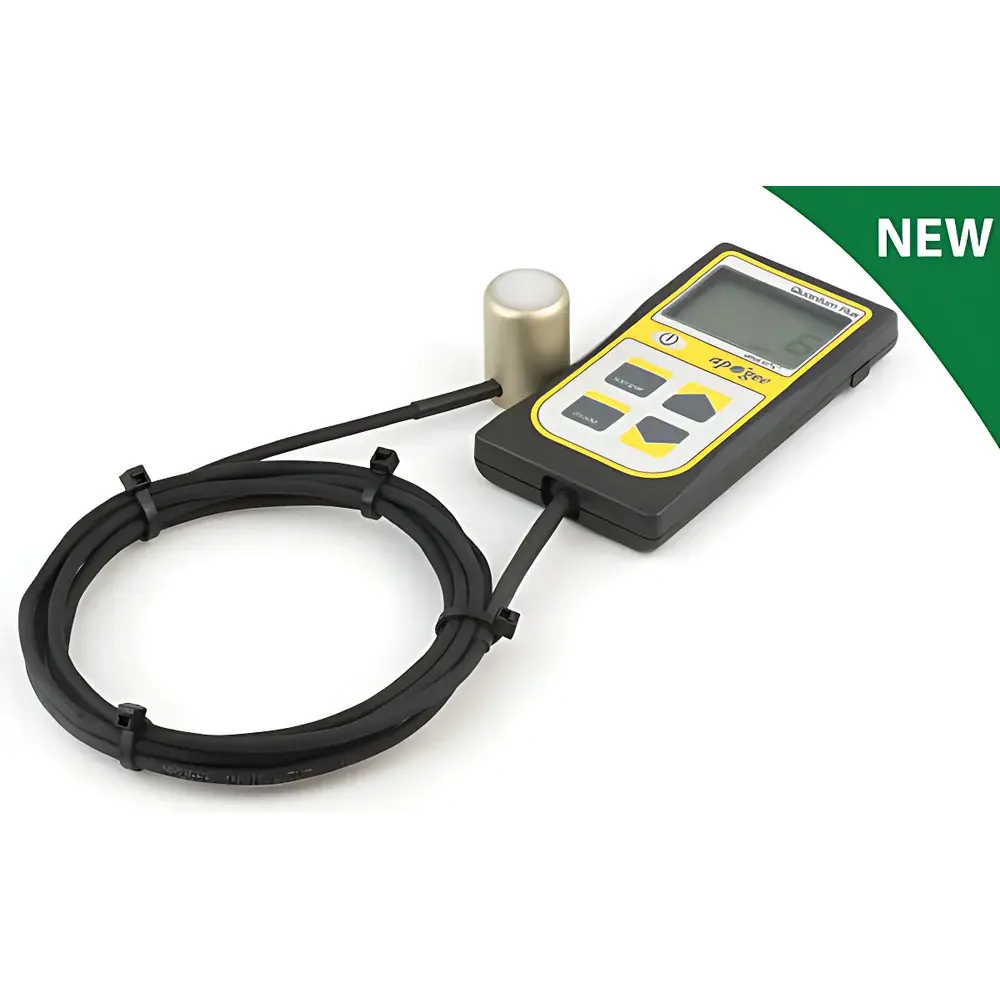
The SQ-500 is compatible with all standard data loggers supporting millivolt analog input (e.g., Campbell Scientific CR series, Onset HOBO UX120, Decagon EM50), as well as Apogee’s dedicated MQ-500 handheld meter. When paired with the MQ-500, users gain immediate PPFD readout, zero-point offset correction, and on-device unit conversion (μmol·m⁻²·s⁻¹, W·m⁻² PAR, or lux). The sensor complies with Good Laboratory Practice (GLP) documentation standards through NIST-traceable calibration reports (available upon request), and its spectral responsivity profile satisfies USDA-ARS and NASA crop modeling input requirements. It is routinely deployed in facilities adhering to FDA 21 CFR Part 11–compliant environmental monitoring protocols where audit-ready calibration history and sensor metadata are mandatory.
Software & Data Management
While the SQ-500 itself is analog-output only, integration into digital ecosystems is streamlined via Apogee’s free Logger Software (Windows/macOS) and third-party platforms such as LabVIEW, Python (via PySerial or AnalogIO libraries), and R (with ‘dplR’ or ‘dataRetrieval’ packages). Raw mV output is converted to PPFD using the factory-determined calibration factor (100 μmol·m⁻²·s⁻¹ per mV), with optional temperature compensation applied using the published thermal coefficient. Apogee provides CSV-formatted calibration certificates containing serial-number-specific sensitivity, uncertainty budgets, and date-stamped verification—essential for ISO/IEC 17025-accredited laboratories requiring full metrological traceability.
Applications
- Controlled-environment agriculture (CEA): Quantifying PPFD uniformity across vertical farms and hydroponic racks.
- Greenhouse light mapping and supplemental lighting optimization.
- Plant phenotyping studies requiring high-temporal-resolution PAR time-series under variable spectra.
- Ecological field research: Under-canopy light profiling, alpine or boreal ecosystem PAR monitoring.
- Photobioreactor and microalgae cultivation system validation.
- Educational labs teaching plant physiology, environmental science, and instrumentation principles.
FAQ
Does the SQ-500 require periodic recalibration?
Yes—Apogee recommends recalibration every two years for critical applications; annual verification is advised for GLP/GMP environments. NIST-traceable recalibration services are available directly from Apogee Instruments.
Can the SQ-500 be used underwater?
Yes—the sensor body is rated IP68 and certified for continuous submersion to 30 meters depth. Ensure the cable gland remains undamaged and the connector is sealed if used with external loggers.
How does the SQ-500 differ from quantum sensors using filtered photodiodes?
Unlike multi-filtered or thermopile-based alternatives, the SQ-500 employs a single monocrystalline silicon photodiode with proprietary optical filtering, delivering superior spectral match to the CIE-defined PAR action spectrum (400–700 nm) while maintaining high signal-to-noise ratio and minimal thermal hysteresis.
Is the MQ-500 meter required to use the SQ-500 sensor?
No—the SQ-500 outputs a calibrated analog voltage signal compatible with any millivolt-input data acquisition system. The MQ-500 is an optional handheld interface offering convenience, real-time display, and built-in temperature compensation.
What mounting options are available for permanent installation?
Standard M5 threaded mounting holes (center-to-center spacing: 20 mm) allow rigid attachment to cross-arms, gantries, or weather station booms. Optional Apogee AL-100 leveling base and AL-200 adjustable tilt mount support precise zenith alignment and azimuth rotation.
Related Products







