
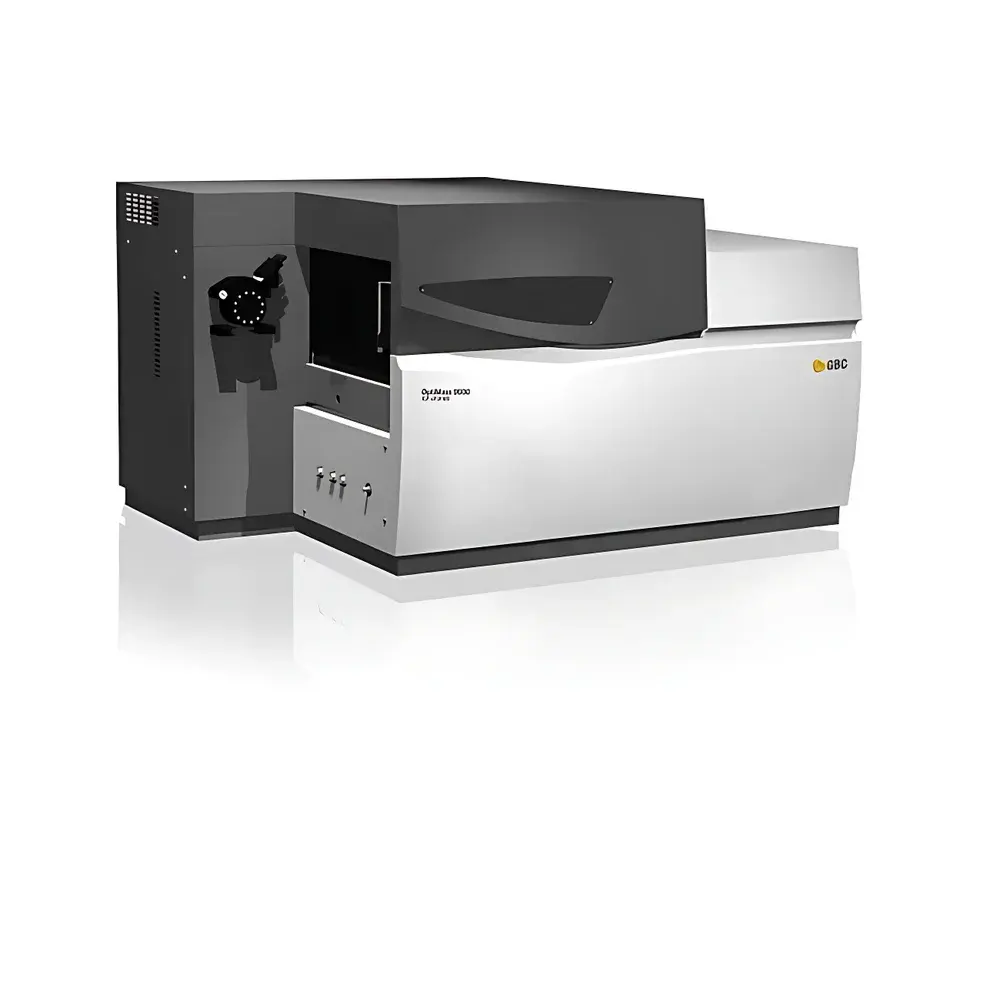
GBC Optimass 9600 Inductively Coupled Plasma Time-of-Flight Mass Spectrometer
| Brand | GBC |
|---|---|
| Origin | Australia |
| Manufacturer Type | Authorized Distributor |
| Origin Category | Imported Instrument |
| Model | Optimass 9600 |
| Price Range | USD 420,000 – 700,000 (FOB) |
| Instrument Type | Time-of-Flight Mass Spectrometer (ICP-TOFMS) |
| Mass Resolution (FWHM at 1 amu) | >4000 |
| Detection Limit (in aqueous solution) | <0.1 pg/mL (ppt-level) |
| Sensitivity | >1 × 10⁶ cps per µg/L (Mcps/ppm) |
Overview
The GBC Optimass 9600 is a third-generation inductively coupled plasma time-of-flight mass spectrometer (ICP-TOFMS) engineered for high-speed, multi-element, isotopic, and transient signal analysis with exceptional sensitivity and mass accuracy. Unlike quadrupole or magnetic sector ICP-MS platforms, the Optimass 9600 employs orthogonal ion acceleration coupled with a reflectron-enhanced TOF analyzer to acquire full mass spectra—spanning 6Li to 238U—in a single 30–100 µs pulse, without scanning or dwell-time limitations. This architecture enables true simultaneous detection of all isotopes, making it uniquely suited for laser ablation (LA), electrothermal vaporization (ETV), high-performance liquid chromatography (HPLC), and single-particle ICP-MS applications where temporal fidelity and elemental correlation are critical.
Key Features
- Orthogonal Time-of-Flight Design: Eliminates mass bias inherent in scanning instruments; delivers uniform transmission efficiency across the entire mass range (1–260 amu).
- Patented Ion Whitening Device: A dynamic energy-focusing element that suppresses isobaric interferences (e.g., 40Ar16O+ on 56Fe+) by narrowing the kinetic energy distribution prior to TOF acceleration—improving peak shape and mass accuracy without sacrificing sensitivity.
- Quadrupole Collision Cell (OCC): Equipped with reactive (H₂) and non-reactive (He) gas modes; operated in kinetic energy discrimination (KED) or reaction mode to remove polyatomic interferences (e.g., ArCl+, NO+) while preserving analyte transmission.
- Dual Turbo-Molecular Vacuum System: Integrates a primary 260 L/s turbo pump dedicated to the OCC region and a secondary high-capacity pump for the TOF flight tube—maintaining ultra-high vacuum (<1 × 10⁻⁷ mbar) even under elevated collision gas flow, ensuring stable resolution and low background noise.
- Sub-picogram-per-liter Detection Limits: Achieves routine detection limits of ≤0.08 pg/mL (80 fg/mL) for key isotopes (e.g., 115In, 208Pb) in standard aqueous matrixes using 1-s integration and no preconcentration.
- Transient Signal Optimization: 100-kHz acquisition rate supports quantitative LA-ICP-TOFMS mapping with spatial resolution down to 1 µm and isotopic ratio precision (2SE) of <0.1% RSD for 206Pb/207Pb over 100-ms pulses.
Sample Compatibility & Compliance
The Optimass 9600 interfaces seamlessly with multiple sample introduction systems—including microflow nebulizers (e.g., PFA-ST, Apex-Q), laser ablation cells (e.g., CETAC LSX-213, UP213), ETV platforms (e.g., PerkinElmer HGA), and LC-ICP coupling modules (e.g., Agilent 1260 Infinity II). Its robust plasma interface tolerates up to 0.2% total dissolved solids (TDS) without significant signal drift or cone clogging. The instrument complies with ISO/IEC 17025:2017 requirements for testing laboratories, supports audit-ready data integrity features aligned with FDA 21 CFR Part 11 (electronic signatures, user access control, immutable audit trails), and meets ASTM D5673 (trace metals in water) and ISO 17294-2 (water quality — ICP-MS methods) validation protocols.
Software & Data Management
Control and data processing are performed via GBC’s proprietary OptiMass Suite v5.x, a Windows-based platform supporting real-time spectral visualization, automated interference correction (including mathematical deconvolution of overlapping isobars), isotope ratio calculation with internal/external standardization, and batch quantification using external calibration, standard addition, or isotope dilution. Raw data files (.opd) are stored in HDF5 format for long-term archival and third-party interoperability (e.g., with MATLAB, Python Pandas, or Thermo Fisher’s QI software via API). All processing steps—including integration windows, background subtraction models, and correction algorithms—are fully traceable and version-controlled within the project metadata.
Applications
- High-resolution geochemical fingerprinting of zircons, apatites, and sulfides via LA-ICP-TOFMS for U–Pb geochronology and trace element mapping.
- Single-cell and nanoparticle metal uptake studies using spICP-TOFMS with size-calibrated response factors and multi-isotope tagging.
- Speciation analysis of organometallic compounds (e.g., methylmercury, butyltin) following HPLC-ICP-TOFMS coupling with post-column UV digestion.
- Ultra-trace monitoring of nuclear fission products (134Cs, 137Cs, 90Sr) in environmental waters and soil leachates under IAEA QA/QC guidelines.
- GMP-compliant elemental impurity screening in pharmaceutical excipients per ICH Q3D, including simultaneous quantification of Class 1–3 elements with certified reference material (CRM) traceability.
FAQ
How does the Ion Whitening Device differ from conventional energy filters?
It applies a time-dependent voltage waveform to a stacked-ring electrode array, compressing the ion kinetic energy spread *before* TOF acceleration—preserving transmission while enhancing mass peak symmetry and reducing mass shift artifacts caused by space charge effects.
Can the Optimass 9600 perform isotope dilution analysis (IDA)?
Yes; its high mass accuracy (<±2 ppm), reproducible sensitivity, and simultaneous full-spectrum acquisition support both standard IDA and multi-collector IDA workflows using enriched isotopic spikes (e.g., 115In–113In, 205Tl–203Tl).
What vacuum specifications ensure long-term stability during LA analysis?
The dual-turbo architecture maintains <1.2 × 10⁻⁷ mbar in the TOF region and <3.5 × 10⁻⁶ mbar in the OCC during continuous 5 Hz LA firing with He carrier gas—verified over 120 h of unattended operation.
Is method transfer possible from quadrupole ICP-MS platforms?
Yes; the OptiMass Suite includes import modules for Agilent MassHunter and Thermo Qtegra method templates, enabling rapid adaptation of existing SOPs—including internal standard selection, dwell times (converted to integration windows), and interference correction logic.
Does the system support remote diagnostics and preventive maintenance alerts?
All hardware modules report real-time status (pump speeds, voltages, cooling fluid levels, RF generator parameters) to the central server; predictive analytics flag deviations >3σ from baseline performance trends and trigger service notifications via encrypted SMTP or SNMP.





