
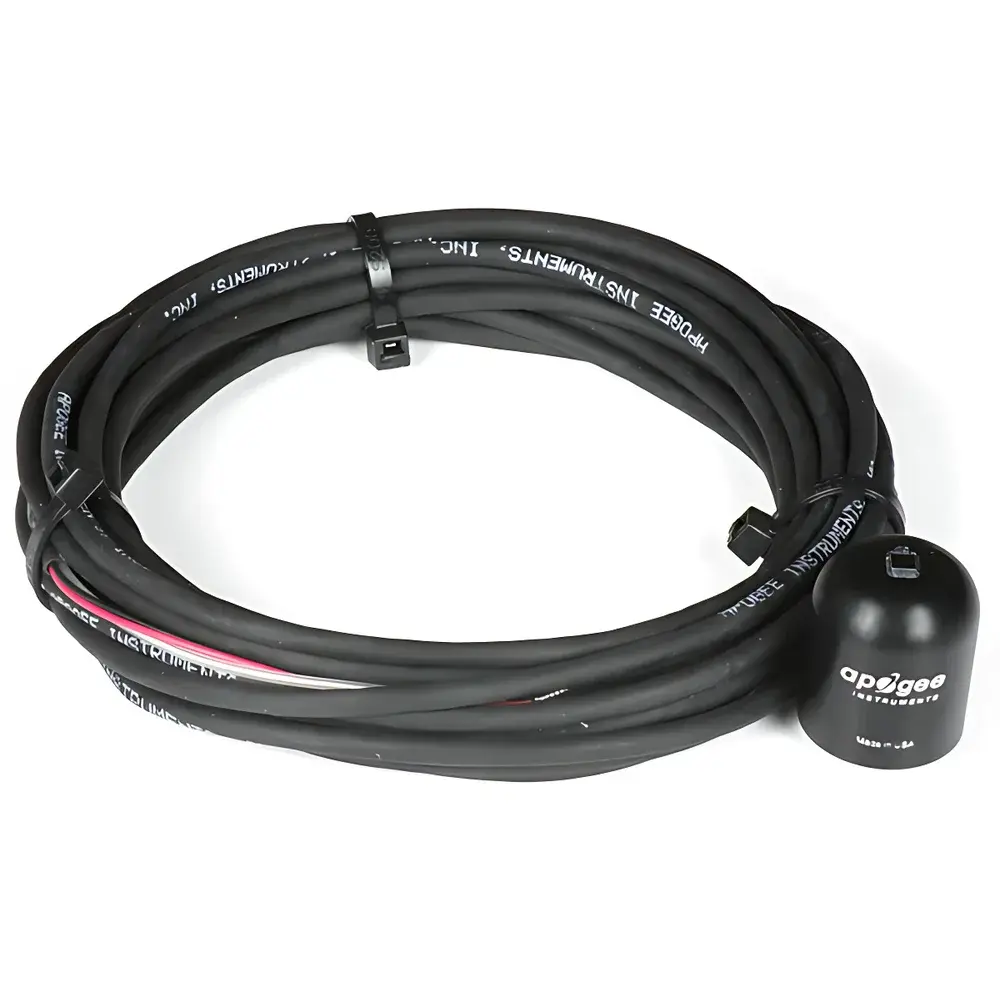
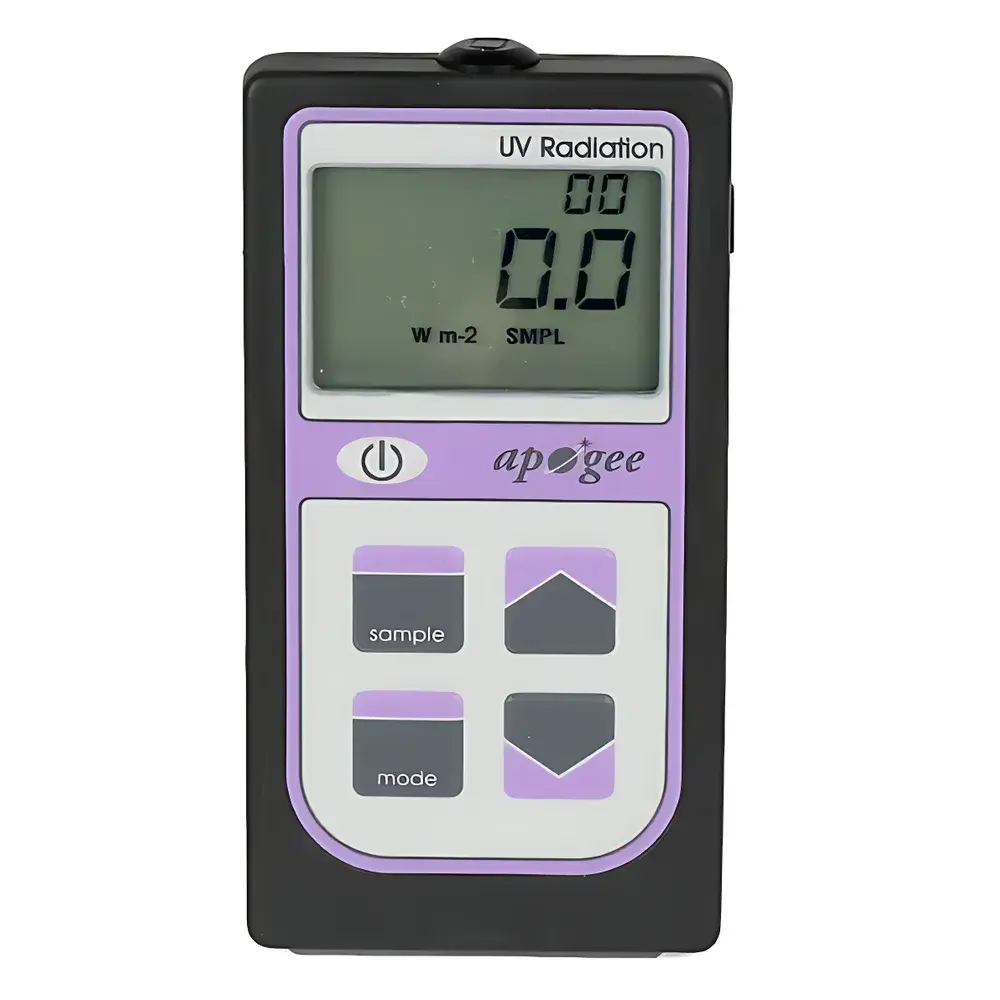
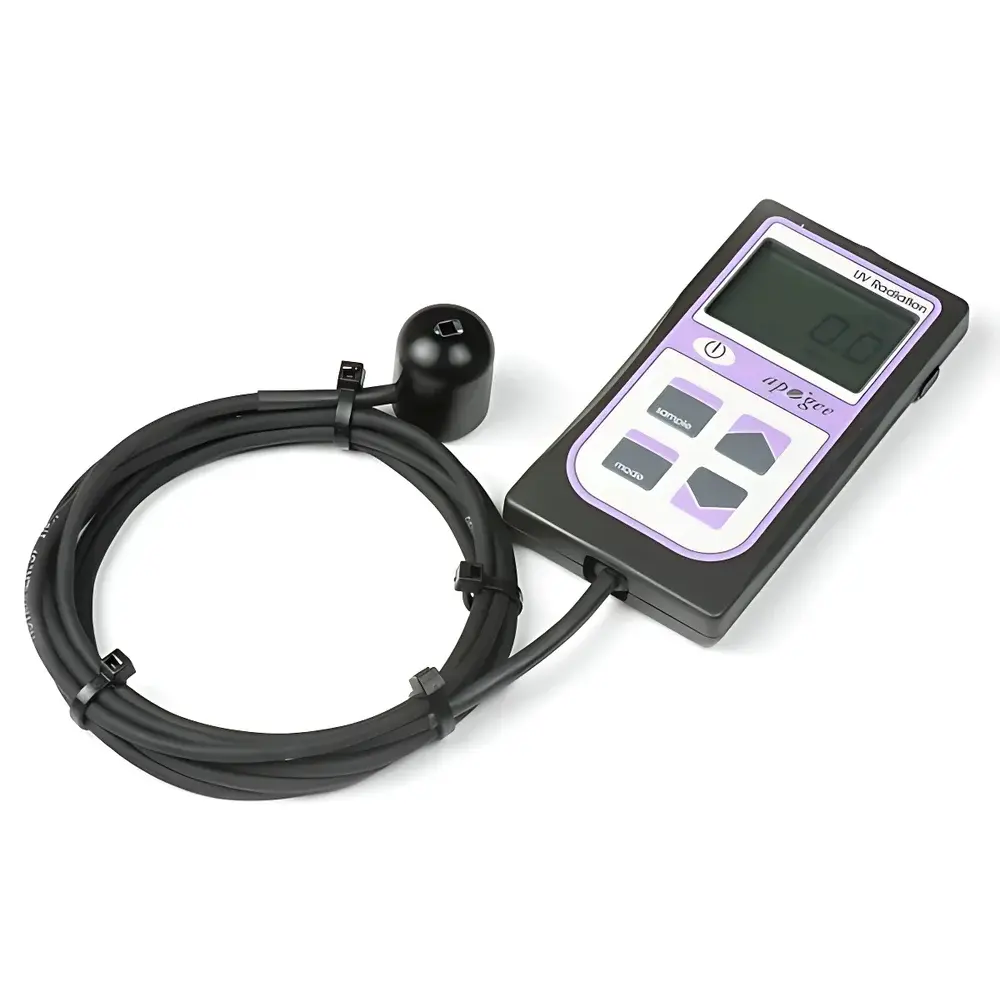
Apogee MU-100/MU-200 Handheld UV Radiometer
| Brand | Apogee |
|---|---|
| Origin | USA |
| Model | MU-100 / MU-200 |
| Spectral Range | 250–400 nm |
| UVA Range | 315–400 nm |
| UVB Range | 280–315 nm |
| Output Units | μmol·m⁻²·s⁻¹ and W·m⁻² |
| Calibration Uncertainty | ±10% |
| Repeatability | <1% |
| Long-Term Drift | <3% per year |
| Nonlinearity | <1% (up to 300 μmol·m⁻²·s⁻¹) |
| Response Time | <1 ms |
| Field of View | 180° |
| Directional Response | ±10% at 75° zenith angle |
| Temperature Dependence | ~0.1%/°C |
| Operating Environment | 0–50°C, ≤90% RH non-condensing |
| Probe IP Rating | IP68 (MU-200 probe, 30 m submersible) |
| Data Logging | Manual (99 points) or Automatic (30 s sampling interval, 30 min averaging, 99 daily means) |
| Power | CR2320 coin cell (MU-100) |
| Dimensions (Meter) | 126 × 70 × 24 mm |
| Weight (Meter only) | 150 g (MU-100), 180 g (MU-200 body) |
| Cable Length (MU-200) | 2 m |
| Accessories | AC-100 USB interface cable, AM-310/AM-320 telescoping probe handles, AL-100/AL-210 leveling mounts with bubble vials and three-point adjustment |
Overview
The Apogee MU-100 and MU-200 are precision handheld UV radiometers engineered for quantitative measurement of ultraviolet irradiance across the biologically and industrially critical 250–400 nm spectral band. Designed in accordance with fundamental radiometric principles, these instruments employ a thermopile-based detector with a custom optical filter stack optimized for spectrally resolved UVA (315–400 nm) and UVB (280–315 nm) quantification. Unlike broadband photodiode sensors subject to angular and thermal artifacts, the MU series integrates cosine-corrected diffusers and temperature-compensated signal conditioning to ensure high reproducibility under variable environmental conditions—essential for field-deployed solar UV monitoring, UV disinfection validation, photobiological safety assessment, and controlled-environment horticultural research. The instruments operate on traceable NIST-calibrated coefficients and conform to ISO/CIE guidelines for spectral responsivity characterization in terrestrial UV measurement.
Key Features
- Two operational configurations: integrated MU-100 (all-in-one design) and modular MU-200 (separate meter and submersible probe connected via 2 m shielded cable)
- Dual output units selectable in real time: photosynthetically weighted irradiance (μmol·m⁻²·s⁻¹) and radiometric irradiance (W·m⁻²), supporting both plant physiology and photometric compliance workflows
- IP68-rated UV probe (MU-200) rated for continuous immersion up to 30 m depth—validated per IEC 60529—enabling underwater UV profiling in aquaculture, wastewater treatment, and marine photobiology studies
- High-speed analog response (<1 ms) and low directional error (±10% up to 75° zenith angle) ensure fidelity in dynamic or off-normal illumination geometries
- Onboard memory stores 99 manual readings or executes automated logging: 30-second sampling with 30-minute rolling averages and daily mean computation (max. 99 days)
- Tool-free mechanical leveling system (AL-100/AL-210 mounts) with integrated bubble vials and three-point micrometer screws enables rapid, repeatable horizontal alignment—critical for albedo, reflectance, and solar zenith angle correction protocols
- AC-100 USB interface provides direct data export to Windows/macOS platforms; compatible with Apogee’s free PC software for time-series visualization, CSV export, and metadata tagging
Sample Compatibility & Compliance
The MU series is validated for use with diverse UV-emitting sources including natural solar radiation, low-pressure mercury vapor lamps (e.g., 254 nm germicidal UVC, though outside nominal range), fluorescent UV-B tubes, LED-based UV curing arrays, and xenon-arc solar simulators. Its 250–400 nm spectral response avoids significant out-of-band sensitivity—verified by monochromator-based spectral characterization—and meets the spectral matching requirements outlined in ASTM E772 and ISO 17166:2019 for erythemal UV dosimetry. While not certified for medical device use under FDA 21 CFR Part 820, the instrument’s calibration traceability, documented uncertainty budget (±10%), and GLP-aligned data logging (with timestamped records and no overwrite capability) support audit-ready documentation in environmental health, industrial hygiene, and academic research settings compliant with ISO/IEC 17025 quality management frameworks.
Software & Data Management
Data acquisition and post-processing are supported via Apogee’s proprietary Windows/macOS-compatible software, which imports raw logs from the AC-100 interface and reconstructs temporal sequences with embedded timestamps, unit selection flags, and logging mode identifiers (manual/auto/daily). The software enforces immutable record integrity: once downloaded, entries cannot be edited or deleted—aligning with ALCOA+ principles (Attributable, Legible, Contemporaneous, Original, Accurate) required in regulated environments. Export options include UTF-8 CSV (with header metadata), PDF summary reports, and time-series PNG plots. No cloud synchronization or remote access functionality is implemented, preserving data sovereignty and minimizing cybersecurity exposure—consistent with institutional IT policies governing scientific instrumentation.
Applications
- Solar UV index monitoring and long-term climatological trend analysis in ecological field stations
- Validation of UV-C and UV-B lamp output decay in hospital sterilization chambers and HVAC duct-mounted disinfection systems
- Quantification of UV transmission through greenhouse glazing, sunscreen films, and protective textiles
- In situ measurement of underwater UV attenuation profiles in coral reef monitoring and phytoplankton photoinhibition studies
- Calibration transfer and intercomparison between fixed-site pyranometers and portable reference standards
- Photocatalytic reactor optimization where UV photon flux directly governs reaction kinetics (e.g., TiO₂-mediated oxidation)
FAQ
Is the MU-200 probe truly submersible? What depth rating applies?
Yes—the MU-200 UV probe is IP68-certified for continuous operation at depths up to 30 meters. Pressure testing was conducted per IEC 60529 Annex B; housing integrity is maintained without desiccant or O-ring maintenance under static immersion.
Can the MU-100 and MU-200 be calibrated independently?
No—calibration is performed as a matched meter-probe pair (MU-200) or integrated unit (MU-100). Apogee does not provide separate probe-only recalibration; full-system recalibration is recommended every 24 months or after mechanical shock.
Does the instrument comply with FDA 21 CFR Part 11 for electronic records?
The MU series does not implement electronic signatures or audit-trail encryption required under Part 11. However, its write-once data logging architecture, timestamped immutable records, and offline export workflow support complementary validation under Part 11 when deployed within a validated laboratory information management system (LIMS).
What is the angular dependence specification, and how is it measured?
Directional response is characterized per CIE S 014-2/E:2006 using a goniophotometer. Error remains within ±10% up to 75° zenith angle—sufficient for most planar surface irradiance measurements but not intended for hemispherical sky scanning without cosine correction algorithms.
How does temperature affect measurement accuracy?
The onboard temperature compensation algorithm corrects for detector drift at ~0.1%/°C. Full-spec performance is guaranteed between 0–50°C; operation outside this range may introduce uncorrected bias exceeding ±3% without external thermal stabilization.







