
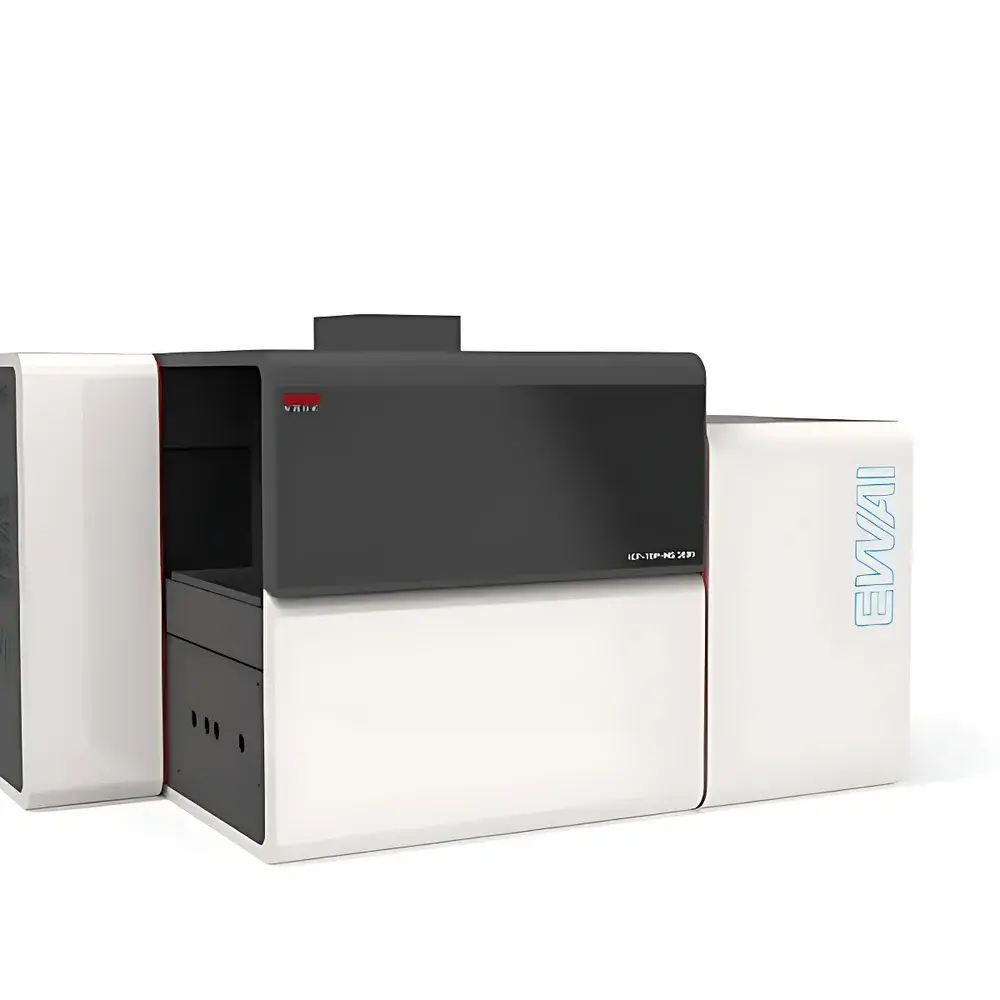
Dongxi Analytical ICP-TOF-MS 3800 Inductively Coupled Plasma Time-of-Flight Mass Spectrometer
| Brand | Dongxi Analytical |
|---|---|
| Origin | Beijing, China |
| Manufacturer Type | Original Equipment Manufacturer (OEM) |
| Instrument Type | Time-of-Flight Mass Spectrometer |
| Mass Range | 1–260 amu |
| Argon Consumption | 12 L/min |
| Analysis Time for 20 Elements | 25 s |
| Application Environment | Laboratory-Based Quantitative Elemental & Isotopic Analysis |
| Collision Cell | Integrated Octopole Collision Cell (OCC) with Mass-Independent Reaction Kinetics |
Overview
The Dongxi Analytical ICP-TOF-MS 3800 is a high-performance inductively coupled plasma time-of-flight mass spectrometer engineered for ultrafast, simultaneous multi-element and isotopic analysis in laboratory environments. Unlike quadrupole-based ICP-MS systems that scan sequentially across mass-to-charge (m/z) values, the ICP-TOF-MS 3800 employs orthogonal acceleration time-of-flight mass analysis—capturing the full mass spectrum (1–260 amu) in every single ion extraction cycle. This architecture enables true transient signal fidelity, sub-second spectral acquisition, and intrinsic synchronization between elemental signals. The instrument integrates a robust RF-driven ICP source, high-efficiency ion optics, and a digitally optimized TOF analyzer with microchannel plate detection, delivering high mass resolution (>4,000 FWHM), excellent mass accuracy (<5 ppm), and low detection limits (sub-attogram level for many elements). Designed for routine compliance-driven workflows, it supports method validation per ISO/IEC 17025, ASTM D5673, and USP / for elemental impurities.
Key Features
- Full-Spectrum Simultaneous Acquisition: Records all detectable isotopes (e.g., 7Li to 238U) within a single 25 µs extraction window—enabling complete isotopic fingerprinting without duty cycle loss or peak skewing.
- Optimized Argon Economy: Operates at a stable 12 L/min Ar consumption—approximately one-tenth the gas usage per element compared to sequential quadrupole ICP-MS systems—reducing operational cost and environmental footprint without compromising plasma stability or sensitivity.
- Integrated Octopole Collision Cell (OCC): Positioned between the interface and TOF analyzer, this mass-independent reaction cell utilizes kinetic energy discrimination and controlled reactive gas chemistry (He/H2/NH3) to suppress polyatomic interferences (e.g., 40Ar16O+, 40Ar40Ar+) across the entire mass range, ensuring robust interference correction for complex matrices (e.g., seawater, biological digests, geological samples).
- High-Throughput Quantification: Achieves quantitative analysis of up to 70+ elements—including trace metals, rare earth elements (REEs), and non-metals—in under 30 seconds per sample, with linear dynamic range exceeding 8 orders of magnitude (ppt to % w/w).
- Modular Service Architecture: OCC, ion lenses, and detector assemblies are field-replaceable with minimal recalibration; vacuum system employs dual-stage turbomolecular pumping with real-time pressure monitoring for long-term stability and uptime >95% in 24/7 operation.
Sample Compatibility & Compliance
The ICP-TOF-MS 3800 accepts liquid samples introduced via standard nebulizers (e.g., MicroMist, PFA-ST) and desolvation systems (e.g., Aridus III), as well as laser ablation (LA) solid sampling interfaces (optional). It complies with GLP/GMP data integrity requirements through built-in audit trail functionality, electronic signature support, and secure user access levels aligned with FDA 21 CFR Part 11. All calibration, QC, and sample run metadata—including instrument parameters, gas flows, voltage settings, and raw TOF transients—are automatically archived in vendor-neutral .mzML format for third-party reprocessing and regulatory submission.
Software & Data Management
Control and data reduction are performed using Dongxi’s proprietary TOF-Analyzer Suite v4.x—a Windows-based platform supporting method development, real-time spectral visualization, isotope ratio calculation, and automated interference correction. The software includes embedded statistical tools for multivariate outlier detection, drift correction via internal standard normalization (e.g., 115In, 203Tl), and batch processing with customizable reporting templates compliant with ISO 17025 Annex A5. Raw data export supports open formats (.csv, .mzML) and integration with LIMS platforms via ASTM E1467-compliant APIs.
Applications
- Environmental monitoring: Multi-element speciation and isotopic tracing in groundwater, wastewater, and airborne particulates.
- Pharmaceutical quality control: Elemental impurity screening per ICH Q3D guidelines, including Co, V, Ni, As, Cd, Pb, and Pt-group metals in APIs and excipients.
- Geochemical research: High-precision REE patterns, U–Pb geochronology, and Hf isotopic analysis in zircon and silicate melts.
- Materials science: Depth-resolved compositional mapping of thin films, battery cathodes, and semiconductor dopants via LA-ICP-TOF-MS coupling.
- Clinical and nutritional analysis: Quantification of essential and toxic elements (e.g., Se, Zn, Cu, Hg) in serum, urine, and tissue homogenates with isotopic dilution capability.
FAQ
How does the ICP-TOF-MS 3800 differ from conventional quadrupole ICP-MS in terms of data acquisition?
It acquires the complete mass spectrum simultaneously—not sequentially—eliminating mass bias, improving precision for isotope ratios, and enabling retrospective analysis of untargeted elements post-acquisition.
Can the integrated OCC be operated in both collision and reaction modes?
Yes—the octopole cell supports He-mode (collisional damping), H2-mode (proton transfer), and NH3-mode (charge transfer), with automated gas flow control and reaction efficiency optimization per isotope group.
Is the system compatible with laser ablation for solid sampling?
Yes—when equipped with a certified LA interface (e.g., UP213 or NWR213), the ICP-TOF-MS 3800 delivers high-spatial-resolution (≤5 µm) elemental imaging with isotopic fidelity.
What regulatory standards does the software meet for data integrity?
The TOF-Analyzer Suite implements full 21 CFR Part 11 compliance, including role-based permissions, electronic signatures, immutable audit trails, and data backup protocols validated per ALCOA+ principles.
Does the instrument support isotope dilution mass spectrometry (IDMS)?
Yes—its high mass accuracy, stability, and simultaneous isotope detection make it suitable for IDMS workflows, particularly for certified reference material (CRM) characterization and metrological applications.
Related Products





