
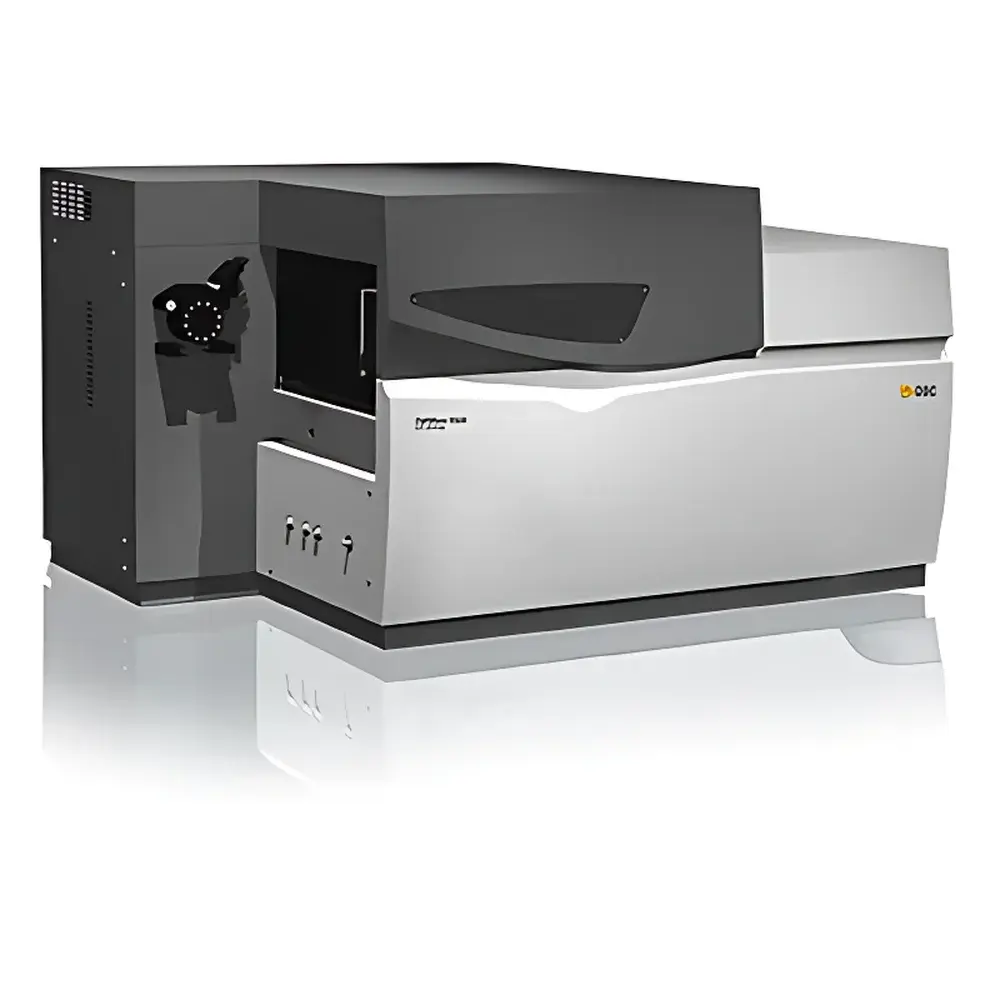
GBC Optimass 9500 ICP-TOFMS
| Brand | GBC |
|---|---|
| Origin | Australia |
| Manufacturer Type | Authorized Distributor |
| Origin Category | Imported |
| Model | Optimass 9500 |
| Instrument Type | Inductively Coupled Plasma Time-of-Flight Mass Spectrometer |
| Mass Resolution (Unit Mass Resolution at m/z = 238) | 2000 |
| Detection Limit | 1–10 ng·L⁻¹ (ppt level, 3–5 s integration time) |
| Sensitivity | Mcps per ppm |
| Mass Range | 1–260 amu (full-spectrum acquisition) |
Overview
The GBC Optimass 9500 ICP-TOFMS is a high-performance inductively coupled plasma time-of-flight mass spectrometer engineered for simultaneous, full-mass-range elemental and isotopic analysis. Unlike quadrupole-based ICP-MS systems that sequentially scan masses, the Optimass 9500 acquires the complete mass spectrum (1–260 amu) in every single transient event—enabling true multi-element detection with microsecond-level temporal resolution. Its orthogonal acceleration TOF design eliminates initial kinetic energy spread by accelerating ions perpendicular to their extraction direction, thereby maximizing mass resolving power and spectral fidelity. This architecture delivers intrinsic advantages in transient signal analysis, particularly when coupled with laser ablation (LA), electrothermal vaporization (ETV), or high-performance liquid chromatography (HPLC) systems. The instrument operates under ultra-high vacuum conditions maintained by a three-cone, four-stage differential pumping system, ensuring long-term signal stability, low background noise, and high measurement reproducibility across extended analytical sessions.
Key Features
- Full-spectrum acquisition from m/z 1 to 260 in a single transient—no mass scanning required
- Orthogonal acceleration TOF geometry delivering >2000 unit mass resolution at m/z 238 (²³⁸U)
- Sub-ppt detection limits (1–10 ng·L⁻¹) with 3–5 second integration times
- SmartGate ion filter for selective suppression of polyatomic interferences (e.g., ⁴⁰Ar⁺, ⁴⁰Ar¹⁶O⁺) and matrix-derived ions—enhancing spectral cleanliness and detector longevity
- High-linearity detector with >8 orders of dynamic range for accurate quantification across trace and major element concentrations
- Automated parameter optimization routines for plasma tuning, ion optics, and TOF voltage calibration
- Integrated semi-quantitative and traceable semi-quantitative workflows—storing all acquired mass spectra for retrospective reprocessing and method validation
- Fingerprinting capability for rapid spectral comparison and batch-to-batch consistency assessment
Sample Compatibility & Compliance
The Optimass 9500 supports a broad range of sample introduction techniques including pneumatic nebulization, laser ablation (with compatible LA cells), hydride generation (via optional HG module), and ETV. Its robust interference management—achieved without reactive gases or collision cell chemistry—ensures compliance with ISO/IEC 17025 method validation requirements and facilitates adherence to EPA Method 6020B, ASTM D5673, and USP / for elemental impurities testing. The system’s audit-trail-enabled software architecture meets FDA 21 CFR Part 11 data integrity requirements when configured with appropriate user access controls and electronic signature protocols. All hardware components conform to IEC 61010-1 safety standards and CE electromagnetic compatibility directives.
Software & Data Management
Control and data processing are managed via the proprietary Optimass Suite software, designed for laboratory information management system (LIMS) interoperability through ASTM E1384-compliant export formats (e.g., .csv, .mzML). Raw transient data files retain full mass-resolved intensity arrays, enabling post-acquisition recalibration, interference correction, and isotope ratio re-evaluation. The software includes built-in tools for drift correction, internal standard normalization, isotope dilution calculations, and statistical outlier detection. Data archiving follows GLP/GMP-aligned folder structures with automatic metadata tagging (operator ID, instrument log, calibration history, and QC reference values). Optional secure remote monitoring and instrument diagnostics support predictive maintenance scheduling and uptime optimization.
Applications
- Geochemical fingerprinting of zircons and accessory minerals using LA-ICP-TOFMS
- Multi-element speciation analysis in environmental water matrices (e.g., river, groundwater, seawater)
- Ultra-trace metal impurity profiling in pharmaceutical excipients and biologics
- High-throughput screening of catalysts and battery materials for elemental contamination
- Isotopic ratio measurements in nuclear forensics and safeguards applications
- Single-cell metallomics with sub-second temporal resolution
- Reference material certification and inter-laboratory comparison studies
FAQ
How does the orthogonal acceleration design improve mass resolution?
Orthogonal acceleration decouples ion extraction from the plasma interface, allowing ions to start from near-zero initial velocity in the drift region. This minimizes time-of-flight dispersion due to kinetic energy spread, directly enhancing mass resolving power and peak shape fidelity.
Can the Optimass 9500 perform isotope ratio analysis?
Yes—the instrument delivers high mass accuracy (<5 ppm) and excellent peak stability, supporting precise isotope ratio determination for applications such as geochronology and nuclear material characterization.
Is reaction/collision cell technology required to remove Ar-based interferences?
No—SmartGate ion filtering provides effective removal of ⁴⁰Ar⁺ and argide interferences without reactive gases, eliminating associated method development complexity and instrumental downtime.
What data formats are supported for LIMS integration?
The system exports fully annotated results in ASTM E1384-compliant CSV, mzML, and custom XML schemas, enabling seamless ingestion into enterprise-grade LIMS platforms.
Does the software support retrospective reprocessing of raw transients?
Yes—all raw TOF transients are preserved with full metadata; users may reapply calibration, background subtraction, or interference corrections without re-running samples.




