
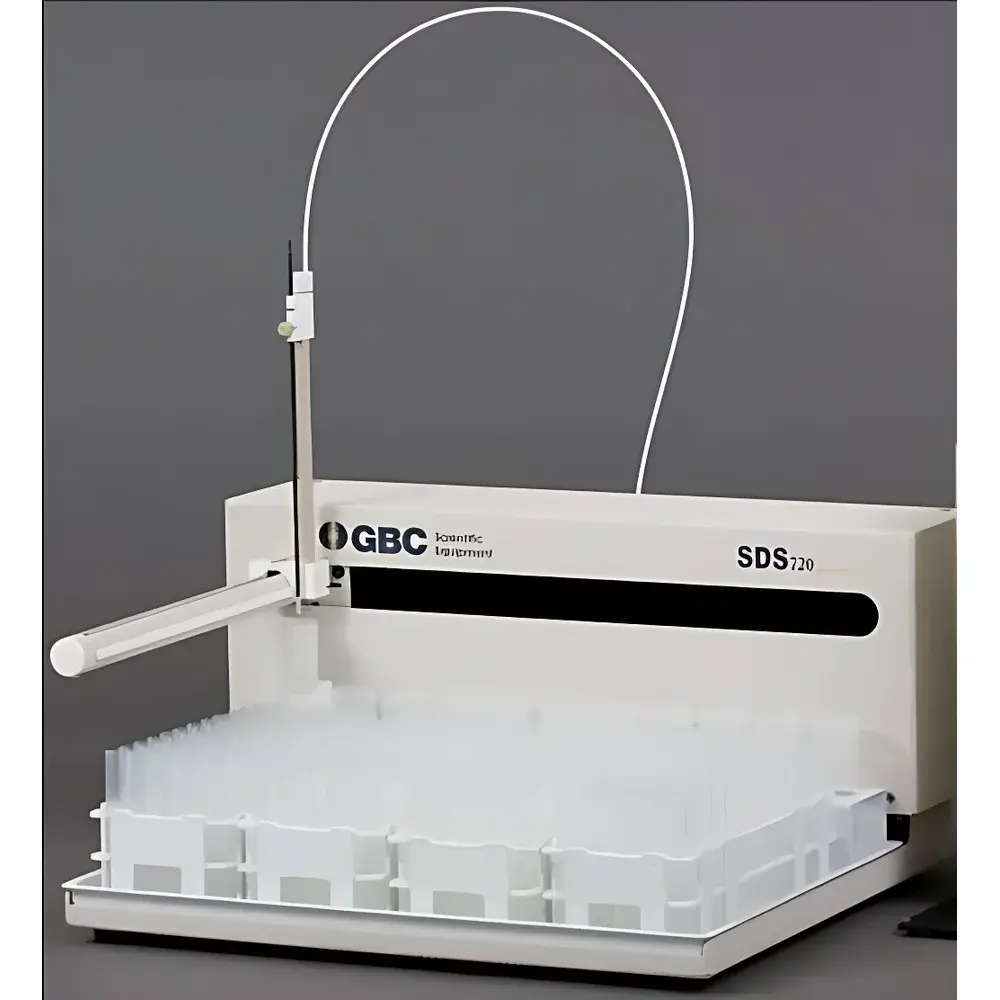
GBC SDS720 XYZ-Axis Automated Sample Introduction System
| Brand | GBC |
|---|---|
| Origin | Australia |
| Manufacturer Type | Authorized Distributor |
| Origin Category | Imported |
| Model | SDS720 |
| Pricing | Available Upon Request |
| Sample Capacity | 360 positions (standard), expandable to 720 |
| Vial Compatibility | 240 × 14 mL vials + 10 × 50 mL standard vials |
| Fluid Path Materials | PTFE and PEEK only (metal-free) |
| Cleaning System | Peristaltic-pump-driven continuous-flow probe wash station |
| Overflow Protection | Fixed overflow tray |
| Instrument Compatibility | GBC XplorAA, SensAA, SavantAA AAS |
| Control Interface | PC-based software with programmable wash time, delay time, replicate injection count, recalibration interval, restandardization cycle, measurement duration, and sequence logic |
| Sampling Mode | Fully random-access sampling |
Overview
The GBC SDS720 XYZ-Axis Automated Sample Introduction System is a purpose-engineered sample handling platform designed for high-integrity, metal-free sample introduction in trace elemental analysis workflows. Built upon a rigid three-axis (X-Y-Z) motion architecture, the SDS720 delivers precise positional repeatability and robust mechanical stability under routine laboratory conditions. Its core function is to automate the sequential or randomized presentation of liquid samples to spectroscopic instruments—specifically atomic absorption spectrometers (AAS), inductively coupled plasma optical emission spectrometers (ICP-OES), inductively coupled plasma orthogonal time-of-flight mass spectrometers (ICP-oTOF-MS), and UV-Vis spectrophotometers—while eliminating manual pipetting variability and operator-induced contamination. The system operates on a closed-loop control principle: each sample aspiration event is synchronized with instrument trigger signals, ensuring deterministic timing for integration windows, background correction cycles, and calibration point insertion. Its design philosophy prioritizes chemical inertness and analytical traceability—no metallic components contact the sample path, minimizing leaching risks critical for sub-pptr-level quantitation.
Key Features
- Metal-free fluidic pathway constructed exclusively from PTFE and PEEK—validated for compatibility with aggressive acids (e.g., HNO₃, HCl), organic solvents, and high-salinity matrices without degradation or extractables.
- Programmable peristaltic pump–driven probe wash station enabling variable-duration, continuous-flow rinsing between samples—reducing carryover to <0.05% for typical aqueous standards (verified per ASTM D5175).
- Dual-vial support configuration: one 240-position rack for 14 mL conical vials and one 10-position rack for standardized 50 mL volumetric flasks—accommodating both high-throughput screening and certified reference material verification protocols.
- Fixed overflow containment tray engineered to capture accidental spills or overfill events, preventing liquid migration onto motor assemblies, electronics, or bench surfaces—supporting ISO/IEC 17025-compliant lab safety requirements.
- Random-access sampling engine allowing non-sequential injection order based on priority flags, QC frequency rules, or dynamic reanalysis requests—eliminating fixed queue bottlenecks in multi-method workflows.
- Expandable sample capacity: standard 360-position tray (7 mL tubes); optional dual-tray configuration supports up to 720 samples without hardware modification—ideal for unattended overnight operation in environmental or clinical testing labs.
Sample Compatibility & Compliance
The SDS720 is validated for use with aqueous, dilute acidic (up to 10% v/v HNO₃), and low-viscosity organic-aqueous mixtures (≤20% methanol/ethanol). It complies with material compatibility requirements outlined in USP , ISO 15195:2018 (clinical laboratory quality), and EPA Method 200.8 Annex A (trace metals in water). All wetted parts meet FDA CFR Title 21 Part 177.1550 (PTFE) and Part 177.2415 (PEEK) food-contact equivalency standards. The system supports GLP/GMP audit readiness through full electronic logging of all motion events, wash cycles, and sample position calls—data exportable in CSV or XML format for LIMS integration.
Software & Data Management
Control is executed via GBC’s proprietary SDS Manager software, compatible with Windows 10/11 (64-bit) and requiring .NET Framework 4.8. The interface provides granular parameter definition: user-configurable rinse volume (0.1–5.0 mL), post-rinse dwell time (0–120 s), inter-sample delay (0–300 s), replicate injection count (1–10), automatic recalibration triggers (every N samples or time interval), and dynamic sequence reordering. Audit trail functionality records timestamped entries for all method edits, start/stop commands, and error alerts—including motor stall detection and fluid-path pressure anomaly flags. Data files conform to ASTM E1382-22 metadata schema for analytical instrument output interoperability.
Applications
- High-volume environmental monitoring: automated analysis of drinking water, wastewater, and soil digests per EPA 200.7, 200.8, and 6020B protocols.
- Clinical trace element profiling: serum, urine, and whole blood analysis using AAS or ICP-MS platforms under CLIA and CAP accreditation frameworks.
- Pharmaceutical excipient testing: elemental impurity screening (ICH Q3D) across raw materials and final drug products.
- Geochemical surveying: batch processing of rock digests and sediment extracts for multi-element quantification by ICP-OES/MS.
- Quality control in metallurgical refining: rapid turnaround of alloy dissolution samples for Ni, Co, Cr, and rare earth elements.
FAQ
Is the SDS720 compatible with third-party spectroscopic instruments beyond GBC systems?
Yes—via TTL-compatible external trigger input and RS-232/USB virtual COM port emulation, provided the host instrument supports asynchronous sample-ready signaling.
Can the system be integrated into a 21 CFR Part 11–compliant environment?
Full Part 11 compliance requires deployment with GBC’s optional SDS Secure Server module, which adds electronic signatures, role-based access control, and immutable audit log archiving.
What maintenance intervals are recommended for the peristaltic pump tubing?
PTFE-reinforced silicone tubing should be replaced every 3,000 injections or quarterly—whichever occurs first—to maintain volumetric accuracy within ±1.5% (per ISO 8655-3).
Does the SDS720 support barcode scanning for sample identification?
Barcode reading is supported via optional USB-connected linear imager (e.g., Honeywell Xenon XP 1950g), with decoded IDs mapped directly to sample metadata fields in SDS Manager.
How is positional accuracy verified during routine operation?
Built-in encoder feedback on all three axes enables real-time deviation tracking; daily verification uses NIST-traceable 0.1 mm pitch calibration grid, with maximum allowable positional drift ≤±0.02 mm per axis.






