
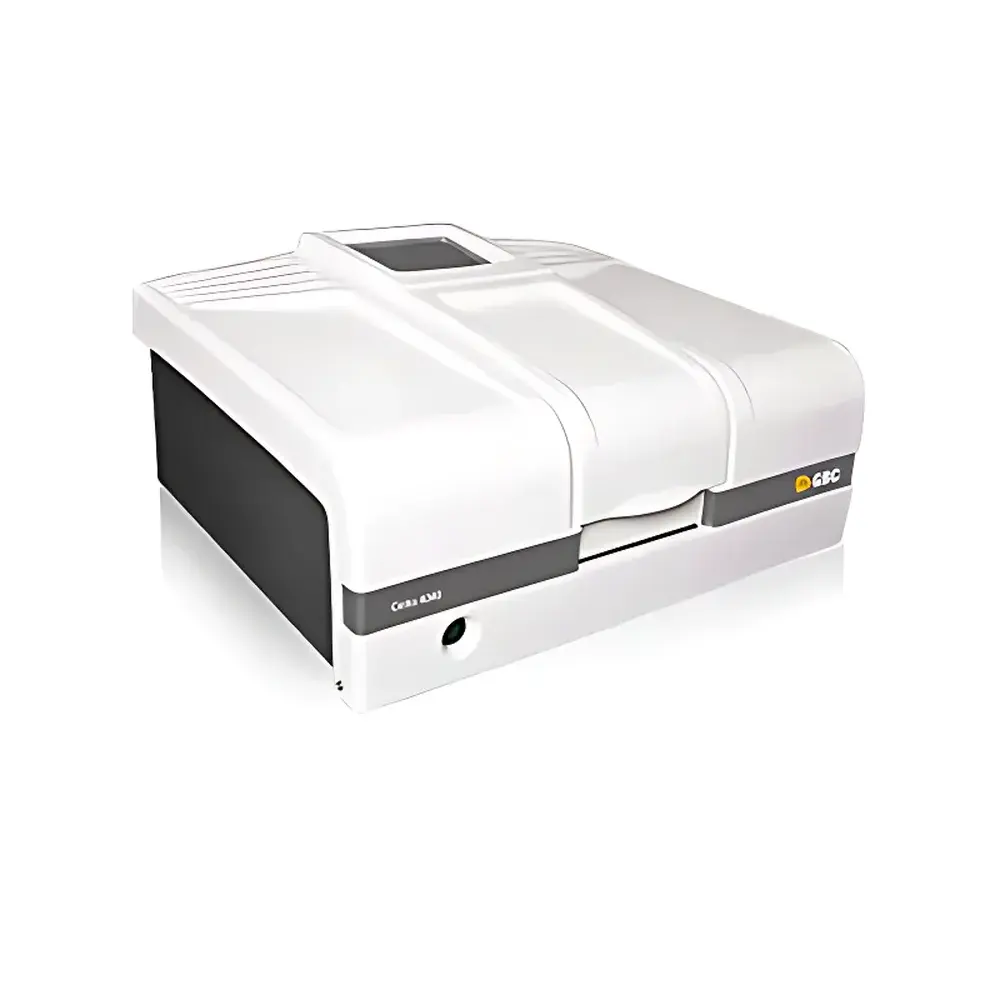
GBC Cintra4040 Dual-Beam, Dual-Monochromator UV-Visible Spectrophotometer
| Brand | GBC |
|---|---|
| Origin | Australia |
| Model | Cintra4040 |
| Optical Design | True Dual-Beam |
| Detector Type | Photodiode Array (PDA) |
| Wavelength Automation | Fully Automatic |
| Slit Width Range | 0.1–2.0 nm |
| Stray Light | <0.0005% T at 220 nm |
| Photometric Linearity | ±1.2% up to 5 Abs |
| Monochromator Configuration | Dual Littrow, Czerny-Turner |
| Dynamic Range | >6 Abs (measured) |
| Compliance | ASTM E275, ISO 6358, USP <857>, EP 2.2.25, JP 2.03 |
Overview
The GBC Cintra4040 is a research-grade, true dual-beam, dual-monochromator UV-Visible spectrophotometer engineered for high-resolution, high-stability quantitative and qualitative analysis across demanding academic, pharmaceutical, and industrial laboratories. Its optical architecture employs two independent Czerny-Turner monochromators—each incorporating Littrow-mounted diffraction gratings—to deliver exceptional spectral purity, minimal stray light (<0.0005% T at 220 nm), and photometric linearity of ±1.2% up to 5 absorbance units. Unlike single-monochromator or pseudo-dual-beam systems, the Cintra4040 maintains real-time reference beam compensation throughout the full wavelength range (190–1100 nm), eliminating drift from lamp intensity fluctuations, detector aging, or environmental thermal shifts. This ensures long-term measurement fidelity essential for kinetic assays, low-concentration DNA quantification, and regulatory-compliant method validation.
Key Features
- True dual-beam optics with simultaneous sample and reference path monitoring—no mechanical chopper or time-shared detection
- Dual Littrow monochromator design delivering <0.1 nm nominal resolution (at 0.1 nm slit width) and sub-0.001% stray light performance
- Photodiode array (PDA) detector enabling rapid full-spectrum acquisition (190–1100 nm in <1 s) without moving parts
- Adjustable slit width from 0.1 nm to 2.0 nm—optimizing resolution/sensitivity trade-offs per application
- Thermally stabilized optical bench and precision-machined aluminum housing for <0.001 Abs/h baseline stability
- Integrated deuterium and tungsten-halogen lamps with automatic source switching and lifetime monitoring
Sample Compatibility & Compliance
The Cintra4040 supports standard 10 mm cuvettes (quartz, fused silica, or UV-grade glass), microvolume adapters (down to 0.5 µL via integrated capillary flow cell), and fiber-optic probes for remote or in-situ measurements. It meets critical regulatory requirements for analytical instrumentation: fully compliant with USP “Spectrophotometry and Light-Scattering”, European Pharmacopoeia 2.2.25, Japanese Pharmacopoeia 2.03, and ASTM E275 “Standard Practice for Description of Ultraviolet, Visible, and Near-Infrared Spectrophotometers”. All IQ/OQ protocols—including wavelength accuracy, photometric accuracy, stray light, resolution, and baseline flatness—are executable via the built-in Auto System Performance Verification module, generating audit-ready PDF reports traceable to NIST-traceable standards.
Software & Data Management
Cintral™ software (v5.2+) provides a validated, 21 CFR Part 11–ready environment with role-based access control, electronic signatures, and full audit trail logging for all instrument parameters, method changes, and data exports. The software includes dedicated modules for: quantitative analysis (single/multi-point calibration, Beer-Lambert fitting), kinetic/time-course studies (with customizable sampling intervals down to 0.1 s), DNA/RNA melting curve analysis (Tm determination, hypochromicity modeling), colorimetry (CIE L*a*b*, ΔE calculations), and advanced spectral processing (derivative spectroscopy, peak deconvolution, spectral subtraction). Raw absorbance, transmittance, and reflectance data are exportable in ASCII, CSV, and JCAMP-DX formats; method files are encrypted and version-controlled.
Applications
The Cintra4040 is routinely deployed in applications requiring metrological rigor and extended dynamic range: nucleic acid purity assessment (A260/A280, A260/A230), protein quantification via Bradford/Lowry/BCA assays, enzyme kinetics (e.g., NADH oxidation at 340 nm), pharmaceutical dissolution testing (USP Apparatus II with inline flow cell), nanoparticle size estimation via plasmon resonance peak analysis, and high-precision color measurement in polymer and coating R&D. Its low-noise PDA and dual-monochromator design enable reliable detection of sub-µM analyte concentrations in complex matrices—particularly where spectral overlap or high background absorption would compromise single-monochromator instruments.
FAQ
What distinguishes the Cintra4040 from the Cintra 3030?
The Cintra4040 features a dual-monochromator architecture (vs. single monochromator in the 3030), delivering superior stray light rejection, enhanced photometric linearity beyond 4 Abs, and improved resolution at narrow slit widths (0.1 nm vs. 0.2 nm minimum on the 3030).
Is the system compliant with FDA 21 CFR Part 11?
Yes—Cintral software includes full electronic signature support, audit trail generation, user authentication, and data integrity safeguards validated per Annex 11 and ALCOA+ principles.
Can the instrument perform GLP/GMP-compliant system suitability tests?
Yes—the Auto System Performance Verification module executes pre-programmed IQ/OQ tests aligned with pharmacopeial standards and generates compliant documentation with pass/fail criteria and uncertainty estimates.
What is the minimum sample volume required for standard cuvette measurements?
1 mL for standard 10 mm pathlength quartz cuvettes; with optional microcell adapter, as low as 0.5 µL using 10 mm pathlength capillary cells.
Does the system support external triggering or integration with autosamplers?
Yes—it provides TTL-compatible trigger I/O ports and RS-232/Ethernet interfaces for synchronization with third-party liquid handlers, dissolution apparatuses, or process analyzers.
Related Products





