
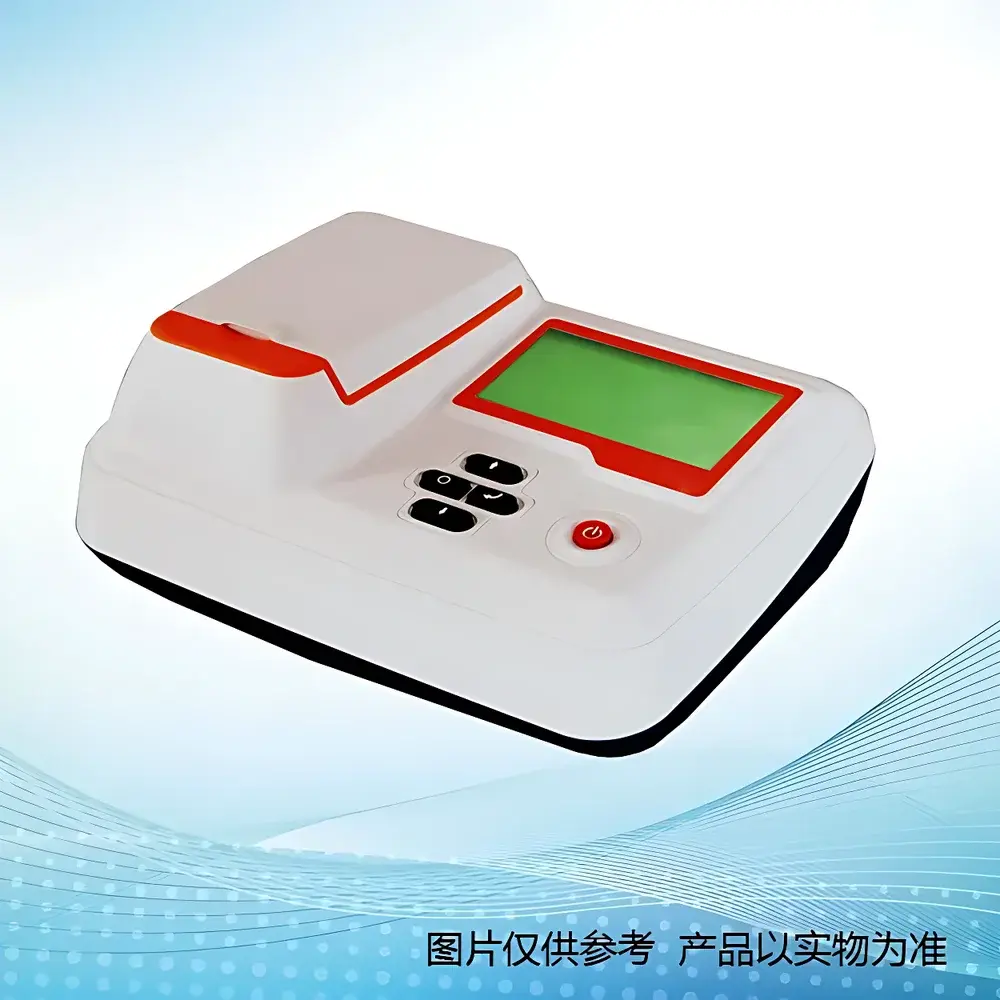
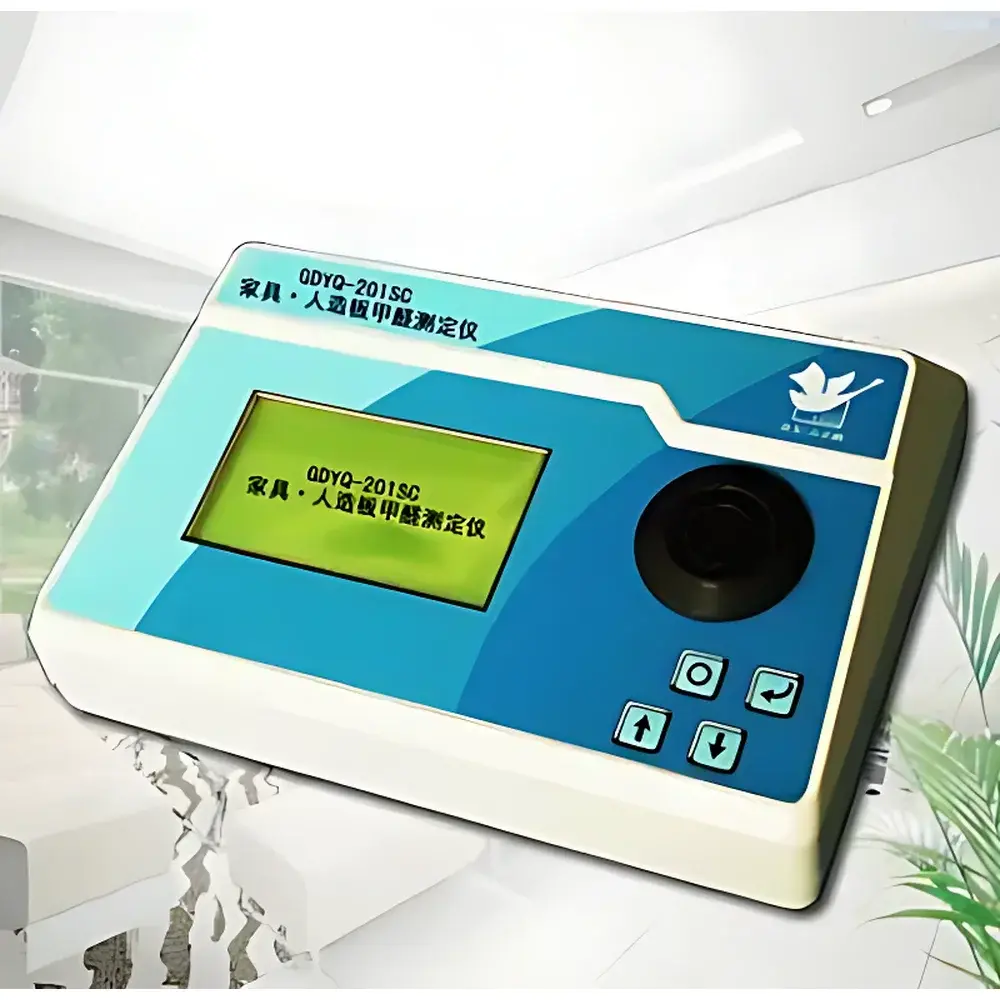
Jiada Xiaotian’e GDYJ-201SC Formaldehyde Analyzer for Furniture and Engineered Wood Panels
| Brand | Jiada Xiaotian'e |
|---|---|
| Origin | Jilin, China |
| Manufacturer Type | Direct Manufacturer |
| Regional Classification | Domestic (China) |
| Model | GDYJ-201SC |
| Price Range | USD 1,400–2,800 (estimated) |
| Measurement Principle | Colorimetric Method |
| Detection Limit | 0.05 mg/L |
| Measurement Range | 0.00–5.00 mg/L |
| Accuracy | ±5% |
| Display | Backlit LCD with Chinese UI |
| Control System | Embedded Microcontroller |
| Data Functions | Real-time measurement, parameter setting, data logging, statistical analysis, USB communication |
| Sample Prep | Dedicated extraction apparatus + single-use reagent kits |
| Compliance | GB 18580–2001, GB 18584–2001 |
Overview
The Jiada Xiaotian’e GDYJ-201SC Formaldehyde Analyzer is a dedicated benchtop instrument engineered for the rapid, quantitative determination of free formaldehyde released from furniture components and engineered wood panels—including plywood, particleboard, medium-density fiberboard (MDF), laminated veneer lumber (LVL), decorative laminate flooring, bamboo flooring, and engineered hardwood. It operates on the internationally recognized colorimetric principle, specifically the acetylacetone (Hantzsch) reaction, in which formaldehyde reacts with acetylacetone under acidic conditions to form a yellow chromophore measurable at 412 nm. This method is standardized in key Chinese national standards—GB 18580–2001 (Formaldehyde Emission Limits in Wood-Based Panels) and GB 18584–2001 (Formaldehyde Content in Wooden Furniture)—and aligns conceptually with ISO 12460-3 (wood-based panels: determination of formaldehyde emission by the flask method) and ASTM D6007 (standard test method for formaldehyde concentrations in air from wood products using small-scale environmental chambers). The GDYJ-201SC is not an ambient air monitor; rather, it quantifies aqueous-phase formaldehyde extracted from solid samples via standardized desorption protocols (e.g., perforator or flask methods), delivering results in mg/L as extract concentration—a critical input for calculating emission rates (mg/m²·h) or content (mg/100g) per regulatory frameworks.
Key Features
- Pre-validated methodology compliant with GB 18580–2001 and GB 18584–2001, enabling direct use in factory QA/QC, third-party testing labs, and certification bodies operating under Chinese regulatory mandates.
- Full-cycle analysis completed within 15 minutes post-extraction—significantly reducing turnaround time compared to traditional spectrophotometric workflows requiring external cuvette handling and manual calibration.
- Integrated microcontroller architecture with embedded firmware for automated wavelength selection, zero-point correction, and linear regression-based concentration calculation using pre-loaded calibration curves.
- Backlit monochrome LCD display with native Chinese character support, facilitating intuitive menu navigation, real-time absorbance readout, and result visualization without external PC dependency.
- Dedicated sample preparation hardware included: precision-machined extraction flasks, temperature-stabilized water bath interface, and calibrated volumetric transfer tools—all optimized for reproducible 24-hour or 48-hour desorption per GB protocols.
- Single-use, factory-prepackaged reagent kits eliminate inter-batch variability and cross-contamination risk; each kit contains acetylacetone reagent, ammonium acetate buffer, and standardized formaldehyde standards for daily verification.
Sample Compatibility & Compliance
The GDYJ-201SC supports formaldehyde quantification across all major categories of wood-based composites regulated under China’s compulsory product certification (CCC) scheme for interior decoration materials. Compatible substrates include urea-formaldehyde (UF)-bonded particleboard, melamine-urea-formaldehyde (MUF) laminates, phenol-formaldehyde (PF)-treated exterior-grade plywood, and formaldehyde-scavenging composite panels. While the instrument itself does not carry CE, UKCA, or FDA clearance, its analytical output satisfies documentation requirements for GB-marked products entering domestic markets. For export-oriented manufacturers targeting EU Ecolabel or CARB ATCM compliance, the GDYJ-201SC serves as a cost-effective internal screening tool—though final certification requires chamber testing (EN 717-1, ASTM E1333) or thermodesorption-GC/MS validation.
Software & Data Management
Data acquisition and reporting are managed through on-device firmware—not cloud-connected software. All measurements are timestamped and stored internally (up to 500 records). USB 2.0 interface enables export of CSV-formatted logs—including sample ID, date/time, absorbance value, calculated concentration (mg/L), operator code, and pass/fail flag relative to preset limits—for integration into LIMS or Excel-based QA dashboards. Audit trail functionality includes automatic logging of calibration events, reagent lot numbers (manually entered), and system self-diagnostic status. While not 21 CFR Part 11 compliant out-of-the-box, the device supports GLP-aligned operation when paired with controlled document procedures for reagent traceability and calibration verification.
Applications
- Quality assurance laboratories in panel manufacturing facilities performing routine batch release testing against GB 18580 Class E1/E0 thresholds (≤0.124 mg/m³ and ≤0.05 mg/m³, respectively).
- Furniture OEMs verifying formaldehyde content in raw veneers, edge banding adhesives, and finished carcass assemblies prior to upholstery and packaging.
- Third-party inspection agencies conducting surveillance testing for market supervision bureaus (e.g., SAMR audits).
- Vocational training centers teaching standardized chemical analysis techniques aligned with national occupational skill standards for “Environmental Testing Technicians” (Code 4-08-06-01).
- Research institutions studying formaldehyde mitigation strategies—e.g., catalyst-doped resins or post-cure thermal treatments—where rapid comparative screening of extract concentrations is required.
FAQ
Does the GDYJ-201SC measure airborne formaldehyde directly?
No. It measures aqueous formaldehyde concentration (mg/L) in extracts obtained from solid samples using standardized desorption methods (e.g., perforator or flask). Airborne formaldehyde monitoring requires separate instrumentation such as electrochemical sensors or DNPH cartridge–HPLC systems.
Can this analyzer be used for compliance with CARB or EU REACH regulations?
It is not certified for CARB ATCM or REACH Annex XVII reporting. Its outputs support internal process control and GB-aligned declarations only. Export compliance requires chamber-based testing per EN 717-1 or ASTM D6007.
Is calibration verification required before each use?
Yes. Daily verification using the included formaldehyde standard solution (0.50 mg/L) is mandatory to ensure linearity and photometric stability; deviation >±3% triggers recalibration.
What maintenance does the optical module require?
The LED light source and photodiode detector are solid-state and maintenance-free. Annual verification of wavelength accuracy (412 ±2 nm) and absorbance linearity (0–2.0 AU) is recommended using NIST-traceable neutral density filters.
Are reagent kits compatible with other formaldehyde analyzers?
No. Reagents are formulation-optimized for the GDYJ-201SC’s specific reaction kinetics and optical path length. Cross-platform use may yield non-linear responses or elevated background noise.







