
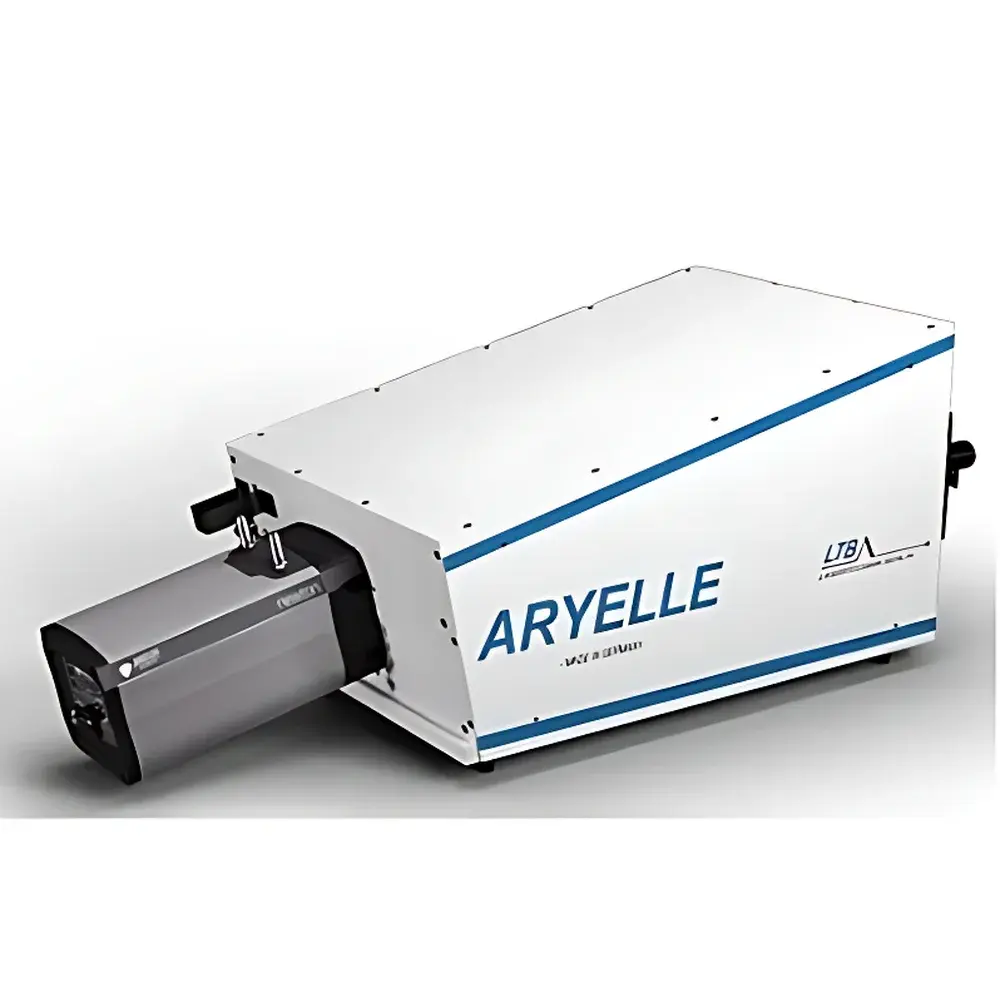
LTB ARYELLE Butterfly Dual-Echelle Laser-Induced Breakdown Spectroscopy (LIBS) Spectrometer
| Brand | LTB |
|---|---|
| Origin | Germany |
| Manufacturer Status | Authorized Distributor |
| Origin Category | Imported |
| Model | ARYELLE Butterfly |
| Price Range | USD 135,000 – 162,000 |
| Instrument Type | Benchtop |
| Integration | Integrated System |
| Laser Energy Range | 5 mJ – 850 mJ |
| Spectral Coverage | 190–950 nm (UV-VIS-NIR) + VUV extension via reflective optics |
| Spectral Resolution | <20 pm @ 200 nm |
| Spectral Resolution Power | >10,000 (practical, non-pixel-limited) |
| Detector Format | 1024 × 255 pixels, 26 × 26 µm, full-well capacity 1 Me⁻ |
| Detector Cooling | −70 °C thermoelectric |
| Optional Detectors | EMCCD or ICCD |
| Focal Length | 400 mm per channel |
| f-number | f/10 |
| Calibration | Automated wavelength recalibration using Hg lamp and internal shutter |
| Optical Path | SMA-fiber-coupled for UV-VIS-NIR |
| Dual-Channel Architecture | Independent VUV and UV-VIS-NIR channels sharing one detector plane |
Overview
The LTB ARYELLE Butterfly is a dual-channel, benchtop echelle spectrometer engineered for high-resolution, wide-spectral-range elemental analysis via Laser-Induced Breakdown Spectroscopy (LIBS) and complementary techniques including Raman spectroscopy, absorption spectroscopy, and gas chromatography–optical emission coupling. Its core architecture integrates two independent 400 mm focal-length echelle spectrometers—each with f/10 aperture—within a single mechanically stable housing. Unlike sequential scanning or filter-based systems, the ARYELLE Butterfly employs simultaneous dual-path optical routing to a shared 1024 × 255 scientific-grade CCD detector (26 × 26 µm pixels, −70 °C thermoelectric cooling), enabling concurrent acquisition across two distinct spectral domains: vacuum ultraviolet (VUV) and ultraviolet–visible–near-infrared (UV-VIS-NIR). This configuration eliminates mechanical reconfiguration delays and preserves shot-to-shot temporal correlation—critical for time-resolved LIBS plasma diagnostics and process monitoring applications. The system leverages CaF₂ prisms and broadband UV-optimized coatings to suppress chromatic aberration across its full operational range, while its modular slit and cross-disperser design permits field-specific optimization of resolution, throughput, and stray-light rejection.
Key Features
- Dual-echelle architecture: Two physically separate 400 mm focal-length echelle spectrometers co-housed and synchronized to a single detector plane.
- Extended spectral coverage: 190–950 nm (UV-VIS-NIR) via fiber-coupled SMA input; VUV extension (down to ~115 nm) enabled by all-reflective optical path with MgF₂ or LiF optics (optional).
- High practical resolution: 10,000), validated under LIBS plasma emission conditions—not pixel-limited but defined by optical aberration control and grating line density.
- Simultaneous multi-range acquisition: No moving parts or motorized gratings; VUV and UV-VIS-NIR spectra captured in parallel within a single laser shot.
- Modular detector compatibility: Supports standard scientific CCD, intensified CCD (ICCD), or electron-multiplying CCD (EMCCD) sensors with 27 × 27 mm² active area.
- Automated calibration: Internal mercury lamp and programmable shutter enable traceable, on-demand wavelength recalibration without external hardware.
- Robust mechanical design: Precision-machined aluminum chassis with thermal stabilization, optimized for laboratory and industrial QC environments requiring long-term spectral fidelity.
Sample Compatibility & Compliance
The ARYELLE Butterfly accommodates solid, liquid, and gaseous samples through standardized LIBS ablation chambers, flow cells, or gas-jet interfaces. Its VUV capability supports analysis of light elements (e.g., C, N, O, F, P, S) that emit below 190 nm—essential for metallurgical grade verification, semiconductor contamination screening, and environmental aerosol characterization. The system complies with ISO/IEC 17025 requirements for analytical instrument validation and supports audit-ready operation under GLP and GMP frameworks. When paired with calibrated reference materials (e.g., NIST SRMs 2709a, 610, 612), it meets ASTM E2926-21 (Standard Test Method for Determination of Elemental Composition by LIBS) for quantitative elemental mapping. All firmware and acquisition software are designed to meet FDA 21 CFR Part 11 data integrity requirements—including electronic signatures, audit trails, and user-access controls—when deployed in regulated pharmaceutical or medical device manufacturing settings.
Software & Data Management
LTB’s proprietary SpectraSuite™ software provides real-time spectrum visualization, multi-channel overlay, peak identification (NIST Atomic Spectra Database integration), and chemometric preprocessing (PCA, PLS regression). Raw data are stored in HDF5 format with embedded metadata (laser energy, delay time, gate width, calibration timestamp, detector temperature), ensuring FAIR (Findable, Accessible, Interoperable, Reusable) compliance. Batch processing workflows support automated spectral normalization, background subtraction (morphological filtering), and intensity ratio quantification. Export modules generate CSV, ASCII, and mzML-compatible files for integration into LIMS (e.g., LabWare, Thermo Fisher SampleManager) and statistical platforms (MATLAB, Python SciPy, JMP). Remote operation via TCP/IP and RESTful API enables integration into Industry 4.0 architectures for closed-loop process control.
Applications
- Laser-Induced Breakdown Spectroscopy (LIBS): Quantitative and semi-quantitative elemental analysis of alloys, soils, polymers, and geological samples with sub-ppm detection limits for selected elements (Fe, Mn, Cr, Al, Si, Mg).
- Raman spectroscopy: Stokes-shift detection from 224 nm to 785 nm excitation lasers; >4000 cm⁻¹ spectral window with single-shot acquisition up to 560 nm bandwidth.
- Process analytical technology (PAT): Real-time monitoring of metal refining, additive manufacturing powder beds, and catalyst deactivation in fluidized-bed reactors.
- Absorption spectroscopy: High-resolution gas-phase analysis of NO, SO₂, NH₃, and hydrocarbon radicals in combustion and emissions testing.
- Gas chromatography–optical emission detection (GC-OED): Coupling with micro-GC columns for speciated volatile organic compound (VOC) identification.
FAQ
Does the ARYELLE Butterfly require vacuum pumping for VUV operation?
Yes—VUV measurements (below 190 nm) require operation under vacuum (≤10⁻³ mbar) or purging with inert gas (e.g., Ar or N₂) to minimize O₂ absorption. The system includes vacuum flange interfaces and optional turbomolecular pump integration.
Can the two spectral channels be used independently?
No—the dual channels are optically and electronically synchronized to share one detector; however, spectral regions are spatially separated on the sensor plane and processed as discrete datasets.
Is spectral recalibration required between sample types?
Not routinely—automated Hg-lamp calibration ensures drift correction every 2–4 hours or per user-defined schedule; no manual wavelength adjustment is needed during extended runs.
What laser repetition rates are supported?
The system is compatible with nanosecond pulsed lasers operating from 1 Hz to 100 Hz; timing synchronization is achieved via TTL trigger input with <10 ns jitter.
Does LTB provide application-specific method development support?
Yes—LTB offers on-site and remote application consulting, including LIBS matrix-matched calibration protocol development, spectral library generation, and regulatory documentation packages for ISO 17025 accreditation.





